
Nickel-based batteries were one of the most common batteries in the last century and were used in almost all portable devices at the time. The major advantage of using nickel in batteries is that it helps deliver higher energy density and greater storage capacity at a lower cost. Nowadays, the emergence of other types of batteries makes the global market more competitive but still, in other formulas, it is one of the most used batteries worldwide. There are two main types of nickel-base batteries:
- NiMH batteries
- NiCd batteries
Nickel is extensively used also in lithium-ion batteries. Two of the most commonly used types of batteries, Nickel Cobalt Aluminium (NCA) and Nickel Manganese Cobalt (NMC) use 80% and 33% nickel, respectively; newer formulations of NMC are also approaching 80% nickel. Most Li-ion batteries now rely on nickel.
Nickel Metal Hydride Battery
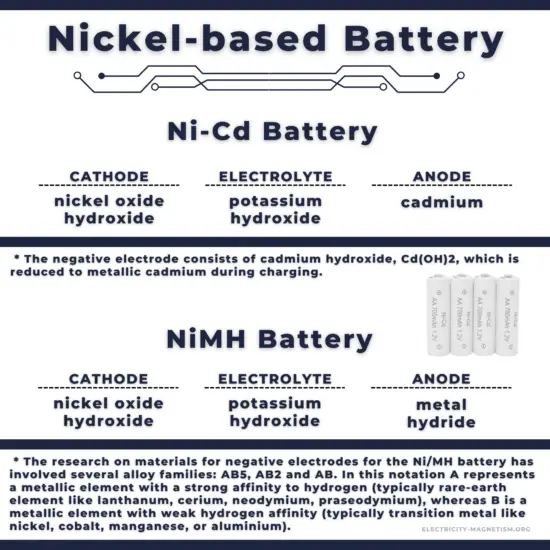
A nickel metal hydride battery, NiMH, is a rechargeable battery with a positive electrode made of nickel hydroxide and a negative electrode made of a metal hydride (a hydrogen-absorbing alloy). The NiMH battery was commercially introduced in 1989 and was mainly used as a power source in portable personal computers. Since then, the NiMH battery system has become very popular in electric hybrid vehicles and makes up 10% of the total market for rechargeable batteries. Compared to the NiCd battery, the NiMH provides 40 percent higher specific energy resulting in about two times higher capacity. NiMH batteries are also less affected by voltage depression, but the main advantage is the absence of toxic cadmium. The memory effect of NiMH batteries is much less than nickel-cadmium batteries.
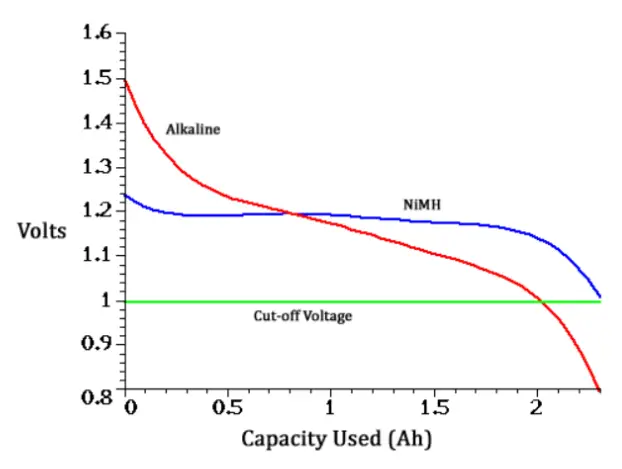
Compared to alkaline batteries, the internal resistance of NiMH batteries is much lower. Because of this, they have the advantage that a higher voltage can be maintained under high load.
With high specific energy (up to 100Wh/kg) and energy density (double of lead-acid and 40% more than nickel-cadmium), high cycle life, low cost, recyclability (cadmium is hazardous), and other qualities made it the most used battery and still nowadays is one of the most used. Its applications are much diverse: battery cells AA or AAA, cameras, old mobile phones, electric razors, medical instruments and equipment, and high-power static applications. Compared to the lead-acid battery, the drawback is that it is more expensive than lead acid per kWh.
Nickel-cadmium Battery
The nickel-cadmium battery (Ni-Cd battery) is a type of secondary battery using nickel oxide hydroxide Ni(O)(OH) as a cathode and metallic cadmium as an anode. The abbreviation Ni-Cd is derived from the chemical symbols of nickel (Ni) and cadmium (Cd).
The battery has low internal impedance resulting in high power capabilities but lower energy storage capacity compared to other battery systems. It has long cycle life and the capability of rapid recharge but may suffer from voltage depression or memory effect, meaning that the maximum charge voltage will decrease and hence the energy capacity if continuously discharged shallowly. The greatest disadvantage is the content of cadmium. Unfortunately, cadmium is extremely toxic; therefore, the Ni-Cd will not be an alternative for a modern battery system.
Nowadays, the applications of nickel-cadmium batteries are in small-size portable devices such as power tools, toys, emergency lighting, medical instrumentation, or industrial portable products. It is used in small-size products because their cost for low-power applications is inexpensive but three to four times more expensive than lead-acid batteries for the same capacity.
Characteristics of Nickel Metal Hydride Batteries
To compare and understand the capability of each battery, some important parameters are characteristic of each battery, also within a type of battery. These parameters are a reference when a battery is needed, and specific qualities are required since batteries are used in all types of devices and for infinite purposes.

Cell Voltage
The voltage of electric batteries is created by the potential difference of the materials that compose the positive and negative electrodes in the electrochemical reaction.
A common open circuit voltage for NiMH batteries (e.g. AAA and AA) is 1.2V.

Cut-off Voltage
The cut-off voltage is the minimum allowable voltage. It is this voltage that generally defines the “empty” state of the battery.
When testing the capacity of a NiMH or NiCd battery, a cut-off voltage of 1.0 V per cell is normally used, whereas 0.9 V is normally used as the cut-off voltage of an alkaline cell.

Capacity
The coulometric capacity is the total Amp-hours available when the battery is discharged at a certain discharge current from 100% SOC to the cut-off voltage.
NiMH AA batteries feature a nominal voltage of 1.2 volts and an average capacity of 2000-2700 mAh. Ni-Cd AA batteries feature a nominal voltage of 1.2 volts and an average capacity of 600-1000 mAh.

C-rate of Battery
C-rate is used to express how fast a battery is discharged or charged relative to its maximum capacity. It has units h−1. A 1C rate means that the discharge current will discharge the entire battery in 1 hour.
Typically, high C-rate NiMH batteries can be charged at 1C and be fully charged in just over an hour.

Self-discharge
Batteries gradually self-discharge even if not connected and delivering current. This is due to non-current-producing “side” chemical reactions that occur within the cell even when no load is applied.
The NiMH battery also has high self-discharge and can lose up to 20 % of its charge during the first 24 hours and thereafter 10 % per month. The self-discharge rate for a Ni-Cd battery is around 10%/month at 20 °C, and rising up to 20% at higher temperatures. It is recommended not to store Ni-Cd batteries for an extended amount of time without occasionally using the batteries.

Degradation
Some degradation of rechargeable batteries occurs on each charge-discharge cycle. Degradation usually occurs because electrolyte migrates away from the electrodes or because active material detaches from the electrodes.
The cycle life for NiMH batteries is typically 700-1,000 life cycles. Ni-Cd batteries can provide 300 to more than 500 discharge/charge cycles.

Depth of Discharge
Depth of discharge is a measure of how much energy has been withdrawn from a battery and is expressed as a percentage of full capacity. For example, a 100 Ah battery from which 40 Ah has been withdrawn has undergone a 40% depth of discharge (DOD).
Why are alkaline batteries (AAA or AA) made to be 1.5V while nickel-based batteries are 1.2V?
In general, batteries convert stored chemical energy into electrical energy through an electrochemical process. This then provides a source of electromotive force to enable currents to flow in electric and electronic circuits.
- Primary (single-use or alkaline) batteries use cells that have 1.5V open circuit voltage when fresh.
- Secondary (rechargeable) batteries use cells from NiMh or NiCd, which have 1.2V open circuit voltage.
In practice, alkaline batteries and rechargeable batteries can be used interchangeably in sets. They have only different voltage characteristics. It is given by their different chemistry. Primary cells gradually drop in voltage from use. They start at 1.5 volts, drop to 1.2 and continue to 1.0 where the appliance stops working. Secondary cells operate more uniformly, even with only 1.2 volts. They have flat discharge where they pretty much stay at 1.2 volts until depleted and then drop off very quickly to below 1.0 volts.
Since electronic devices are usually made to run from cell voltages of 1.0 to 1.5 volts, alkaline batteries and rechargeable batteries perform similarly. In fact, it’s generally considered that secondary 1.2 V cells work better than alkalines having lower output impedance and more consistent voltage from start to finish of a charge.
Other Types of Batteries
The following list summarizes notable electric battery types composed of one or more electrochemical cells. Four lists are provided in the table. The first list is a battery classification by size and format. Then, the primary (non-rechargeable) and secondary (rechargeable) cell lists are lists of battery chemistry. The third list is a list of battery applications. The final list is a list of different battery voltages.
Sizes
- AA battery
- AAA battery
- AAAA battery
- C battery
- D battery
- cr1220 battery
- cr1620 battery
- cr1632 battery
- cr1616 battery
- cr2016 battery
- cr2032 battery
- cr2025 battery
- cr2430 battery
- cr2450 battery
- cr123 battery
- cr2 battery
- cr132a battery
- lr1130 battery
- lr41 battery
- lr44 battery
- A23 battery
- a13 battery
- 18650 battery
- 21700 battery