
30-second summary
Battery Charging
Battery charging is a process in which the electrochemical potential of the rechargeable battery is restored.
Only certain types of batteries can be charged, and these are secondary, or rechargeable, batteries.
Types of rechargeable batteries:
A battery charger is a device that stores energy in a battery by running an electric current through it. The charging protocol (how much voltage or current for how long and what to do when charging is complete) depends on the battery’s size and type.
When the power supply is transferring electricity the opposite way, the role of the materials changes in order to reach the initial status. Thus, the material that acted as anode works as the cathode, and in the process of recharge, it is reduced, and the material that acted as cathode now works as anode and is oxidized in the process.
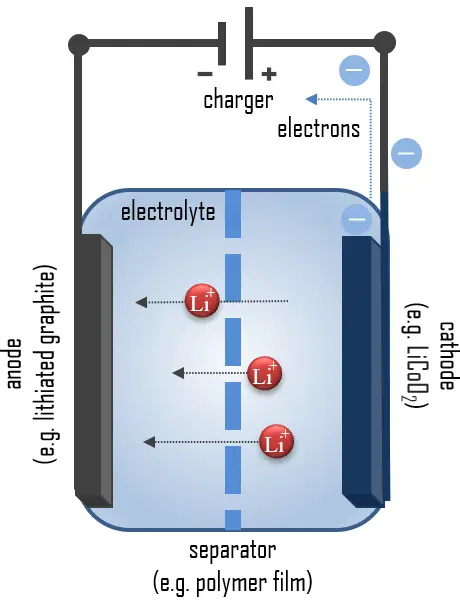

An electric battery is essentially a source of DC electrical energy. It converts stored chemical energy into electrical energy through an electrochemical process. This then provides a source of electromotive force to enable currents to flow in electric and electronic circuits. A typical battery consists of one or more voltaic cells.
The fundamental principle in an electrochemical cell is spontaneous redox reactions in two electrodes separated by an electrolyte, which is a substance that is ionic conductive and electrically insulated.
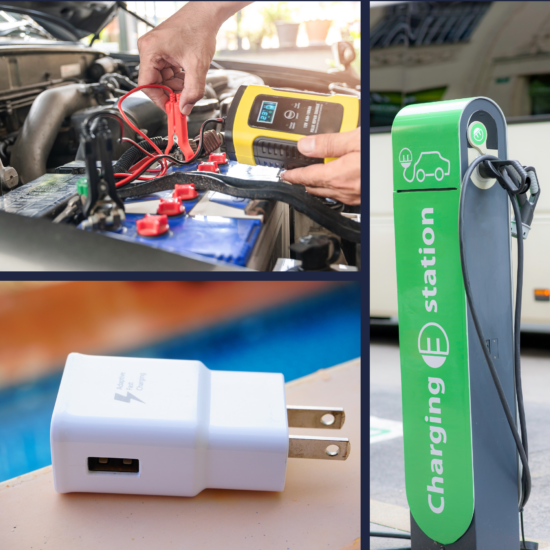
Rechargeable batteries are (re)charged by applying electric current, which reverses the chemical reactions that occur during discharge/use. Devices to supply the appropriate current are called chargers. The oldest form of rechargeable battery is the lead–acid battery, which is widely used in automotive and boating applications. Currently, the most common type of rechargeable battery is a lithium-ion battery, which is used in many laptop computer batteries, cordless power tools, certain electric cars, electric kick scooters, most e-bikes, portable power banks, and LED flashlights.
Rechargeable batteries are often more expensive, but they offer greater value in high-drain applications as they can be re-used. In low drain applications, the service life is more important, and the self-discharge characteristics of a rechargeable battery mean that they are less suitable for use as the primary energy source.
Types of rechargeable batteries:
Chemistry of Battery Charging
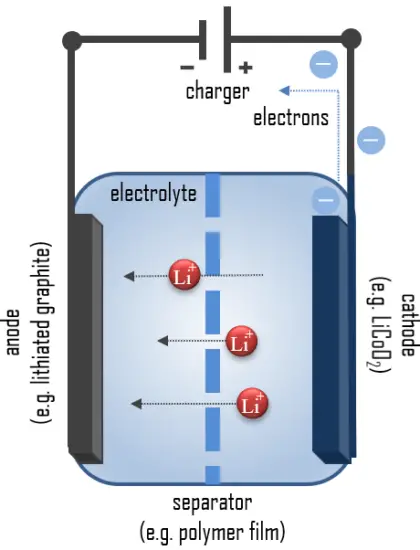
In simple terms, each battery is designed to keep the cathode and anode separated to prevent a reaction. The stored electrons will only flow when the circuit is closed. This happens when the battery is placed in a device, and the device is turned on.
When the circuit is closed, the stronger attraction for the electrons by the cathode (e.g., LiCoO2 in lithium-ion batteries) will pull the electrons from the anode (e.g., lithium-graphite) through the wire in the circuit to the cathode electrode. This battery chemical reaction, this flow of electrons through the wire, is electricity.
If we go into detail, batteries convert chemical energy directly to electrical energy. For example, chemical energy can be stored in Zn or Li, which are high-energy metals because they are not stabilized by d-electron bonding, unlike transition metals. Lithium metal is the lightest metal and possesses a high specific capacity (3.86 Ah/g) and an extremely low electrode potential (−3.04 V vs. standard hydrogen electrode). Therefore lithium is an ideal anode material for high-voltage and high-energy batteries.
During discharge, lithium is oxidized from Li to Li+ (0 to +1 oxidation state) in the lithium-graphite anode through the following reaction:
C6Li → 6C(graphite) + Li+ + e–
These lithium ions migrate through the electrolyte medium to the cathode, where they are incorporated into lithium cobalt oxide through the following reaction, which reduces cobalt from a +4 to a +3 oxidation state:
CoO2 (s) + Li+ + e– → LiCoO2 (s)
Here is the full reaction (left to right = discharging, right to left = charging):
C6Li + CoO2 ⇄ C6 + LiCoO2
These reactions can be run in reverse to recharge the cell. In this case, the lithium ions leave the lithium cobalt oxide cathode and migrate back to the anode, where they are reduced back to neutral lithium and reincorporated into the graphite network.
C-rate of Battery
C-rate is used to express how fast a battery is discharged or charged relative to its maximum capacity. It has units h−1. The energy contained in a battery can be discharged at different rates, which means that the higher the discharge current is, the shorter the working time of the battery. In the same way, the lower the discharge current, the longer the time to discharge it completely will be needed. High C-rates generate more heat and cause the temperature of the cell to rise invoking the high-temperature degradation mechanisms. C-rate reduces the usable life and capacity of a battery. Manufacturers often publish datasheets with graphs showing capacity versus C-rate curves. A 1C rate means that the discharge current will discharge the entire battery in 1 hour. For a battery with a capacity of 100 Amp-hrs, this equates to a discharge current of 100 Amps. Standards for rechargeable batteries generally rate the capacity and charge cycles over a 4-hour (0.25C), 8 hour (0.125C) or longer discharge time.
- Alkaline battery. To obtain a reasonably good capacity reading, manufacturers commonly rate alkaline and lead acid batteries at a very low 0.05C, or a 20-hour discharge.
- According to Energizer, for NiMH batteries, the normal discharge rate is 0.2C. The battery nominal capacity is measured at this rate. At a higher discharge rate, the actual capacity of the battery will be much less than the nominal. The NiMH battery could be discharged at a maximum 3C rate.
- Most li-ion batteries can only withstand a maximum temperature of 60°C and are recommended to be charged at a maximum of 45°C under a 0.5C charge rate. C rating for a 18650 battery is usually 1C, this means that we can consume a maximum of 2.85A from the battery.
To avoid danger or premature capacity degradation, it is necessary to follow the manufacturer’s recommendations.
Charging and Battery Capacity
Capacity is calculated by multiplying the discharge current (in Amps) by the discharge time (in hours). It depends on certain conditions:
- Temperature. Typically, at higher temperatures, the performance of the battery is higher than at lower temperatures because the electrochemical reactions are less efficient. As a result, the energy extracted is lower than expected. High and low temperatures have different effects on battery life. Li-ion cells have an optimal temperature operating range, and outside this range, the battery cell undergoes severe loss of capacity.
- The life cycle of the battery. Battery life (and its synonym battery lifetime) has two meanings for rechargeable batteries but only one for non-rechargeables. For rechargeables, the life cycle can mean either the length of time a device can run on a fully charged battery or the number of charge/discharge cycles possible before the cells fail to operate satisfactorily. The active material on the battery plates changes the chemical composition on each charge and discharge cycle. Degradation usually occurs because electrolyte migrates away from the electrodes or because active material detaches from the electrodes. Low-capacity NiMH batteries (1,700–2,000 mA·h) can be charged some 1,000 times, whereas high-capacity NiMH batteries (above 2,500 mA·h) last about 500 cycles. NiCd batteries tend to be rated for 1,000 cycles before their internal resistance permanently increases beyond usable values. Fast charging increases component changes, shortening battery lifespan. If a charger cannot detect when the battery is fully charged, then overcharging is likely, damaging it.
- Charging and discharging rate. If a battery is discharged using a high current, the capacity is reduced because the amount of active material that had time to react is less than would be if the discharge current was lower, letting the electrodes react more effectively with the electrolyte extracting more energy from the battery and therefore having a higher capacity. The C-rate is a measure of the rate at which a battery is being charged or discharged. Typically, maximum capacity is found at a low C-rate, and charging or discharging at a higher C-rate reduces the usable life and capacity of a battery. Manufacturers often publish datasheets with graphs showing capacity versus C-rate curves.
See also: Memory Effect
Degradation of Rechargeable Batteries due to Cycling
Some degradation of rechargeable batteries occurs on each charge–discharge cycle. Degradation usually occurs because electrolyte migrates away from the electrodes or because active material detaches from the electrodes. Manufacturers’ datasheet typically uses the word “cycle life” to specify lifespan in terms of the number of cycles to reach 80% of the rated battery capacity. To avoid danger or premature capacity degradation, it is necessary to follow the manufacturer’s recommendations.
In lithium-ion batteries, degradation and capacity fade are generally attributed to the growth of the solid electrolyte interface (SEI). The solid electrolyte interface is created due to reactions between the electrodes and the electrolyte. These reactions form a film that hinders lithium ions from reacting with the electrodes, and as this film grows in thickness, the cell degrades.
Low-capacity NiMH batteries (1,700–2,000 mA·h) can be charged some 1,000 times, whereas high-capacity NiMH batteries (above 2,500 mA·h) last about 500 cycles. NiCd batteries tend to be rated for 1,000 cycles before their internal resistance permanently increases beyond usable values. Fast charging increases component changes, shortening battery lifespan. If a charger cannot detect when the battery is fully charged, then overcharging is likely, damaging it.
Most modern 18650 lithium-ion batteries, which are common for laptop batteries, have a typical cycle life of 300 – 500 (charge, discharge cycles). When in C-rate or high DOD situations, this can decrease substantially to 200 cycles.
In real life applications, Li-ion cells experience accelerated degradation due to certain stress factors. Stress factors such as deep DODs, elevated C-rates, high or low temperatures, and operating at high SOCs can have a negative impact on the cell capacity and cause accelerated degradation.
- Temperature. Degradation is strongly temperature-dependent: degradation at room temperature is minimal but increases for batteries stored or used in hot or cold environments. Batteries generate heat when being charged or discharged, especially at high currents. High temperatures during charging may lead to battery degradation, and charging at temperatures above 45 °C will degrade battery performance. Large battery packs, such as those used in electric vehicles, are generally equipped with thermal management systems that maintain a temperature between 15 °C (59 °F) and 35 °C (95 °F).
- Elevated C-rate. High C-rates generate more heat and cause the temperature of the cell to rise invoking the high-temperature degradation mechanisms. C-rate reduces the usable life and capacity of a battery.
- DOD. For lithium-ion batteries, the cycle life of a cell strongly depends on the DOD. The loss of lithium ions and active electrode material is higher for larger DOD cycles. At high DODs, additional degradation mechanisms can occur, resulting in decomposition and dissolution of cathode material and capacity fading.
Other Characteristics
To compare and understand the capability of each battery, some important parameters are characteristic of each battery, also within a type of battery. These parameters are a reference when a battery is needed, and specific qualities are required since batteries are used in all types of devices and for infinite purposes.

Cell Voltage
The voltage of electric batteries is created by the potential difference of the materials that compose the positive and negative electrodes in the electrochemical reaction.

Cut-off Voltage
The cut-off voltage is the minimum allowable voltage. It is this voltage that generally defines the “empty” state of the battery.

Capacity
The coulometric capacity is the total Amp-hours available when the battery is discharged at a certain discharge current from 100% SOC to the cut-off voltage.

C-rate of Battery
The cut-off voltage is the minimum allowable voltage. It is this voltage that generally defines the “empty” state of the battery.

Self-discharge
Batteries gradually self-discharge even if not connected and delivering current. This is due to non-current-producing “side” chemical reactions that occur within the cell even when no load is applied.

Degradation
Some degradation of rechargeable batteries occurs on each charge–discharge cycle. Degradation usually occurs because electrolyte migrates away from the electrodes or because active material detaches from the electrodes.

Depth of Discharge
Depth of discharge is a measure of how much energy has been withdrawn from a battery and is expressed as a percentage of full capacity. For example, a 100 Ah battery from which 40 Ah has been withdrawn has undergone a 40% depth of discharge (DOD).

State of Charge
The state of charge refers to the amount of charge in a battery relative to its predefined “full” and “empty” states i.e. the amount of charge in Amp-hours left in the battery.

