
Explore the world of inductive resonant circuits, their resonance frequency, applications, and characteristics in modern technology.
Introduction to Inductive Resonant Circuits
In the realm of electronics, a fascinating and crucial component is the inductive resonant circuit. This essential aspect of electronic circuits forms the backbone of many modern technologies, from radios to wireless charging systems.
What is an Inductive Resonant Circuit?
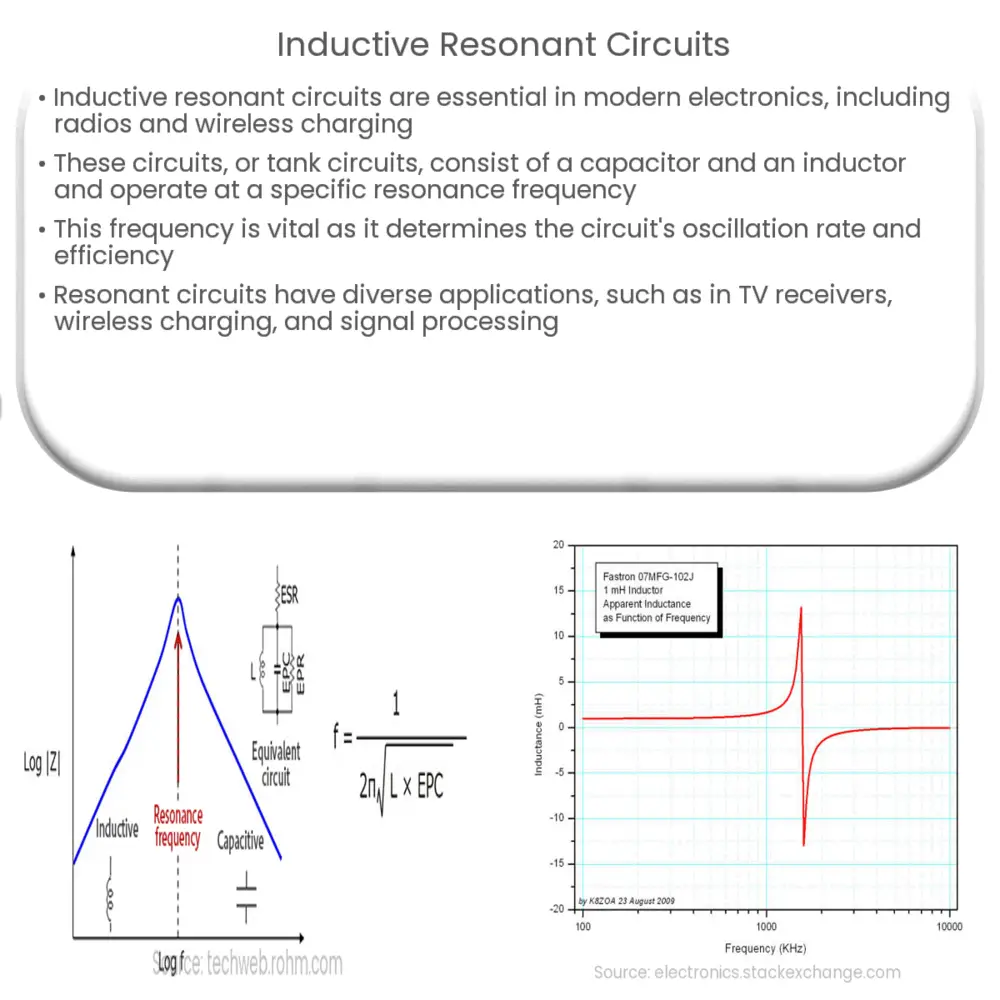
An inductive resonant circuit, also known as a tank circuit, comprises of a capacitor and an inductor connected in parallel. This configuration allows for the storage of energy in two distinct ways – electric field energy in the capacitor and magnetic field energy in the inductor. The energy oscillates back and forth between these two components at a frequency known as the resonance frequency.
Resonance Frequency and Its Significance
The resonance frequency (fR) in an inductive resonant circuit is the frequency at which the circuit oscillates naturally. It is determined by the values of the inductor (L) and the capacitor (C). The resonance frequency can be calculated using the formula:
- fR = 1 / (2π √(LC))
At resonance, the inductive reactance equals the capacitive reactance, resulting in maximum current or voltage across the circuit. Therefore, the resonance frequency is of paramount importance in the function of resonant circuits, as it determines the rate of oscillation and ultimately the circuit’s effectiveness in its application.
Applications of Inductive Resonant Circuits
Inductive resonant circuits are utilized in various applications in the field of electronics and communication. Here are a few instances where they play a crucial role:
- Radio and TV Receivers: The tuning circuits in these devices are resonant circuits. They allow for the selection of a desired frequency from the multitude of frequencies received.
To be continued…
- Wireless Charging: Inductive resonant circuits form the basis of wireless charging technology. They allow the transfer of energy between two objects via electromagnetic fields.
- Signal Processing: They are also used in bandpass filters, an essential component in signal processing. This allows specific frequencies to pass while blocking others, improving the clarity and quality of the signal.
- Oscillators: Resonant circuits are also used in oscillators, which generate high frequency sinusoidal waveforms. These are used in a wide array of applications, including testing electronic equipment and transmitting signals.
Inductive Resonant Circuit Characteristics
It’s important to note that inductive resonant circuits have some defining characteristics:
- At resonance, the impedance of the circuit is at its minimum, leading to a maximum current.
- The voltage across the inductor and capacitor can be greater than the applied voltage, due to the phase difference between them.
- Resonant circuits can either be series or parallel, depending on the configuration of the inductor and capacitor.
Conclusion
In conclusion, inductive resonant circuits are a pivotal aspect of electronic engineering, possessing a broad range of applications. From radio and television reception to wireless charging and signal processing, the influence of these circuits is indeed ubiquitous. Understanding their workings, including resonance frequency and the energy oscillation mechanism, is key to exploiting their potential to the fullest.
As technology continues to advance, the importance of inductive resonant circuits will likely continue to grow. They form a fundamental building block for many emerging technologies, marking them as a critical study area for anyone interested in electronics and communication engineering.



