
How is the Hall effect used to measure electrical conductivity?
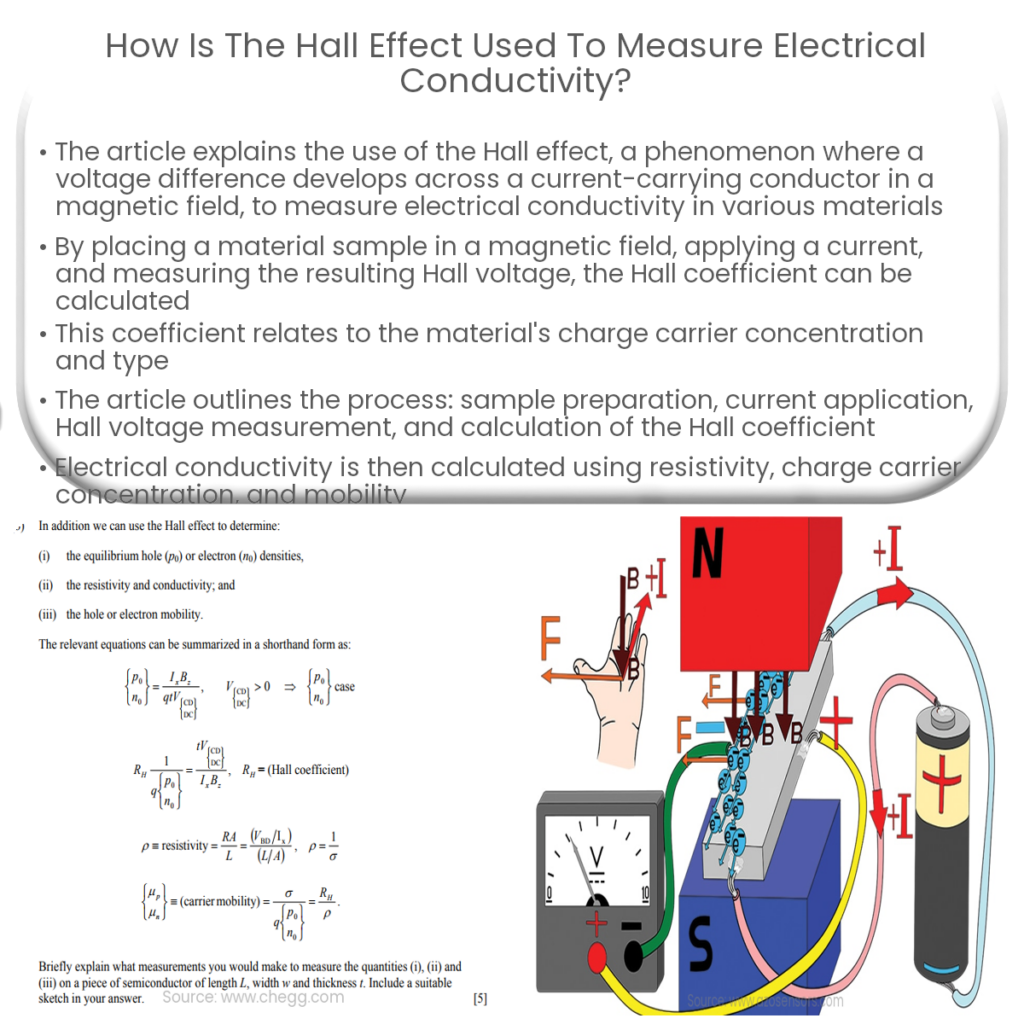
The Hall effect is used to measure electrical conductivity by applying a magnetic field and current to a material, then measuring the Hall voltage.
The Hall effect is used to measure electrical conductivity by applying a magnetic field and current to a material, then measuring the Hall voltage.

Electrical conductivity and resistivity are inversely proportional; as one increases, the other decreases. They determine a material’s ability to conduct electricity.
Grain boundaries can reduce electrical conductivity by scattering electrons, but engineering these boundaries can improve material performance.

The van der Pauw method measures resistivity and Hall coefficient of thin, flat, and homogeneous materials using four-point contacts on the edges.

To calculate electrical conductivity, first determine the material’s resistivity (ρ) using ρ = R*(A/L), then find conductivity (σ) using σ = 1/ρ.

To measure electrical conductivity, common methods include the four-point probe, Van der Pauw, resistivity bridge, and electromagnetic induction methods.

The four-point probe technique measures electrical conductivity by injecting current through outer probes and measuring voltage drop with inner probes.

Superconducting materials include pure metals, metallic compounds, and ceramics, such as mercury, aluminum, niobium-tin, and yttrium barium copper oxide.

High-temperature superconductors can exhibit superconductivity at higher temperatures than conventional ones, making them more practical for various applications.

Superconductors have applications in medical equipment, power transmission, transportation, scientific research, electronics, computing, and energy storage.

The primary purpose of this project is to help the public to learn some exciting and important information about electricity and magnetism.
Our Website follows all legal requirements to protect your privacy. Visit our Privacy Policy page.
The Cookies Statement is part of our Privacy Policy.
The information contained on this website is for general information purposes only. This website does not use any proprietary data. Visit our Editorial note.
It’s simple:
1) You may use almost everything for non-commercial and educational use.
2) You may not distribute or commercially exploit the content, especially on another website.
