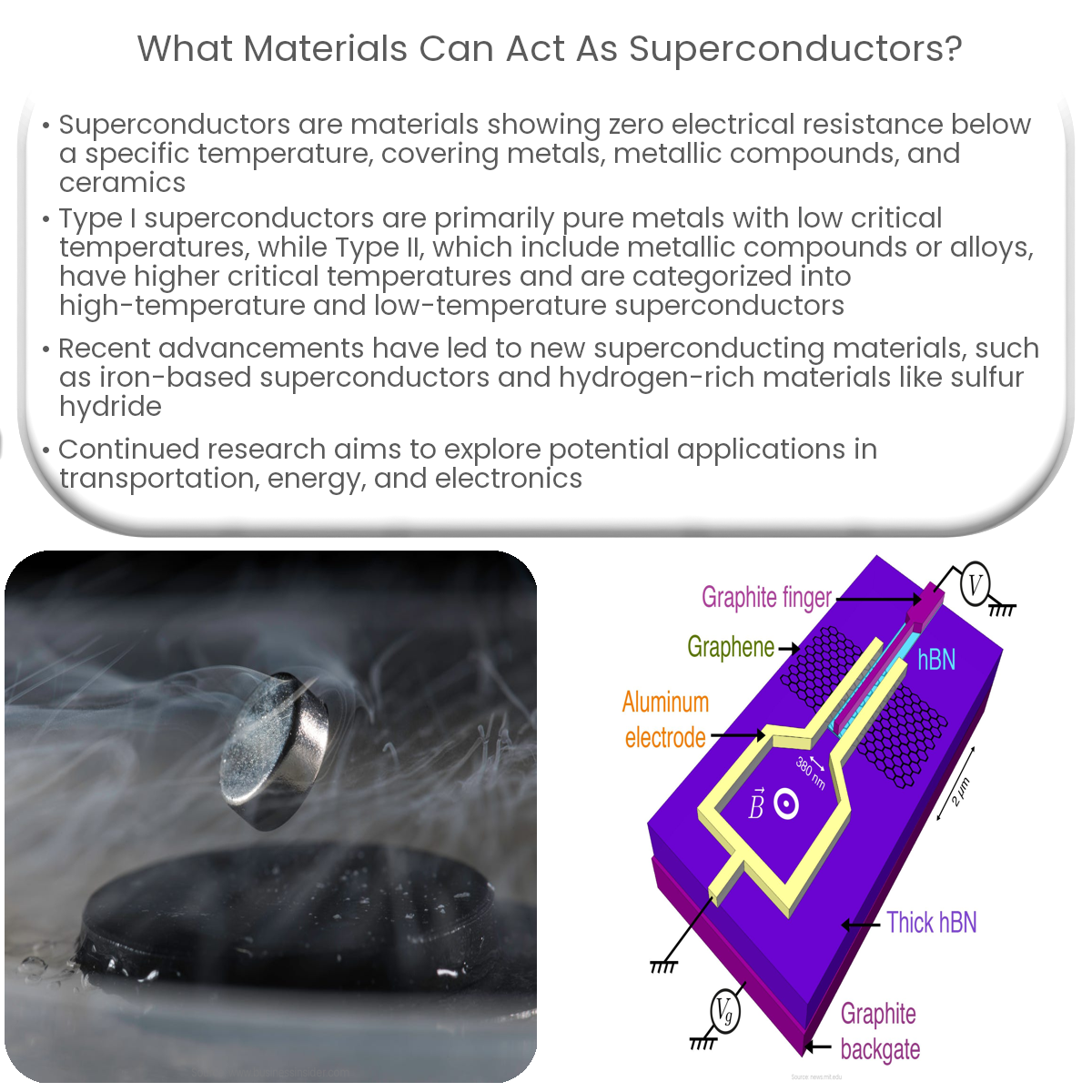
Superconducting materials include pure metals, metallic compounds, and ceramics, such as mercury, aluminum, niobium-tin, and yttrium barium copper oxide.
Superconductor Materials
Superconductors are materials that exhibit zero electrical resistance when cooled below a certain critical temperature. There is a wide range of materials that can act as superconductors, including metals, metallic compounds, and ceramics. The following sections detail the main categories of superconducting materials.
Type I Superconductors
Type I superconductors are primarily pure metals with relatively low critical temperatures, typically below 30 Kelvin (K). Some examples of Type I superconductors include:
- Mercury (Hg)
- Aluminum (Al)
- Lead (Pb)
- Tin (Sn)
Type II Superconductors
Type II superconductors are usually metallic compounds or alloys and have higher critical temperatures compared to Type I superconductors. They are further divided into two subcategories: high-temperature superconductors (HTS) and low-temperature superconductors (LTS). Examples of Type II superconductors are:
- Niobium-tin (Nb3Sn) – LTS
- Niobium-titanium (NbTi) – LTS
- Yttrium barium copper oxide (YBa2Cu3O7-δ) – HTS
- Bismuth strontium calcium copper oxide (BiSrCaCuO) – HTS
Emerging Superconducting Materials
Recent advancements in material science have led to the discovery of new superconducting materials. For example, iron-based superconductors, also known as pnictides, exhibit superconductivity at relatively high temperatures. Some examples of iron-based superconductors are:
- LaOFeAs
- SmOFeAs
- BaFe2As2
Another recent discovery is hydrogen-rich materials, such as sulfur hydride, which exhibit superconductivity at temperatures as high as 203 K (-70°C) under high pressures.
Conclusion
Superconducting materials vary from pure metals to metallic compounds and ceramics. These materials are classified into Type I and Type II superconductors, with the latter further divided into high-temperature and low-temperature superconductors. Research in material science continues to discover new superconducting materials with potential applications in various fields, including transportation, energy, and electronics.