
30-second summary
Silver-oxide Battery
A silver-oxide battery is a primary cell using silver oxide as the cathode material and zinc for the anode. They are available in small sizes as button cells.
- The open circuit voltage of silver oxide batteries is 1.6 volts.
- The operating voltage at typical current drains is 1.55 volts or more.
- A typical silver-oxide battery in the standard SR721SW has about 25 mAh.
- A typical silver-oxide battery has a cutoff voltage of 1.2V.
- A typical annual self-discharge rate of 2-10% when being stored @20-25°C.
- Silver-oxide batteries feature a shelf life of 2-5 years.
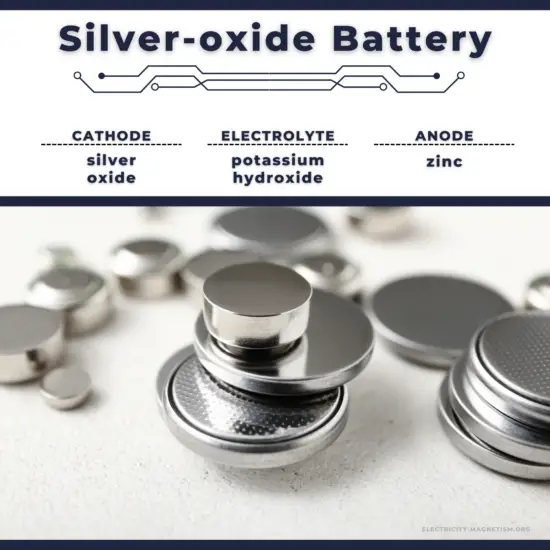
Silver-oxide Battery
A silver-oxide battery is a primary cell using silver oxide as the cathode material, zinc for the anode, and a highly alkaline electrolyte consisting of either sodium hydroxide or potassium hydroxide. They are available in small sizes as button cells. The first letter in the IEC standard system identifies the chemical composition of the battery. S is for silver-oxide battery (as SR516). These cells maintain a nearly constant nominal voltage during discharge until fully depleted. A silver-oxide battery and a zinc-silver battery are different types of batteries.
The open circuit voltage of silver oxide batteries is 1.6 volts. The operating voltage at typical current drains is 1.55 volts or more. A typical silver-oxide battery in the standard SR721SW has about 25 mAh.
Characteristics of Silver-oxide Batteries
To compare and understand the capability of each battery, some important parameters are characteristic of each battery, also within a type of battery. These parameters are a reference when a battery is needed, and specific qualities are required since batteries are used in all types of devices and for infinite purposes.

Cell Voltage
The voltage of electric batteries is created by the potential difference of the materials that compose the positive and negative electrodes in the electrochemical reaction.
The open circuit voltage of silver oxide batteries is 1.6 volts. The operating voltage at typical current drains is 1.55 volts or more.

Cut-off Voltage
The cut-off voltage is the minimum allowable voltage. It is this voltage that generally defines the “empty” state of the battery.
A typical silver-oxide battery has a cutoff voltage of 1.2V.

Capacity
The coulometric capacity is the total Amp-hours available when the battery is discharged at a certain discharge current from 100% SOC to the cut-off voltage.
A typical silver-oxide battery in the standard SR721SW has about 25 mAh.

C-rate of Battery
C-rate is used to express how fast a battery is discharged or charged relative to its maximum capacity. It has units h−1. A 1C rate means that the discharge current will discharge the entire battery in 1 hour.

Self-discharge
Batteries gradually self-discharge even if not connected and delivering current. This is due to non-current-producing “side” chemical reactions that occur within the cell even when no load is applied.
A typical annual self-discharge rate of 2-10% when being stored @20-25°C.

