What are the safety precautions to take when working with electric circuits?
Always disconnect power, use insulated tools, wear protective gear, follow wiring procedures, test for live circuits, use circuit breakers, and obtain proper training.
Troubleshooting and repairing these circuits is an essential skill for any technician or DIY enthusiast. In this article, we’ll explore the key steps to identify and resolve issues in electric circuits.
Key factors affecting electric circuit performance and reliability include circuit design, material properties, environmental conditions, power supply stability, and manufacturing quality.
PCB materials include FR-4, polyimide, PTFE, and ceramics. Fabrication techniques are subtractive, additive, and semi-additive processes.
To design a PCB layout, create a schematic, choose the PCB type, place components, route traces, add ground and power planes, perform a DRC, and generate Gerber files.
PCBs serve as the foundation for electronic components, enabling efficient signal transfer and providing compact, reliable, and cost-effective circuit design.
Simulation software helps engineers test and optimize electric circuit designs, identify issues early, and analyze circuit performance efficiently.
Different types of electric circuit simulation software include SPICE-based, graphical circuit, and system-level simulation tools.
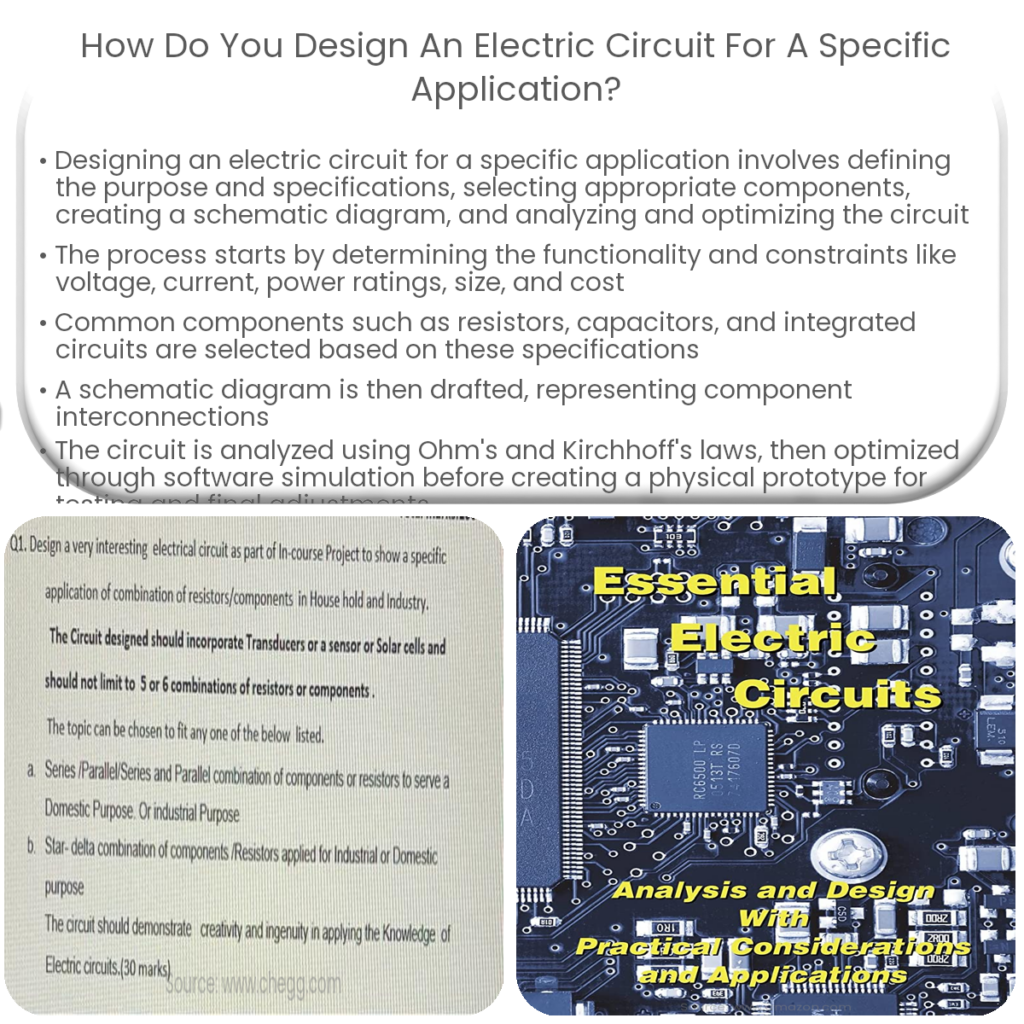
To design an electric circuit for a specific application, define the purpose, select appropriate components, create a schematic, analyze, and test a prototype.
Transient voltage suppressors (TVS) are semiconductor devices designed to protect sensitive electronic circuits from voltage spikes and transient overvoltages.

The primary purpose of this project is to help the public to learn some exciting and important information about electricity and magnetism.
Our Website follows all legal requirements to protect your privacy. Visit our Privacy Policy page.
The Cookies Statement is part of our Privacy Policy.
The information contained on this website is for general information purposes only. This website does not use any proprietary data. Visit our Editorial note.
It’s simple:
1) You may use almost everything for non-commercial and educational use.
2) You may not distribute or commercially exploit the content, especially on another website.