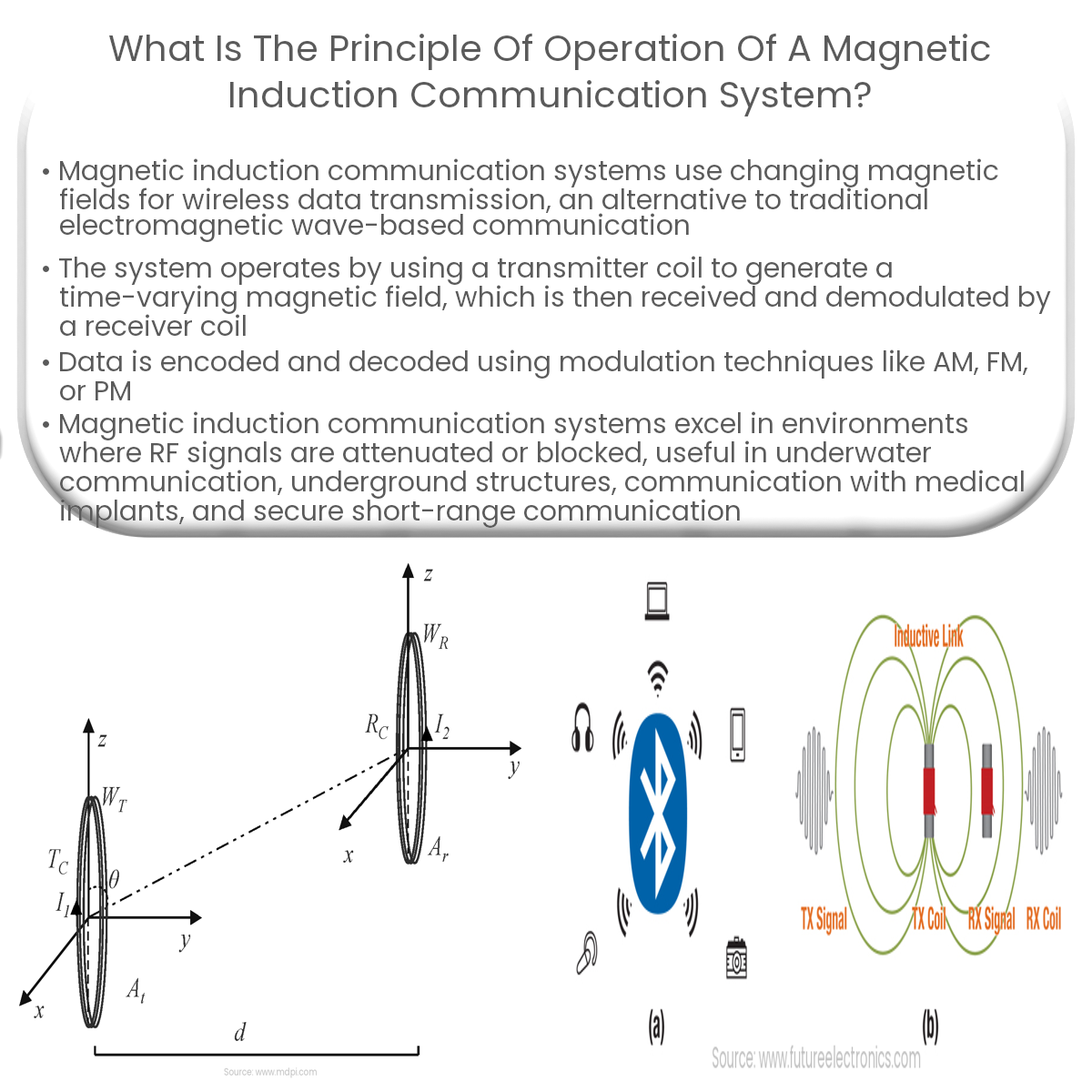
Magnetic induction communication systems use modulated, time-varying magnetic fields to wirelessly transmit data between transmitter and receiver coils.
Understanding the Principle of Operation of a Magnetic Induction Communication System
Magnetic induction communication systems enable wireless data transmission through changing magnetic fields, providing an alternative to traditional electromagnetic wave-based communication methods. This article will discuss the principle of operation of a magnetic induction communication system and its potential applications.
Principle of Magnetic Induction
Magnetic induction is the process by which a changing magnetic field induces an electromotive force (EMF) in a nearby conductor. According to Faraday’s law of electromagnetic induction, when a conductive coil is subjected to a time-varying magnetic field, an induced current is generated within the coil. This phenomenon is the basis for many technologies, including transformers, induction motors, and wireless power transfer.
Operation of a Magnetic Induction Communication System
A magnetic induction communication system typically consists of two or more coils, acting as transmitters and receivers. The key components of the system include:
- Transmitter: The transmitter coil generates a time-varying magnetic field by passing an alternating current through the coil. This magnetic field is modulated to encode the data being transmitted.
- Receiver: The receiver coil is placed within the vicinity of the transmitter coil. The changing magnetic field generated by the transmitter induces a current in the receiver coil, which is then demodulated to retrieve the transmitted data.
- Data Modulation and Demodulation: Modulation techniques, such as amplitude modulation (AM), frequency modulation (FM), or phase modulation (PM), are employed to encode and decode the data transmitted through the magnetic field.
Applications of Magnetic Induction Communication Systems
Magnetic induction communication systems have several advantages over traditional electromagnetic wave-based communication systems, particularly in environments where radio frequency (RF) signals are attenuated or blocked. Some potential applications include:
- Underwater Communication: Magnetic induction communication systems can penetrate water more effectively than RF signals, making them suitable for underwater communication in submersibles or underwater sensor networks.
- Tunnel and Underground Communication: These systems can provide reliable communication in tunnels, mines, or underground structures where RF signals may be obstructed or reflected.
- Medical Implants: Magnetic induction communication systems can enable data transmission through biological tissues, allowing for communication with implanted medical devices, such as pacemakers or neurostimulators.
- Secure Communication: Due to their short-range and localized nature, magnetic induction communication systems can provide increased security against eavesdropping or interference compared to RF-based communication.
In conclusion, magnetic induction communication systems offer a unique approach to wireless data transmission, particularly in challenging environments where traditional RF communication is limited. By understanding the principle of operation and potential applications, these systems can be harnessed to improve communication in various industries and scenarios.