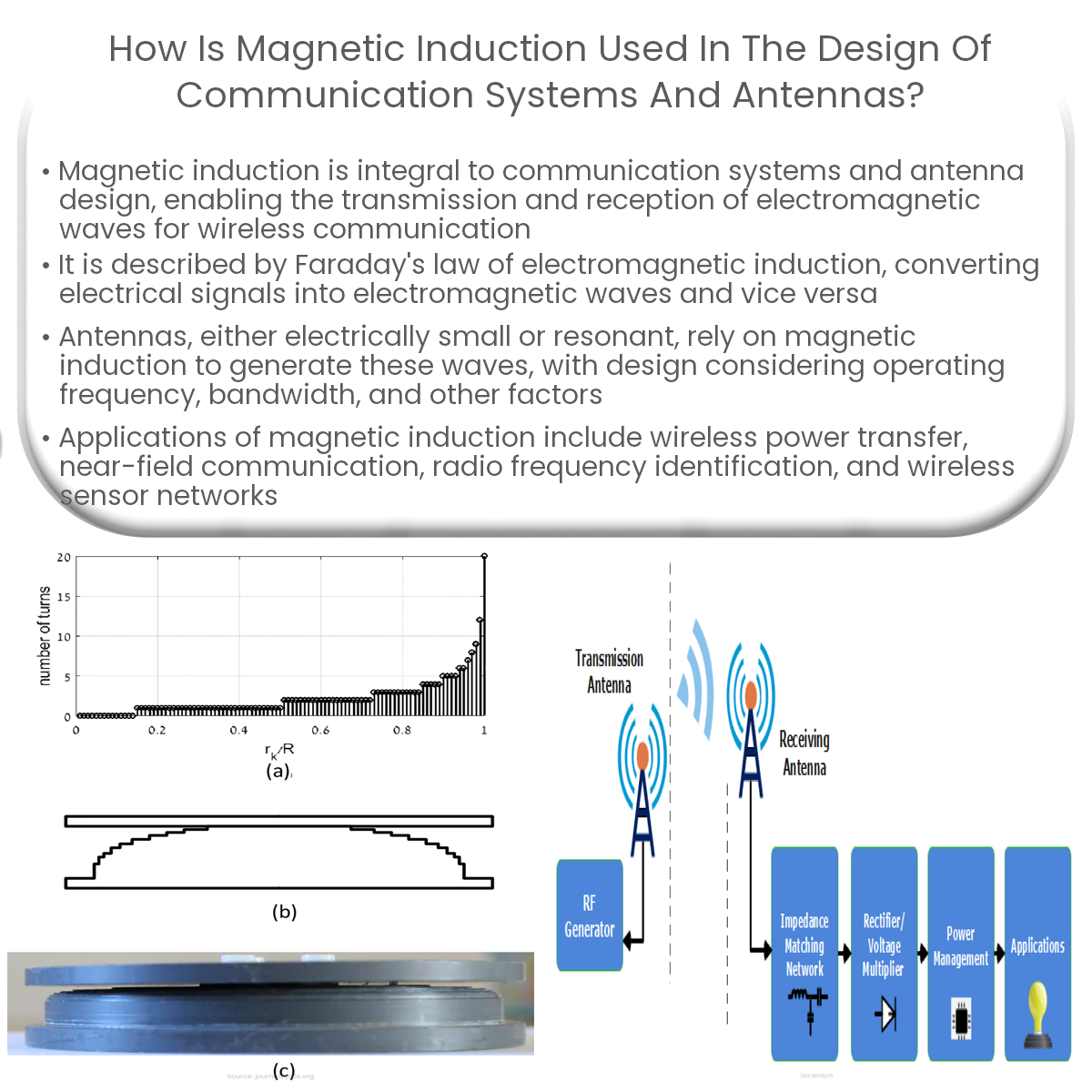
Magnetic induction is used in communication systems for antenna design, wireless power transfer, near-field communication, RFID, and wireless sensor networks.
Magnetic Induction in Communication Systems and Antenna Design
Magnetic induction plays a vital role in the design of communication systems and antennas. It enables the transmission and reception of electromagnetic waves, facilitating wireless communication. In this article, we will explore the principles of magnetic induction and its applications in communication systems and antenna design.
Principles of Magnetic Induction
Magnetic induction is the process by which a changing magnetic field induces an electromotive force (EMF) in a nearby conductor. This phenomenon, described by Faraday’s law of electromagnetic induction, is the basis for many technologies, including the generation of electrical power and the functioning of transformers. In the context of communication systems, magnetic induction allows for the conversion of electrical signals into electromagnetic waves and vice versa.
Antenna Design
Antennas are designed to transmit or receive electromagnetic waves, which are generated by oscillating electric and magnetic fields. There are two primary types of antennas:
- Electrically Small Antennas: These antennas, such as loop antennas and magnetic dipoles, rely primarily on magnetic induction to generate electromagnetic waves. They are often used in low-frequency applications and for near-field communication.
- Resonant Antennas: These antennas, including half-wave dipoles and monopoles, use both electric and magnetic induction to generate electromagnetic waves. They are typically used in higher frequency applications, such as radio, television, and cellular communication.
Antenna design involves careful consideration of factors such as the operating frequency, bandwidth, radiation pattern, and polarization to optimize the transmission and reception of electromagnetic waves.
Applications in Communication Systems
Magnetic induction is essential in various communication systems and antenna applications:
- Wireless Power Transfer: Inductive coupling can be used to wirelessly transfer power between two coils, enabling wireless charging for devices like smartphones and electric vehicles.
- Near-Field Communication (NFC): NFC technology uses magnetic induction to enable short-range, high-frequency communication between devices, such as contactless payment systems and data transfer.
- Radio Frequency Identification (RFID): RFID systems use magnetic induction for short-range communication between RFID tags and readers, facilitating inventory tracking, access control, and asset management.
- Wireless Sensor Networks: Wireless sensor networks rely on antennas and magnetic induction for the transmission and reception of data, enabling remote monitoring and control in various applications.
In conclusion, magnetic induction plays a crucial role in the design of communication systems and antennas. It enables the transmission and reception of electromagnetic waves, facilitating wireless communication across a wide range of applications and industries.