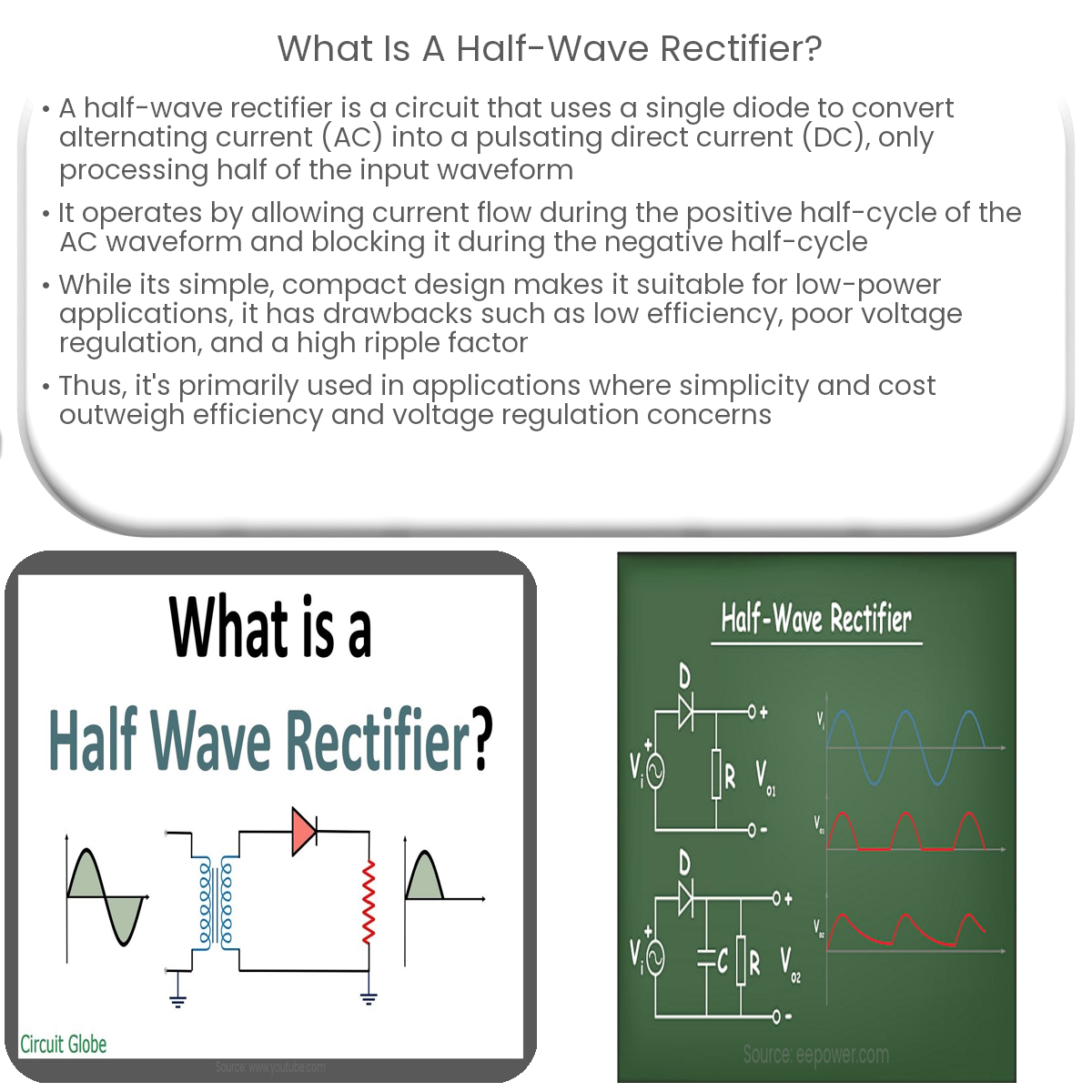
A half-wave rectifier uses a single diode to convert AC into pulsating DC, processing only the positive half-cycle of the AC waveform.
Introduction to Half-Wave Rectifiers
A half-wave rectifier is a type of rectifier circuit that utilizes a single diode to convert alternating current (AC) into direct current (DC). The primary function of a rectifier is to eliminate the negative portion of the AC waveform, resulting in a pulsating DC output. The half-wave rectifier gets its name because it only processes half of the input waveform.
How a Half-Wave Rectifier Works
In a half-wave rectifier, the diode is connected in series with the AC input voltage. During the positive half-cycle of the AC waveform, the diode is forward-biased, allowing current to flow through the circuit and producing a positive DC output voltage. Conversely, during the negative half-cycle, the diode is reverse-biased, blocking the flow of current and effectively eliminating the negative portion of the waveform. The result is a pulsating DC voltage with a frequency equal to that of the input AC voltage.
Advantages of Half-Wave Rectifiers
Half-wave rectifiers have certain advantages that make them suitable for specific applications:
- Simple Design: A half-wave rectifier requires only a single diode, making it a cost-effective and straightforward solution for low-power applications.
- Low Component Count: The minimal component count allows for a compact design, which is beneficial in space-constrained environments.
Disadvantages of Half-Wave Rectifiers
Despite their advantages, half-wave rectifiers also have some significant drawbacks:
- Low Efficiency: Since half of the input waveform is discarded, the output power is only 40.6% of the input power, making half-wave rectifiers relatively inefficient.
- Poor Voltage Regulation: The output voltage of a half-wave rectifier is highly dependent on the load current, leading to poor voltage regulation.
- High Ripple Factor: Half-wave rectifiers produce a pulsating DC output with a high ripple factor, which can cause noise and instability in sensitive electronic circuits.
Applications of Half-Wave Rectifiers
Half-wave rectifiers are generally used in low-power applications where simplicity and cost are more important than efficiency and voltage regulation. Examples include signal detection, demodulation, and basic power supply designs for low-cost electronic devices.
In summary, a half-wave rectifier is a simple, cost-effective solution for converting AC to pulsating DC in low-power applications. However, its low efficiency, poor voltage regulation, and high ripple factor limit its suitability for more demanding applications.