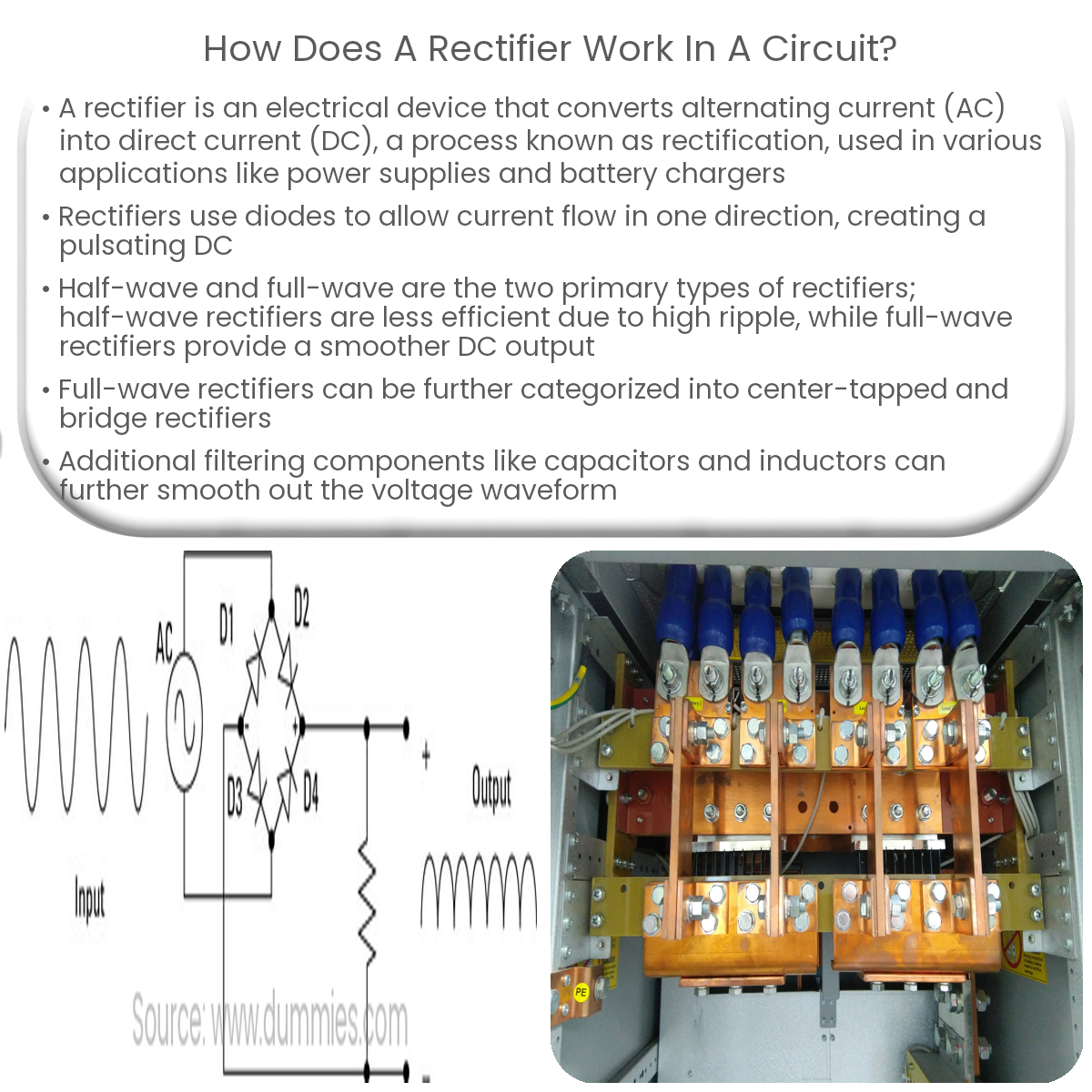
A rectifier works in a circuit by using diodes to convert alternating current (AC) into direct current (DC), producing a pulsating DC output.
Introduction to Rectifiers
A rectifier is an electrical device that converts alternating current (AC) to direct current (DC). The process of converting AC to DC is known as rectification. Rectifiers are used in various applications, including power supplies, battery chargers, and electronics devices.
Working Principle of Rectifiers
Rectifiers utilize diodes to convert AC to DC. Diodes are semiconductor devices that allow current to flow in one direction only. When an AC voltage is applied across a diode, it conducts during the positive half-cycle and blocks during the negative half-cycle, thereby converting AC into a pulsating DC.
Types of Rectifiers
There are two main types of rectifiers: half-wave rectifiers and full-wave rectifiers.
Center-Tapped Full-Wave Rectifier
A center-tapped full-wave rectifier uses a center-tapped transformer and two diodes to rectify both half-cycles of the AC input. The center-tap serves as a common ground for the diodes, allowing them to conduct alternately during the positive and negative half-cycles. This results in a smoother DC output with a lower ripple factor than a half-wave rectifier.
Bridge Rectifier
A bridge rectifier uses four diodes in a bridge configuration to rectify both half-cycles of the AC input. Unlike the center-tapped rectifier, it does not require a center-tapped transformer. The diodes conduct in pairs during each half-cycle, allowing the entire input waveform to be utilized, which leads to a smoother DC output with even lower ripple.
Filtering and Smoothing
Although rectifiers produce a pulsating DC output, additional components like capacitors and inductors can be used to smooth out the voltage waveform. Capacitors store energy during voltage peaks and discharge during voltage dips, reducing the ripple effect. Inductors oppose rapid changes in current, further smoothing the output voltage.
In conclusion, rectifiers are essential components in many electrical and electronic circuits, converting AC into a usable DC voltage. Depending on the application, different types of rectifiers and filtering components can be used to achieve the desired DC output characteristics.