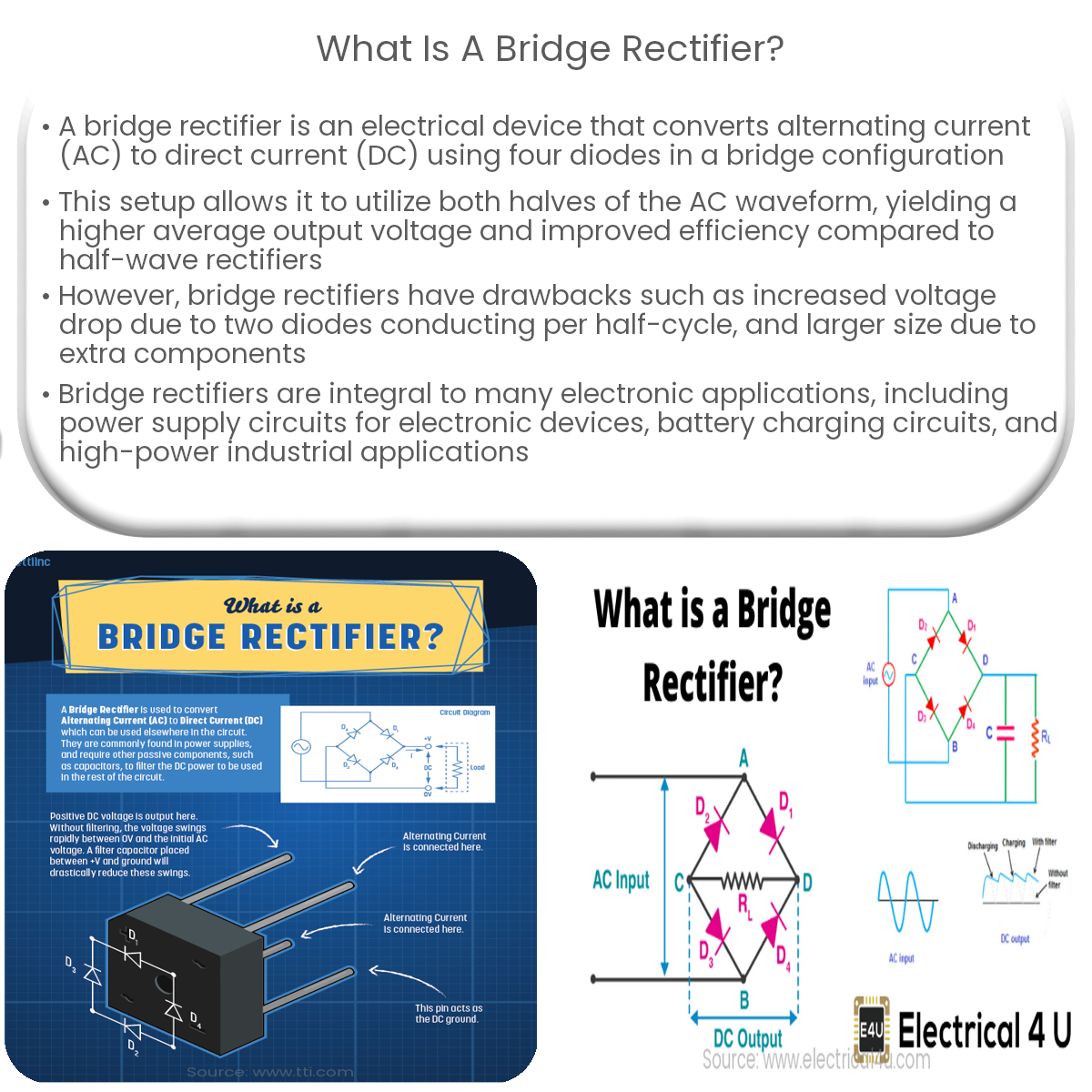
A bridge rectifier is an electrical device that converts AC to DC using four diodes in a bridge configuration, providing efficient full-wave rectification.
Introduction to Bridge Rectifiers
A bridge rectifier is an electrical device that converts alternating current (AC) to direct current (DC) by using four diodes connected in a bridge configuration. Its primary purpose is to efficiently convert AC power from a power source to DC power for electronic devices and circuits.
Working Principle
In a bridge rectifier, the four diodes are connected in such a way that they form a closed loop, or a “bridge.” During each half-cycle of the AC input voltage, two diodes conduct, while the other two are reverse-biased. This arrangement ensures that the output voltage polarity remains the same, regardless of the input AC waveform’s polarity. As a result, the bridge rectifier produces a pulsating DC output voltage.
Advantages of a Bridge Rectifier
- Full-wave rectification: Unlike half-wave rectifiers, bridge rectifiers use both positive and negative cycles of the input AC waveform, leading to a higher average output voltage and improved efficiency.
- Simplicity: Bridge rectifiers have a simple design that requires only four diodes, making them easy to construct and cost-effective.
- Higher output voltage: As the bridge rectifier uses both halves of the AC waveform, the output voltage is higher than in a half-wave rectifier, which is beneficial for many applications.
Disadvantages of a Bridge Rectifier
- Voltage drop: Due to the presence of two diodes in series during each half-cycle, the voltage drop across the rectifier is double that of a center-tap full-wave rectifier. This reduces the efficiency and increases power dissipation.
- Size: Bridge rectifiers tend to be bulkier than other types of rectifiers due to the need for additional diodes and components.
Applications of Bridge Rectifiers
Bridge rectifiers are widely used in various electronic applications, including:
- Power supply circuits for electronic devices such as computers, televisions, and audio equipment.
- Battery charging circuits for electric vehicles, smartphones, and other portable devices.
- Welding equipment and other high-power industrial applications.
In conclusion, a bridge rectifier is an essential component in many electronic circuits, providing efficient and reliable full-wave rectification for a wide range of applications.