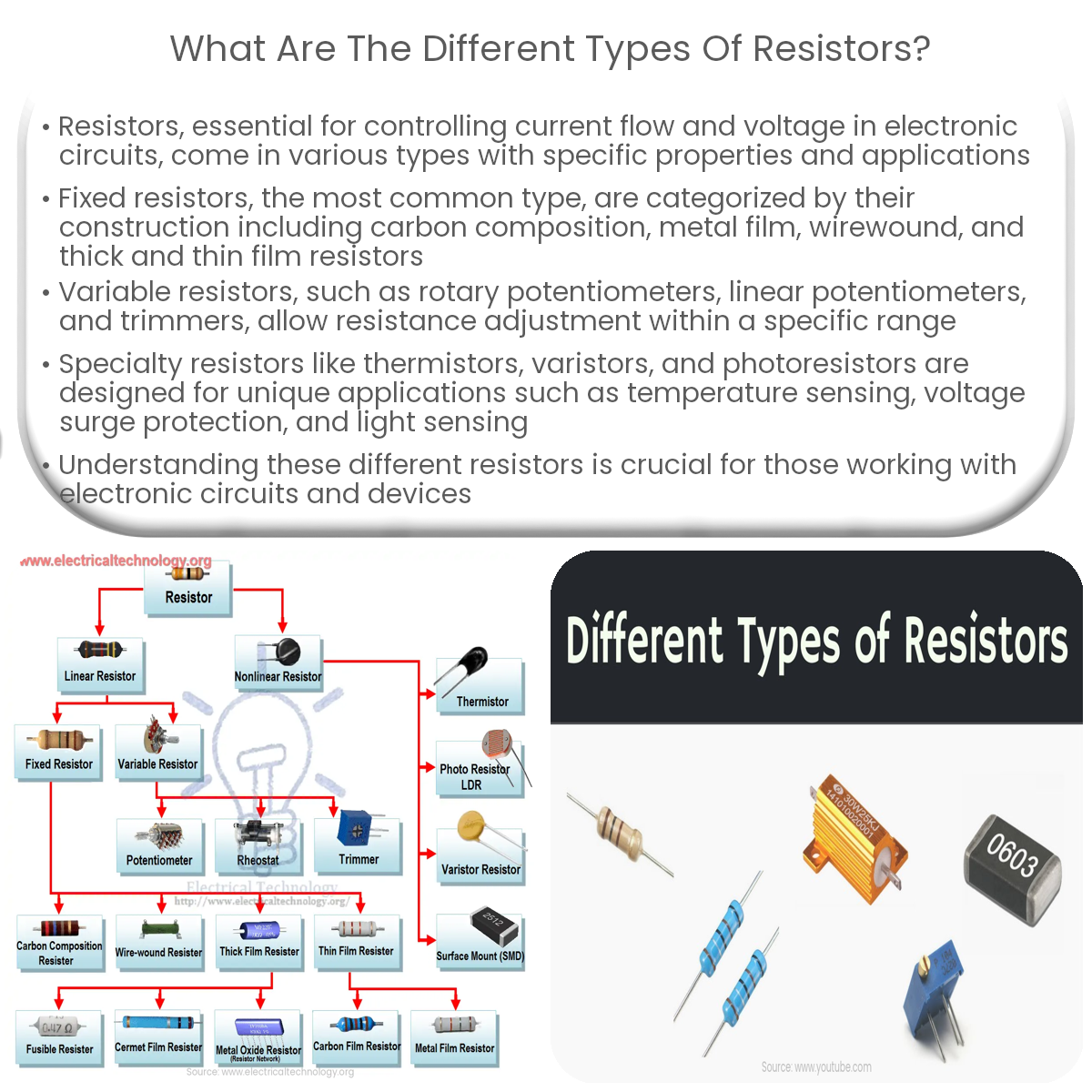
Different types of resistors include fixed resistors, variable resistors, and specialized resistors like thermistors, varistors, and photoresistors.
Types of Resistors
Resistors are essential components in electronic circuits that impede the flow of electric current and maintain desired voltage levels. There are numerous resistor types, each with specific characteristics and applications. This article will outline some of the most common resistor types.
1. Fixed Resistors
- Carbon Composition Resistors: Composed of carbon granules mixed with a binder, these resistors are cost-effective but have low accuracy and stability.
- Carbon Film Resistors: A thin carbon layer is deposited on an insulating material, creating a spiral cut to adjust the resistance. These resistors have better accuracy and stability than carbon composition resistors.
- Metal Film Resistors: A metal alloy is deposited on an insulating material, offering higher precision and stability compared to carbon film resistors. These resistors have low noise and are suitable for high-frequency applications.
- Metal Oxide Film Resistors: These resistors consist of a metal oxide film on a ceramic rod, providing better temperature stability and higher power ratings than other film resistors.
- Wirewound Resistors: A wire made of an alloy is wound around a non-conductive core. Wirewound resistors have excellent power dissipation capabilities, low noise, and high precision, making them ideal for high-power applications.
2. Variable Resistors
- Potentiometers: Also known as “pots,” these resistors have a wiper that moves along a resistive element, allowing users to adjust the resistance value. They are commonly used in volume control and other adjustable settings.
- Trimmers: These are miniature potentiometers used for fine-tuning and calibration in electronic circuits.
- Rheostats: A type of variable resistor used for adjusting current by changing the resistance. Rheostats are typically found in high-power applications.
3. Specialized Resistors
- Thermistors: These temperature-sensitive resistors change resistance with temperature. There are two types: Negative Temperature Coefficient (NTC) and Positive Temperature Coefficient (PTC) thermistors, each with specific applications.
- Varistors: Also known as Voltage Dependent Resistors (VDR), these components have a non-linear resistance that changes with voltage, offering surge protection in electronic circuits.
- Photoresistors: Also called Light Dependent Resistors (LDR), these components change resistance based on the amount of light they receive, making them suitable for light-sensing applications.
In summary, the variety of resistor types allows engineers to design electronic circuits with the desired functionality, stability, and performance characteristics.