
What are resistors?

Resistors are electronic components that limit current flow and control voltage levels in circuits, used in applications like voltage division and timing.

What are Resistors?

Resistors are fundamental components in electronic circuits designed to limit the flow of electric current, which in turn helps control voltage levels in a circuit. Resistors implement resistance, a crucial property that opposes or restricts the flow of electrons.

Types of Resistors

Resistors come in various types, with the most common ones being:

  • Fixed Resistors: These have a constant resistance value and cannot be adjusted. They are widely used in electronic circuits for tasks like voltage division and current limiting.
  • Variable Resistors: These have adjustable resistance values, allowing users to control the current flow in a circuit. Examples include potentiometers, used in volume controls, and rheostats, used to regulate light levels.
  • Thermistors: These are temperature-sensitive resistors. Their resistance value changes with temperature, making them useful for temperature sensing and control applications.
  • Light Dependent Resistors (LDRs): Also known as photoresistors, these components exhibit a change in resistance when exposed to light. They are employed in applications like light-sensing circuits and automatic lighting systems.
  • Resistor Color Coding

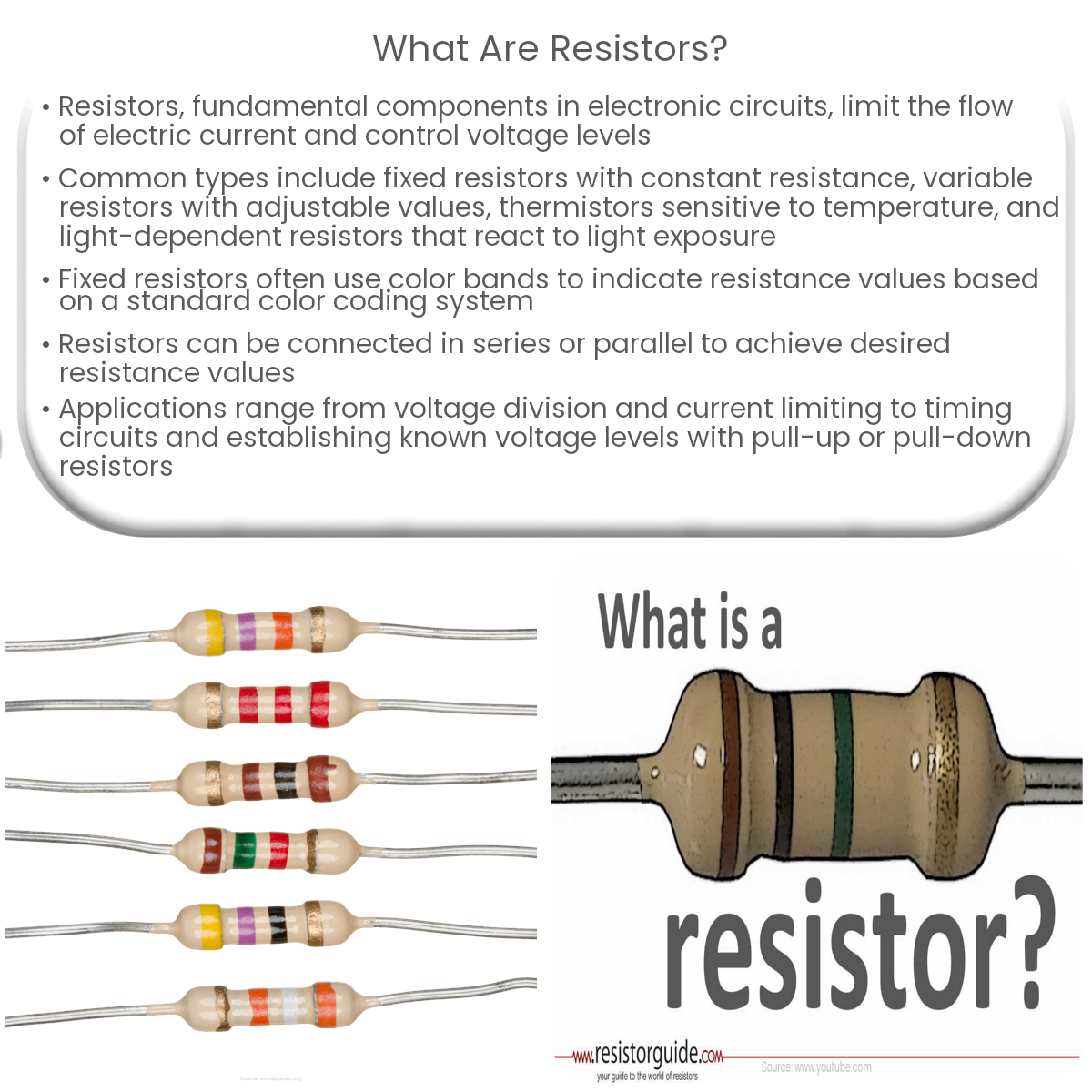
    Fixed resistors often have color bands painted on their bodies to indicate their resistance values. The color coding system is based on a standardized set of colors that represent numbers from 0 to 9. The resistance value, tolerance, and sometimes the temperature coefficient are encoded using these color bands.

    Resistors in Series and Parallel

    Resistors can be connected in series or parallel configurations to achieve desired resistance values in a circuit. In a series connection, resistors are connected end-to-end, and the total resistance is equal to the sum of individual resistances (Rtotal = R1 + R2 + …). In a parallel connection, resistors are connected side by side, with their terminals joined together. The total resistance in this configuration is calculated using the formula 1/Rtotal = 1/R1 + 1/R2 + …

    Applications of Resistors

    Resistors are utilized in various electronic applications, such as:
  • Voltage division: Resistors can be used to create voltage dividers, splitting an input voltage into smaller, proportional voltages.
  • Current limiting: By adding a resistor to a circuit, the current flow can be limited to protect sensitive components.
  • Pull-up and pull-down resistors: These help establish a known voltage level on an input pin when it is not connected to a signal.
  • Timing circuits: In combination with capacitors, resistors can be used to create time delays in electronic circuits.
  • What are resistors?

    header - logo

    The primary purpose of this project is to help the public to learn some exciting and important information about electricity and magnetism.

    Privacy Policy

    Our Website follows all legal requirements to protect your privacy. Visit our Privacy Policy page.

    The Cookies Statement is part of our Privacy Policy.

    Editorial note

    The information contained on this website is for general information purposes only. This website does not use any proprietary data. Visit our Editorial note.

    Copyright Notice

    It’s simple:

    1) You may use almost everything for non-commercial and educational use.

    2) You may not distribute or commercially exploit the content, especially on another website.
