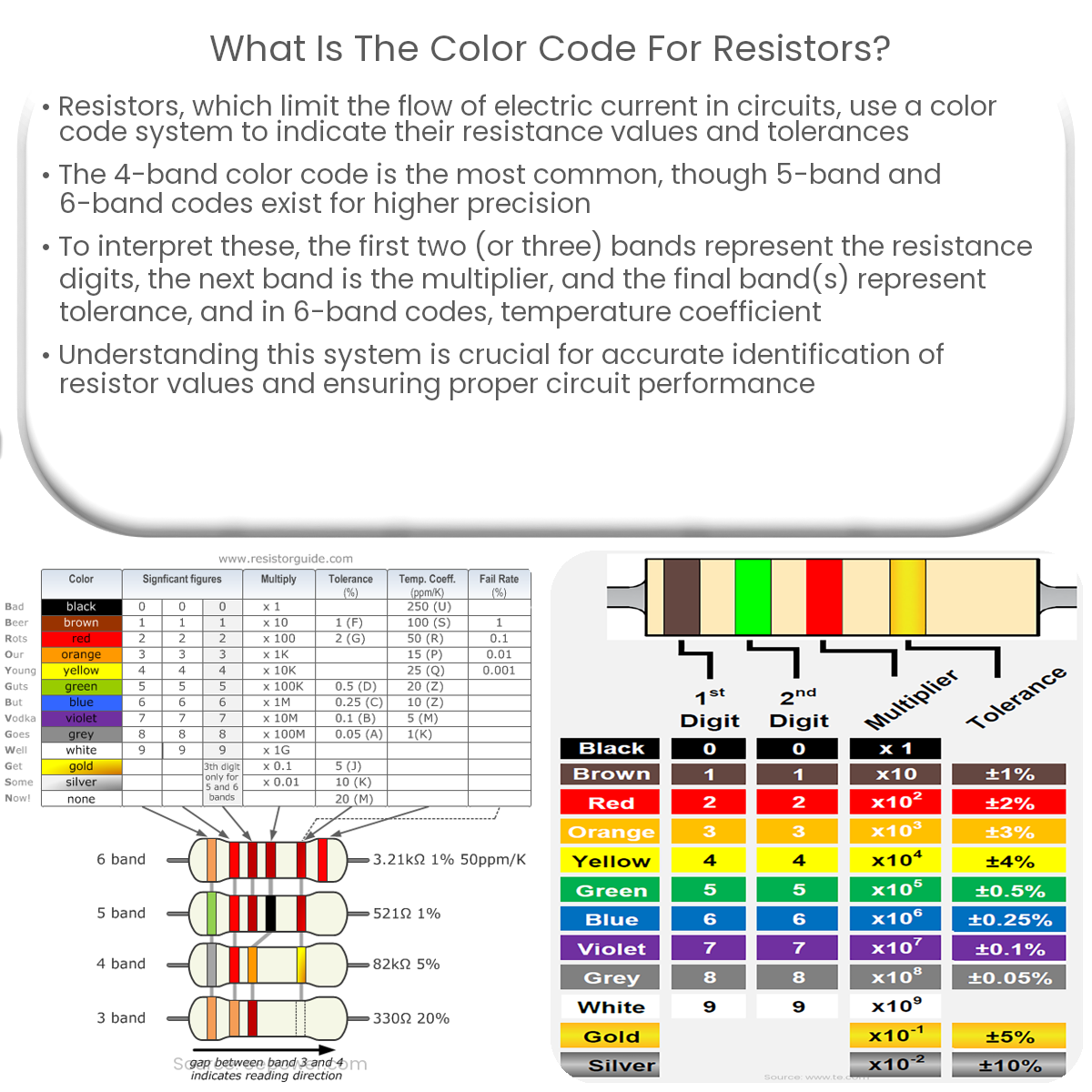
Resistor color codes are a standardized system using colored bands to indicate resistance values and tolerances on resistors, ensuring accurate identification.
Understanding Resistor Color Codes
Resistors are passive electronic components that limit the flow of electric current in a circuit. They come in various sizes and resistance values, which are often indicated by a color code printed on the resistor’s body. This article will discuss the resistor color code system and how to read and interpret it.
The Color Code System
The resistor color code is a standardized system that uses colored bands to represent resistance values and tolerances. The most common system is the 4-band color code, although 5-band and 6-band color codes also exist for higher precision resistors. The colors and their corresponding numerical values are as follows:
- Black: 0
- Brown: 1
- Red: 2
- Orange: 3
- Yellow: 4
- Green: 5
- Blue: 6
- Violet: 7
- Gray: 8
- White: 9
Reading 4-Band Color Codes
To read a 4-band resistor color code, follow these steps:
- Identify the first two bands, which represent the first two digits of the resistance value.
- Find the third band, which indicates the multiplier. Multiply the two-digit number from step 1 by 10 raised to the power of the third band’s value.
- Locate the fourth band, which denotes the tolerance. This band indicates the resistor’s accuracy as a percentage of the nominal resistance value.
For example, a resistor with color bands of yellow, violet, red, and gold would have a resistance value of 47 × 102 ohms (4,700 ohms) and a tolerance of ±5%.
Reading 5-Band and 6-Band Color Codes
For 5-band and 6-band color codes, the process is similar to the 4-band system with slight modifications:
- Identify the first three bands, which represent the first three digits of the resistance value.
- Find the fourth band, which indicates the multiplier. Multiply the three-digit number from step 1 by 10 raised to the power of the fourth band’s value.
- Locate the fifth band, which denotes the tolerance.
- For 6-band color codes, the sixth band indicates the temperature coefficient in ppm/°C (parts per million per degree Celsius).
Understanding and interpreting resistor color codes is an essential skill for electronics enthusiasts and professionals alike. It enables accurate identification of resistor values and tolerances, ensuring proper circuit performance and reliable operation of electronic devices.