
Explore the principles, features, and applications of Vortex Shedding Flow Meters, pivotal for precise flow measurement in various industries.
Introduction to Vortex Shedding Flow Meters
Vortex Shedding Flow Meters, often referred to as Vortex Flow Meters, are crucial instruments in modern industrial applications for precise flow measurement. These meters exploit the physical principle known as the von Kármán vortex street to deliver accurate flow rate measurements.
Working Principle
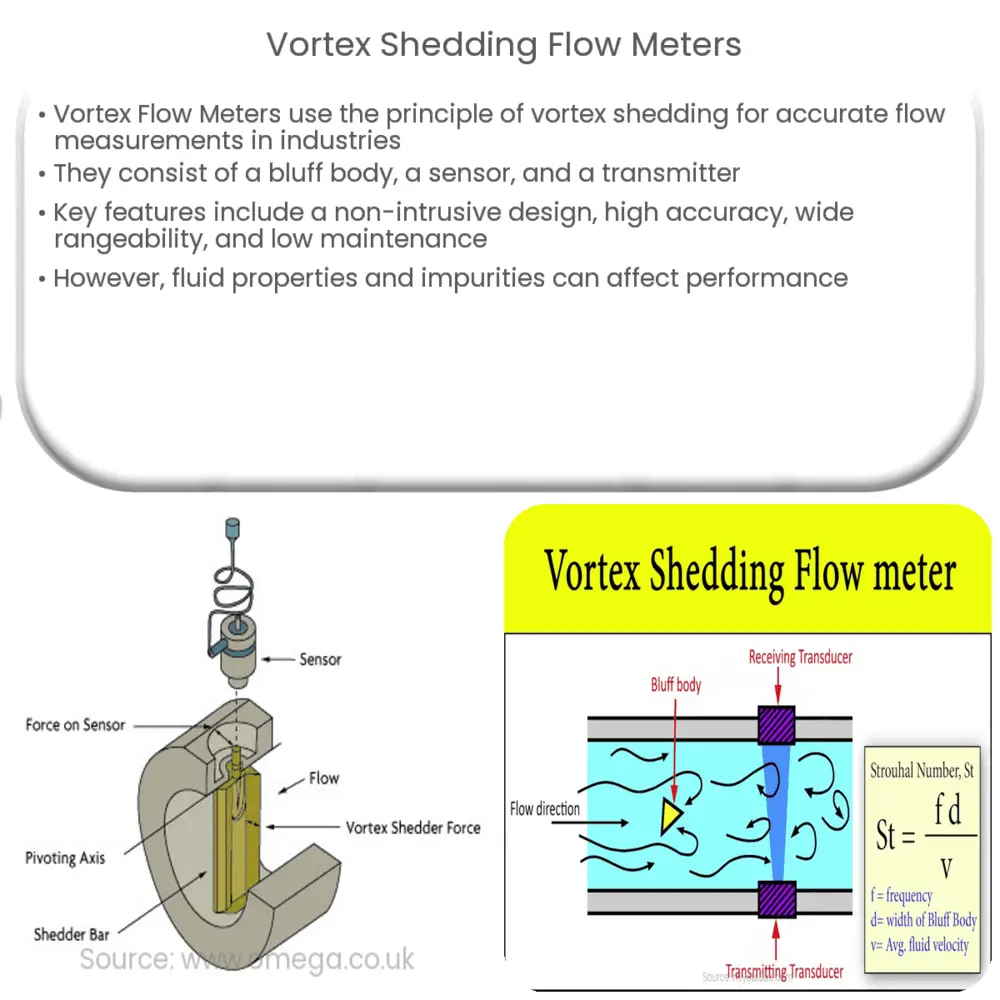
At the heart of the Vortex Flow Meter’s operation is the phenomenon of vortex shedding. This occurs when a fluid, such as gas or liquid, passes a bluff body — an obstacle within the fluid flow path. The obstruction forces the fluid to separate, causing alternating vortices to be shed on the downstream side of the bluff body. This formation of vortices is known as the ‘vortex trail’, or the von Kármán vortex street.
Components and Design
The Vortex Flow Meter primarily consists of three essential components. First, the bluff body that encourages vortex shedding. Second, a sensor to detect these vortices. And third, a transmitter that processes the sensor data into a readable flow rate.
- Bluff Body: The bluff body creates vortices in the fluid. The frequency at which these vortices shed, known as the vortex shedding frequency, is directly proportional to the velocity of the fluid.
- Sensor: The sensor, typically a piezoelectric crystal or capacitance sensor, is responsible for detecting the pressure fluctuations caused by the vortex shedding.
- Transmitter: This component processes the raw signal from the sensor, often converting it into a 4-20mA signal or a digital output that represents the flow rate.
Key Features and Benefits
Vortex Flow Meters offer numerous advantages that make them highly desirable in a variety of industrial settings. Some of these include their non-intrusive design, high accuracy, wide rangeability, and relatively low maintenance requirements. We will delve into these features in the following sections.
Non-Intrusive Design
One of the principal advantages of Vortex Flow Meters is their non-intrusive nature. Because the bluff body is the only part that interacts with the fluid, there are no moving parts within the fluid stream. This feature significantly reduces wear and tear, extending the longevity of the device.
High Accuracy and Wide Rangeability
Accuracy is of paramount importance in flow measurement, and Vortex Flow Meters are renowned for their precise readings. They provide an accuracy of up to ±1% of the flow rate, making them suitable for both low and high flow velocity measurements. Additionally, these flow meters offer wide rangeability – typically 20:1 – which allows them to function effectively over a vast range of flow rates.
Low Maintenance
The lack of moving parts not only contributes to the longevity of the Vortex Flow Meter but also significantly reduces maintenance requirements. With less mechanical wear and tear, these devices can operate efficiently for extended periods without the need for frequent servicing or part replacements.
Application
Vortex Flow Meters find application in various industries, including oil and gas, chemical processing, power generation, and food and beverage production. They are used to measure the flow rates of a wide variety of fluids, such as steam, gases, and liquids.
Limits and Considerations
While Vortex Flow Meters offer numerous advantages, it is essential to note that their performance can be affected by changes in fluid properties such as density, viscosity, and temperature. Also, the presence of suspended solids or bubbles in the fluid may disrupt the vortex shedding, leading to inaccurate measurements. Therefore, these factors should be considered when selecting a Vortex Flow Meter for a specific application.
Conclusion
In conclusion, Vortex Shedding Flow Meters are innovative devices that provide precise and reliable flow measurement in a wide range of industrial applications. They leverage the phenomenon of vortex shedding to deliver accurate readings, boasting features such as a non-intrusive design, high accuracy, wide rangeability, and low maintenance requirements. Despite certain limitations, their versatility and durability make them an excellent choice for various fluid flow measurement tasks. As industries continue to demand higher precision and reliability, the role of Vortex Flow Meters is expected to become increasingly significant in the future.



