
Explore the workings of voltage triplers, their design, applications, advantages, and future prospects in this comprehensive guide.
Understanding Voltage Triplers
A voltage tripler is an electronic circuit that effectively triples the peak input voltage, creating an output voltage that is approximately three times the amplitude of the input voltage. These devices are typically used when a substantial increase in voltage is required, and where using a transformer or similar conventional device would be impractical.
Working Principle
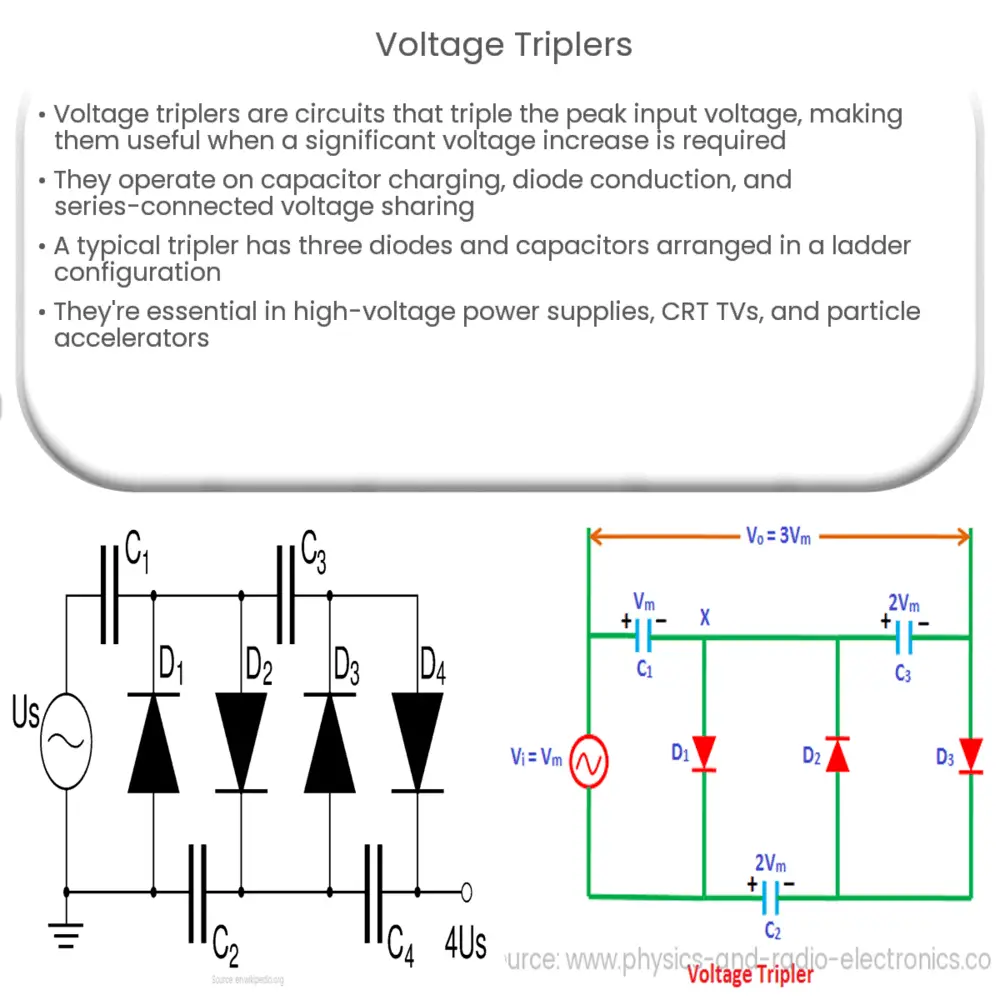
The voltage tripler circuit operates on the principles of capacitor charging, diode conduction, and the sharing of voltage in series-connected elements. The components essential for a voltage tripler are capacitors and diodes, which work together in a specific arrangement to magnify the input voltage.
- Capacitors: In the voltage tripler, the capacitors are charged during different halves of the AC input cycle. They store electric charge and block direct current while allowing alternating current to pass.
- Diodes: These components direct the flow of current in one direction and block it in the opposite direction. In a voltage tripler, diodes play a crucial role in the charging and discharging processes of the capacitors.
Design and Operation
A typical voltage tripler consists of three diodes and three capacitors connected in a specific ladder-like configuration. In the first half cycle of the AC input, one diode conducts, charging one of the capacitors. In the second half cycle, the other two diodes conduct, charging the other two capacitors in series. The process repeats with every input cycle, producing a tripled voltage at the output.
Applications
- High voltage power supplies: Voltage triplers are commonly used in high-voltage power supplies, where they efficiently increase the output voltage with a minimal increase in input current.
- Television sets and monitors: Voltage triplers, along with voltage doublers, are used in cathode ray tube television sets and monitors to produce the high voltages necessary for creating the electron beam.
- Particle accelerators: In scientific applications like particle accelerators, voltage triplers provide the high voltages needed to accelerate charged particles to high speeds.
The above points illustrate the fundamental working principle, design, and common applications of voltage triplers. In the next section, we will delve into their performance characteristics, advantages, disadvantages, and explore more about their use in modern electronics.
Performance Characteristics of Voltage Triplers
Voltage triplers, like all electrical devices, have unique performance characteristics. The output voltage from a tripler is not a steady DC voltage but a pulsating DC voltage. The peak-to-peak ripple voltage is inversely proportional to the load resistance and the frequency of operation. The output voltage is also influenced by the forward voltage drop across the diodes and the quality of the capacitors used.
Advantages and Disadvantages
- Advantages
- Compact size: Voltage triplers provide an efficient way of increasing voltage in a compact circuit, saving space in devices.
- Cost-effective: The components used in a voltage tripler are inexpensive and easily available, making it a cost-effective solution.
- No need for transformers: Voltage triplers do not require heavy and expensive transformers, which makes them preferable in portable electronic devices.
- Disadvantages
- Output limitations: The output current is limited and decreases as the multiplier factor increases.
- Dependence on component quality: The performance of a voltage tripler depends heavily on the quality of the diodes and capacitors used.
Future of Voltage Triplers
Despite their limitations, voltage triplers continue to play a critical role in modern electronics due to their unique capabilities. They are integral to the design of many high-voltage and portable devices. With ongoing research into improving capacitor technology and diode efficiency, the performance and application scope of voltage triplers are set to increase.
Conclusion
In conclusion, voltage triplers are versatile, compact, and efficient devices that find wide-ranging applications in modern electronics. Their operation based on simple diode and capacitor arrangements results in a three-fold increase in voltage, which is instrumental in driving many high-voltage applications. Despite some challenges concerning output limitations and component quality, advancements in electronic components promise an exciting future for voltage triplers. Understanding these devices’ intricacies helps us appreciate their significant role in shaping our electronic world.



