
What is the maximum power transfer theorem, and how is it applied to electric circuits?
The Maximum Power Transfer Theorem states that maximum power transfer occurs when the load impedance equals the complex conjugate of the source impedance.
The Maximum Power Transfer Theorem states that maximum power transfer occurs when the load impedance equals the complex conjugate of the source impedance.
Thevenin’s theorem simplifies complex circuits by replacing them with an equivalent circuit having a single voltage source and a single resistor.
Norton’s theorem simplifies complex circuits into an equivalent current source in parallel with a resistor, making analysis easier for engineers.
Nodal analysis is a technique used to determine voltages at different nodes in electric circuits by applying Kirchhoff’s Current Law and solving equations.
Mesh analysis is a technique that applies Kirchhoff’s Voltage Law to solve complex electrical circuits by determining mesh currents.
To apply Kirchhoff’s laws, identify nodes and loops, apply KCL to nodes and KVL to loops, solve the equations, and verify the solution.

Different circuit analysis methods include Ohm’s Law, Kirchhoff’s Laws, Nodal Analysis, Mesh Analysis, Thevenin’s and Norton’s Theorems, Superposition, and Maximum Power Transfer.
Kirchhoff’s Current Law (KCL) states that the total current entering a junction in a circuit equals the total current leaving that junction.
Kirchhoff’s Voltage Law (KVL) states that the sum of voltages around any closed loop in a circuit equals zero, reflecting energy conservation.
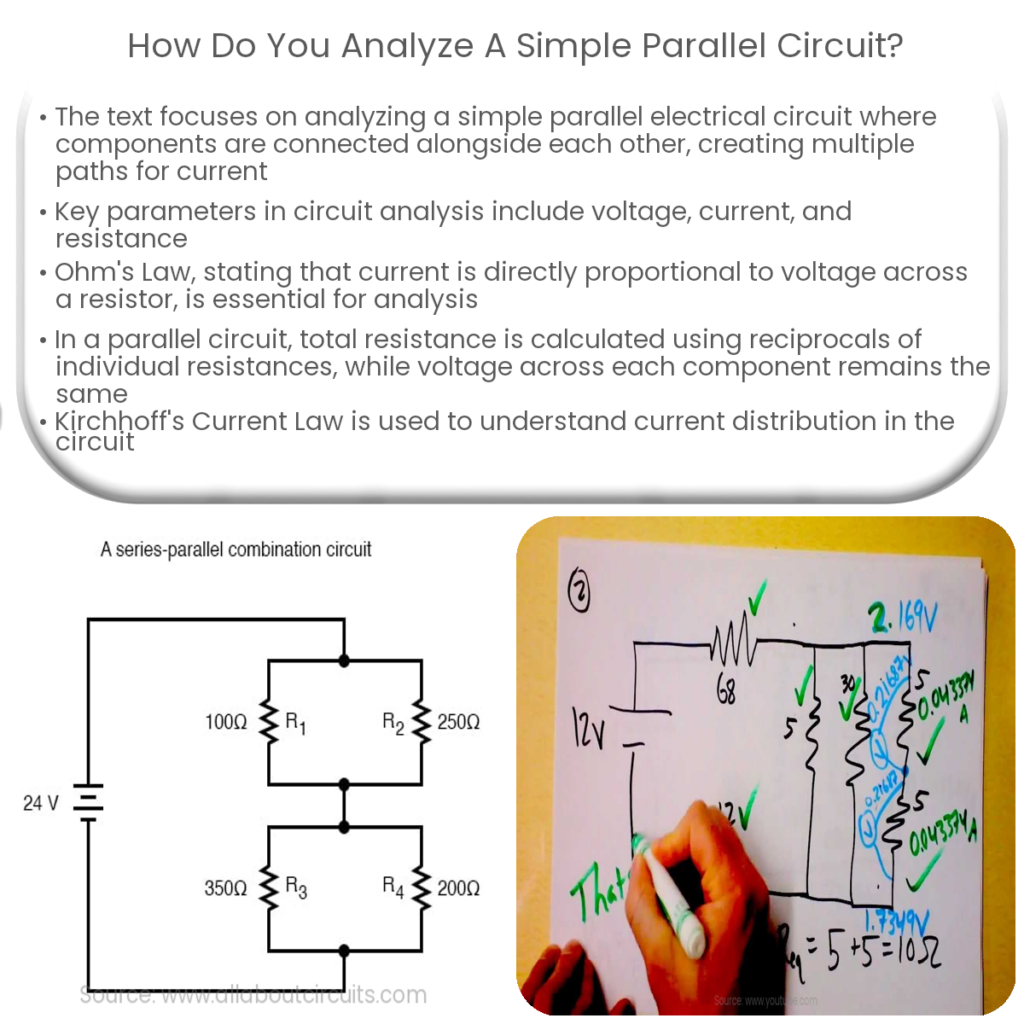
To analyze a parallel circuit, calculate total resistance using the reciprocal formula, ensure voltage is equal across components, and apply Ohm’s and Kirchhoff’s Laws.

The primary purpose of this project is to help the public to learn some exciting and important information about electricity and magnetism.
Our Website follows all legal requirements to protect your privacy. Visit our Privacy Policy page.
The Cookies Statement is part of our Privacy Policy.
The information contained on this website is for general information purposes only. This website does not use any proprietary data. Visit our Editorial note.
It’s simple:
1) You may use almost everything for non-commercial and educational use.
2) You may not distribute or commercially exploit the content, especially on another website.
