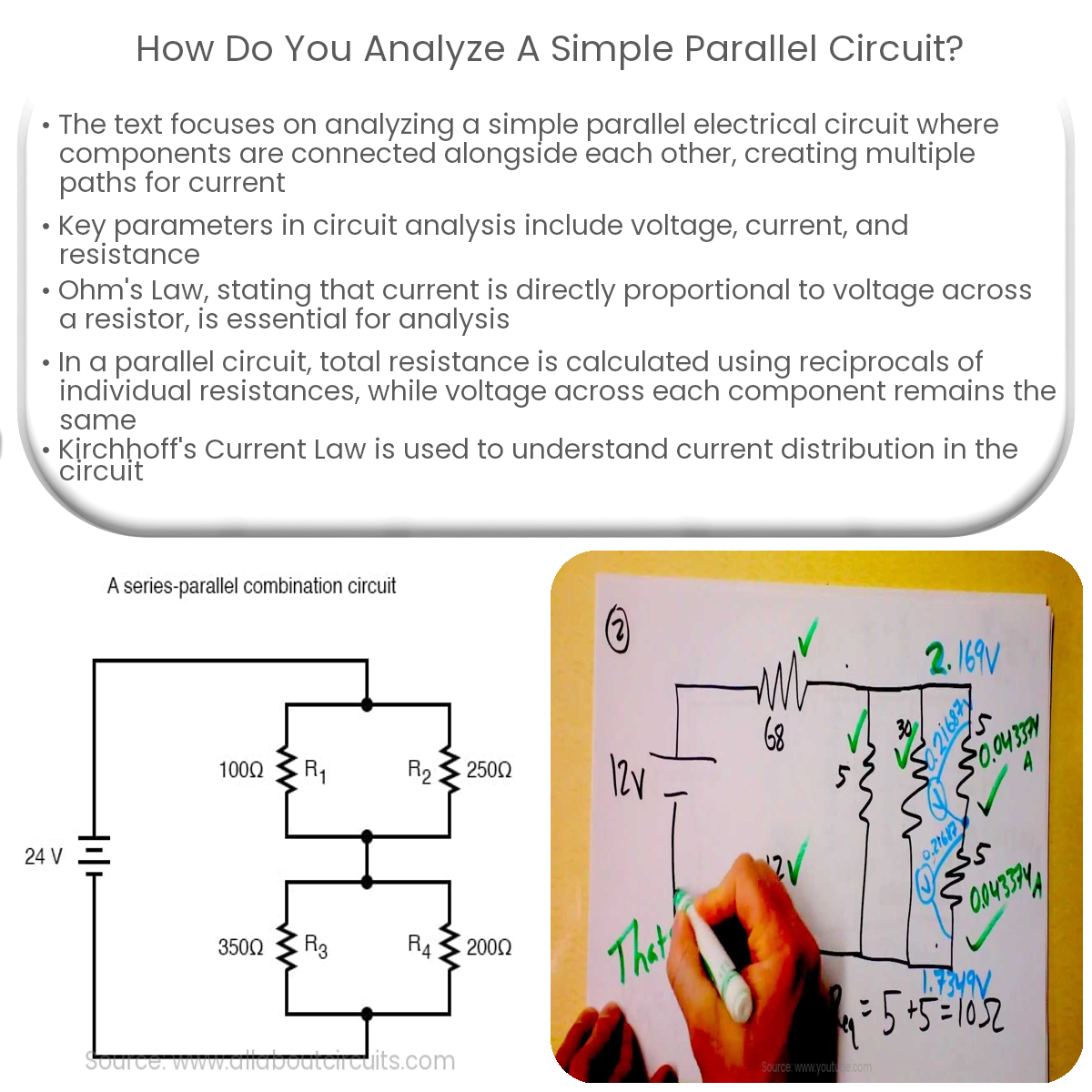
To analyze a parallel circuit, calculate total resistance using the reciprocal formula, ensure voltage is equal across components, and apply Ohm’s and Kirchhoff’s Laws.
Analyzing a Simple Parallel Circuit
A parallel circuit is a type of electrical circuit where components are connected alongside each other, creating multiple paths for current to flow. This article will discuss how to analyze a simple parallel circuit, focusing on essential parameters such as voltage, current, and resistance.
Basic Components and Parameters
Before analyzing a parallel circuit, it is essential to understand the fundamental components and parameters involved:
- Voltage (V): The electric potential difference between two points in a circuit, measured in volts (V).
- Current (I): The flow of electric charge through a circuit, measured in amperes (A).
- Resistance (R): The opposition to the flow of electric current, measured in ohms (Ω).
Ohm’s Law
Ohm’s Law is a fundamental principle in the analysis of electrical circuits. It states that the current (I) flowing through a resistor (R) is directly proportional to the voltage (V) across the resistor:
I = V / R
Applying Ohm’s Law, we can analyze the behavior of a parallel circuit, considering the total resistance, voltage, and current.
Calculating Total Resistance
In a parallel circuit, the total resistance (RT) is found using the reciprocal formula of the individual resistances (R1, R2, R3, etc.) connected in parallel:
1 / RT = 1 / R1 + 1 / R2 + 1 / R3 + …
Voltage in a Parallel Circuit
In a parallel circuit, the voltage across each component is the same and equal to the total voltage (VT) supplied by the voltage source:
V1 = V2 = V3 = … = VT
Current Distribution
According to Kirchhoff’s Current Law (KCL), the sum of the currents entering a junction in a parallel circuit is equal to the sum of currents leaving the junction:
IT = I1 + I2 + I3 + …
Applying Ohm’s Law, we can find the current flowing through each resistor:
In = V / Rn
Conclusion
To analyze a simple parallel circuit, one must understand the fundamental components and parameters involved, such as voltage, current, and resistance. By applying Ohm’s Law and Kirchhoff’s Current Law, we can calculate the total resistance, voltage distribution, and current flowing through individual components. Analyzing parallel circuits is essential for understanding and troubleshooting electrical and electronic systems.