
Magnetic gear actuators are non-contact systems that transfer motion & torque using magnetic fields, offering high precision, efficiency, and reduced wear.
Magnetic Gear Actuator: An Innovative and Efficient Solution for Mechanical Motion
Introduction
The field of mechanical engineering is constantly evolving with innovative solutions to improve the efficiency, precision, and performance of different systems. One such groundbreaking development is the magnetic gear actuator, which is rapidly gaining popularity as an alternative to traditional mechanical gears. In this article, we will explore the fundamental principles, advantages, and applications of magnetic gear actuators.
What are Magnetic Gear Actuators?
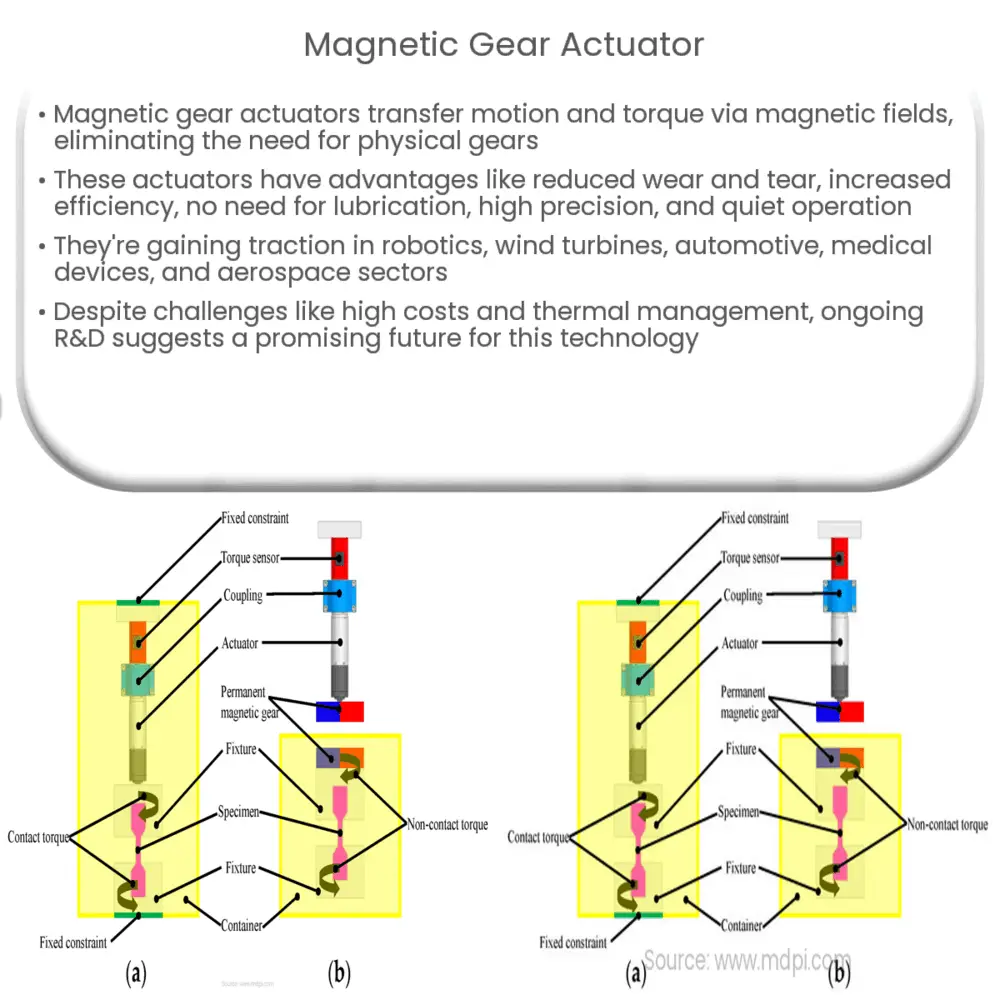
Magnetic gear actuators are non-contact mechanical systems that transfer motion and torque through magnetic fields instead of physical gears. These systems rely on the interaction between permanent magnets and soft magnetic materials to create a magnetic gear ratio, allowing for a precise and controlled transmission of motion without the need for mechanical contact. The actuator typically consists of three main components: the input rotor, the output rotor, and the stationary magnetic gear.
How Do Magnetic Gear Actuators Work?
The working principle of magnetic gear actuators is based on the concept of magnetic coupling. The input rotor, which is connected to the driving motor, has a set of permanent magnets arranged in a specific pattern. The output rotor, connected to the load, also has an arrangement of permanent magnets. The stationary magnetic gear, made of soft magnetic material, is placed between the input and output rotors. As the input rotor rotates, the magnetic field generated by its magnets interacts with the magnetic gear, causing the magnetic field to be modulated.
This modulated magnetic field, in turn, interacts with the magnets on the output rotor, causing it to rotate at a specific gear ratio determined by the relative number of magnets on the input and output rotors. This magnetic coupling enables the transfer of torque and motion without any physical contact between the components, eliminating the need for lubrication and reducing wear and tear on the system.
Advantages of Magnetic Gear Actuators
Magnetic gear actuators offer numerous benefits over traditional mechanical gears, including:
- Reduced wear and tear: Since there is no physical contact between the components, magnetic gear actuators experience less friction, wear, and tear, resulting in a longer lifespan and reduced maintenance requirements.
- Increased efficiency: The absence of friction and mechanical losses in magnetic gear actuators leads to improved efficiency and reduced energy consumption.
- Elimination of lubrication: Magnetic gear actuators do not require lubrication, reducing environmental impact and maintenance costs.
- High precision: The magnetic coupling enables precise control of the output motion, allowing for accurate positioning and motion control.
- Quiet operation: The lack of mechanical contact results in virtually noiseless operation, making magnetic gear actuators suitable for applications where noise is a concern.
Applications of Magnetic Gear Actuators
Due to their numerous advantages, magnetic gear actuators find use in a wide range of industries and applications, such as:
- Robotics: Magnetic gear actuators provide precise motion control and high torque density, making them ideal for use in robotic arms, grippers, and other robotic systems.
- Wind turbines: The non-contact nature of magnetic gear actuators makes them a suitable solution for wind turbine gearboxes, where they can help reduce maintenance and increase efficiency.
- Automotive industry: Magnetic gear actuators can be used in electric vehicle drivetrains to improve performance, reduce noise, and lower maintenance requirements.
- Medical devices: The high precision and noiseless operation of magnetic gear actuators make them suitable for use in medical devices such as surgical robots, prosthetics, and medical imaging equipment.
- Aerospace industry: The lightweight and low maintenance characteristics of magnetic gear actuators are beneficial in aerospace applications, where weight and reliability are crucial factors.
Challenges and Future Developments
While magnetic gear actuators offer many advantages, they also face some challenges that need to be addressed to further enhance their performance and adoption. Some of these challenges include:
- Cost: The high cost of permanent magnets and the complex manufacturing process can make magnetic gear actuators more expensive than traditional mechanical gears. However, advancements in magnet production and design are expected to help reduce these costs over time.
- Thermal management: Magnetic gear actuators can generate heat due to the interaction between the magnets and the soft magnetic material, requiring effective thermal management solutions to maintain optimal performance.
- Scaling and customization: Developing magnetic gear actuators for specific applications may require custom designs and scaling, which can be complex and time-consuming.
Despite these challenges, ongoing research and development in magnetic materials, design optimization, and manufacturing techniques are expected to drive the growth and adoption of magnetic gear actuators in various industries.
Conclusion
Magnetic gear actuators represent a promising and innovative solution for mechanical motion transfer, offering numerous advantages over traditional mechanical gears. With their reduced wear and tear, increased efficiency, elimination of lubrication, high precision, and quiet operation, magnetic gear actuators have the potential to revolutionize various industries, including robotics, wind energy, automotive, medical devices, and aerospace. As research and development efforts continue to address the current challenges, the future of magnetic gear actuators appears bright, with the potential to become a standard technology in many applications.



