
Linear magnetic gears transmit power via magnetic forces between linearly moving components, reducing wear, noise, and maintenance costs.
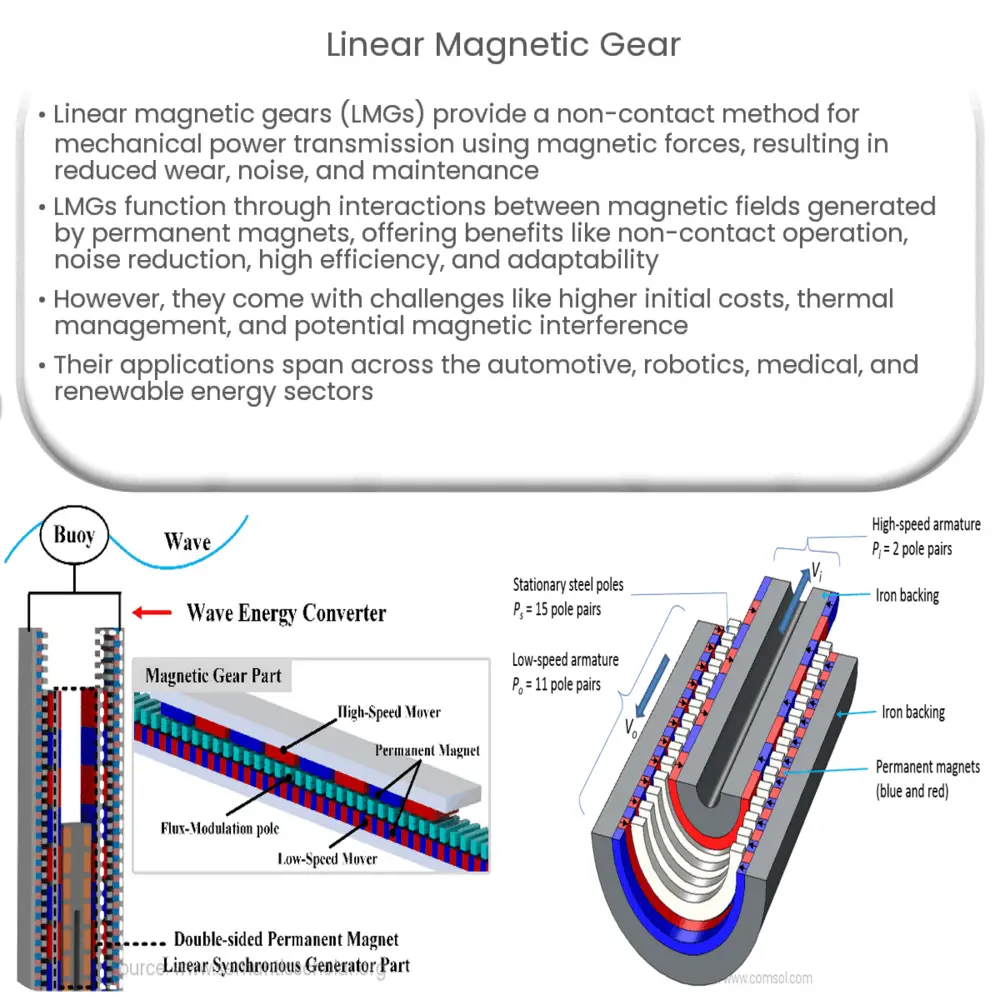
Linear Magnetic Gear: Revolutionizing the Future of Mechanical Power Transmission
Introduction
Linear magnetic gears (LMGs) are emerging as a promising alternative to traditional mechanical gears, offering numerous benefits in terms of efficiency, maintenance, and noise reduction. In this article, we will delve into the concept of LMGs, their working principles, and their potential applications in various industries.
What is a Linear Magnetic Gear?
A linear magnetic gear is a non-contact mechanical power transmission system that employs magnetic forces to transmit motion between two linearly moving components. Unlike conventional gears, LMGs do not rely on physical contact between gears to transfer power, which can result in reduced wear, noise, and maintenance costs. By utilizing the attractive and repulsive forces of permanent magnets, linear magnetic gears can transfer motion with high efficiency and precision.
Working Principle of Linear Magnetic Gears
The fundamental principle behind LMGs is the interaction between the magnetic fields generated by permanent magnets. An LMG typically consists of three primary components: the primary mover, the magnetic gear, and the secondary mover. The primary mover is a series of permanent magnets arranged in a linear pattern, which generates a magnetic field. The magnetic gear consists of an assembly of magnetic poles, which interacts with the magnetic field produced by the primary mover. Finally, the secondary mover, also consisting of permanent magnets, is attracted or repelled by the magnetic gear, resulting in linear motion.
When the primary mover moves linearly, the magnetic field it generates causes the magnetic gear to interact with the secondary mover. This interaction between the magnetic fields results in the linear motion of the secondary mover at a specific ratio relative to the primary mover. This ratio, known as the gear ratio, is determined by the number of magnetic poles in the magnetic gear and the arrangement of magnets in the primary and secondary movers.
Advantages of Linear Magnetic Gears
LMGs offer a number of advantages over traditional mechanical gears. Some of the key benefits include:
- Non-contact operation: Since there is no physical contact between the primary and secondary movers, LMGs can reduce wear and tear, leading to lower maintenance requirements and longer operational lifetimes.
- Noise reduction: The absence of mechanical contact also results in quieter operation, which can be particularly beneficial in sensitive environments such as hospitals, laboratories, and residential areas.
- High efficiency: The magnetic forces involved in LMGs ensure efficient power transmission with minimal energy loss, making them an energy-efficient alternative to traditional gears.
- Adaptability: LMGs can be designed for a wide range of gear ratios, making them suitable for various applications across different industries.
Disadvantages of Linear Magnetic Gears
While LMGs offer numerous benefits, they also have certain drawbacks that need to be considered:
- Cost: The use of permanent magnets and complex design may lead to higher initial costs compared to traditional gears. However, this can be offset by the reduced maintenance costs and increased lifespan.
- Thermal management: LMGs may require specialized cooling systems to dissipate heat generated by the magnetic fields, particularly in high-power applications.
- Magnetic interference: The magnetic fields generated by LMGs can potentially interfere with nearby electronic equipment, necessitating proper shielding and isolation measures.
Potential Applications of Linear Magnetic Gears
Due to their unique advantages, LMGs are finding applications in a wide range of industries:
- Automotive industry: LMGs can be used in electric vehicle (EV) powertrains to provide efficient, noiseless power transmission, contributing to the overall performance and driving experience of EVs.
- Robotics and automation: The high precision and adaptability of LMGs make them ideal for use in robotic arms, linear actuators, and other automated systems that require smooth, precise motion control.
- Medical equipment: LMGs can be utilized in medical devices such as MRI scanners, where their non-contact operation and low noise levels are highly desirable.
- Renewable energy: LMGs can be employed in linear generators for wave and tidal energy harvesting, providing an efficient and environmentally friendly way to generate electricity from renewable sources.
Conclusion
Linear magnetic gears are a groundbreaking technology that holds immense potential in revolutionizing mechanical power transmission across various industries. With their non-contact operation, reduced noise levels, high efficiency, and adaptability, LMGs offer significant advantages over traditional gears, making them an attractive option for an array of applications. While initial costs and thermal management challenges may be drawbacks, the long-term benefits of LMGs, including lower maintenance and extended operational lifetimes, make them a promising alternative in the quest for more sustainable and efficient power transmission systems.