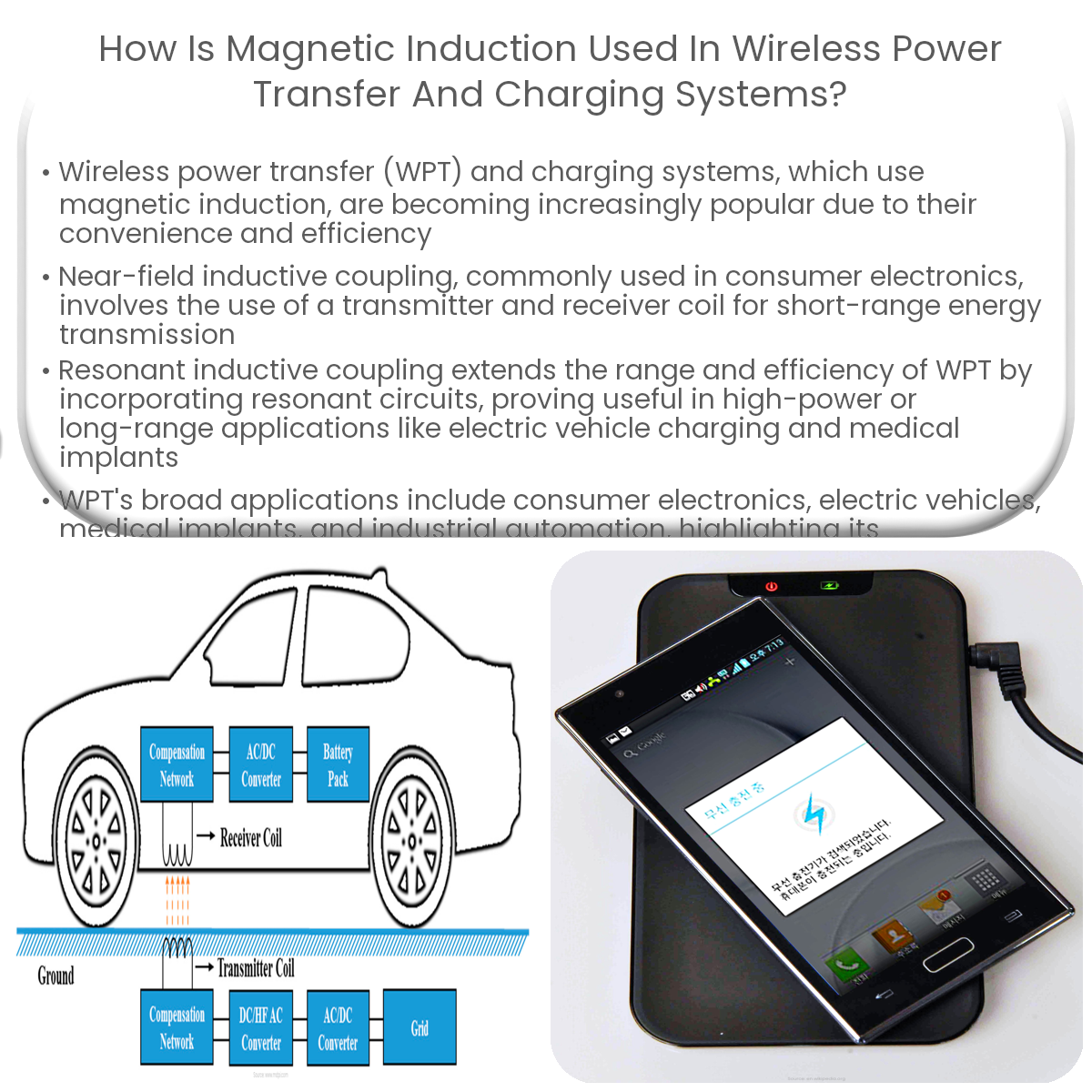
Magnetic induction is used in wireless power transfer by generating an alternating magnetic field to induce voltage in a receiver coil, enabling contactless charging.
Wireless Power Transfer and Charging Systems Utilizing Magnetic Induction
Wireless power transfer (WPT) and charging systems have gained popularity in recent years as a convenient and efficient method for transmitting energy without physical connectors. One of the key principles enabling this technology is magnetic induction. In this article, we will explore how magnetic induction is employed in wireless power transfer and charging systems, focusing on near-field induction, resonant induction, and applications of WPT.
1. Near-Field Inductive Coupling
Near-field inductive coupling is the most common method for wireless power transfer in consumer electronics, such as smartphones and smartwatches. It operates over short distances, typically a few millimeters to centimeters. The system consists of two coils – a transmitter coil and a receiver coil – placed in close proximity. The transmitter coil generates an alternating magnetic field when an alternating current is passed through it. This magnetic field induces an alternating voltage in the receiver coil, which is then rectified and used to power or charge the receiving device.
2. Resonant Inductive Coupling
Resonant inductive coupling improves the efficiency and range of wireless power transfer by utilizing resonant circuits. Both the transmitter and receiver coils are connected to capacitors, forming resonant circuits that oscillate at the same frequency. When the two circuits resonate, energy is transferred efficiently between the coils, even across greater distances than with near-field inductive coupling.
Resonant inductive coupling is used in applications where higher power transfer or increased range is required, such as electric vehicle charging and medical implants.
3. Applications of Wireless Power Transfer
Magnetic induction-based wireless power transfer has been integrated into a wide range of applications:
- Consumer Electronics: Wireless charging pads and docks for smartphones, smartwatches, and earbuds.
- Electric Vehicles: Wireless charging systems for electric cars and buses, reducing the need for physical connectors and simplifying the charging process.
- Medical Implants: Wireless power transfer to implantable medical devices, such as pacemakers and cochlear implants, enabling continuous operation without invasive surgeries for battery replacement.
- Industrial Automation: Wireless power transfer to robotic systems and automated machinery, reducing cable clutter and improving reliability.
In conclusion, magnetic induction has played a crucial role in the development of wireless power transfer and charging systems. By eliminating the need for physical connectors, these systems offer increased convenience, reliability, and efficiency in various applications across multiple industries.