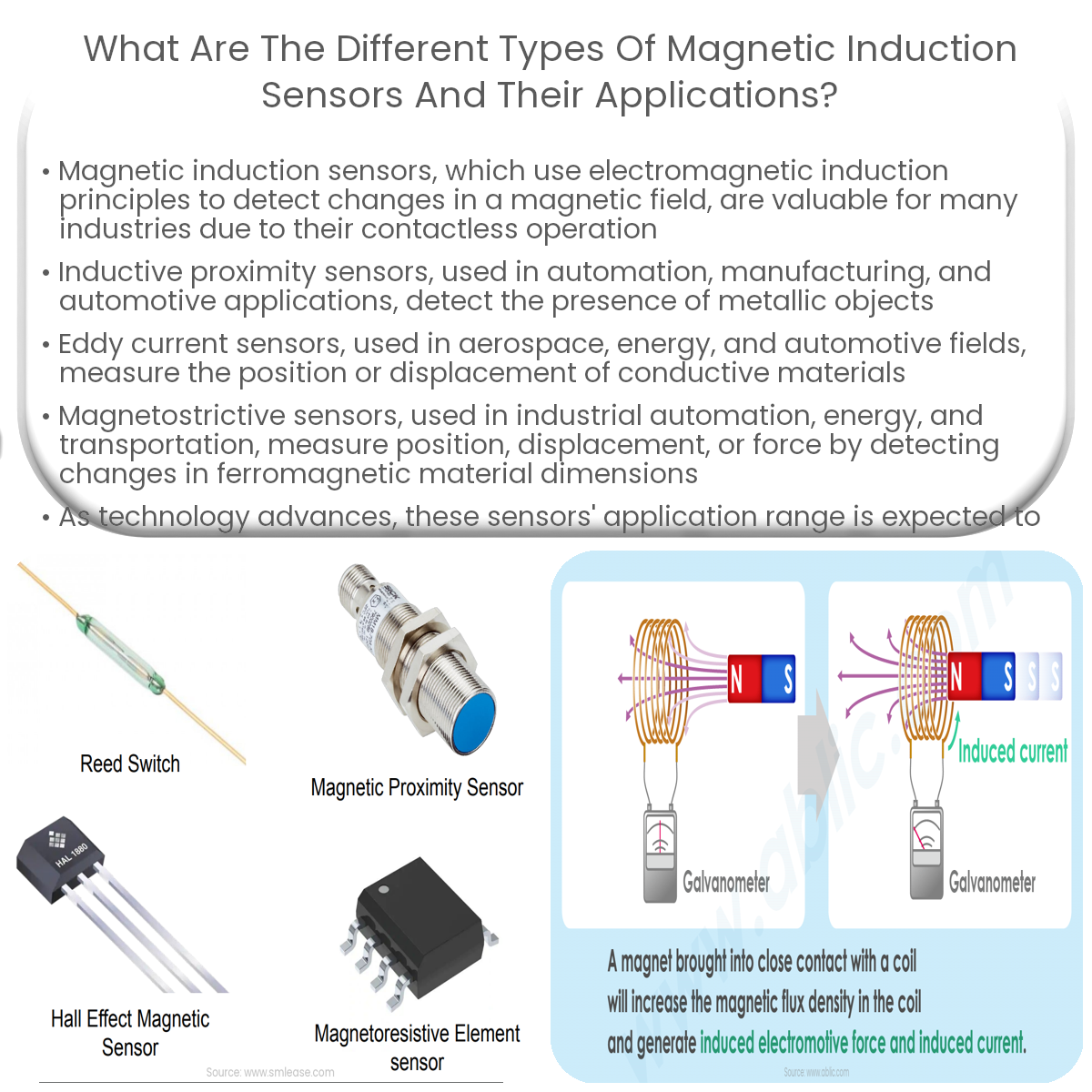
Magnetic induction sensors include inductive proximity sensors, eddy current sensors, and magnetostrictive sensors, used in various industries.
Exploring Magnetic Induction Sensors and Their Applications
Magnetic induction sensors are devices that leverage the principles of electromagnetic induction to detect changes in a magnetic field, object presence, or proximity. These sensors offer contactless operation, making them suitable for various applications across multiple industries. This article will delve into different types of magnetic induction sensors and their applications, including inductive proximity sensors, eddy current sensors, and magnetostrictive sensors.
1. Inductive Proximity Sensors
Inductive proximity sensors detect the presence or absence of metallic objects without physical contact. They operate by generating an electromagnetic field around a coil and monitoring changes in the coil’s impedance due to the presence of a metallic object. Inductive proximity sensors are widely used in the following applications:
- Automation and robotics: Object detection, sorting, and positioning.
- Manufacturing: Assembly line monitoring and quality control.
- Automotive: Gear position sensing and metal component inspection.
2. Eddy Current Sensors
Eddy current sensors measure the distance, position, or displacement of conductive materials by inducing eddy currents in the target object. The induced eddy currents generate a secondary magnetic field that opposes the primary field created by the sensor, causing changes in the sensor coil’s impedance. Eddy current sensors are utilized in applications such as:
- Aerospace: Crack detection, material thickness measurement, and coating inspection.
- Energy: Turbine blade vibration monitoring and bearing wear detection.
- Automotive: Brake and suspension component inspection.
3. Magnetostrictive Sensors
Magnetostrictive sensors measure the position, displacement, or force of a target object by detecting the magnetostrictive effect in a ferromagnetic material. When a magnetic field interacts with the material, it causes a change in the material’s dimensions. Magnetostrictive sensors have applications in areas such as:
- Industrial Automation: Precise position and displacement control in machinery.
- Energy: Level sensing in fuel storage tanks and hydraulic systems.
- Transportation: Rail track monitoring and stress detection in bridges.
In conclusion, magnetic induction sensors offer diverse sensing capabilities, enabling contactless and robust operation in various environments. As technology continues to evolve, the range of applications for these sensors is expected to expand, contributing to the advancement of numerous industries.