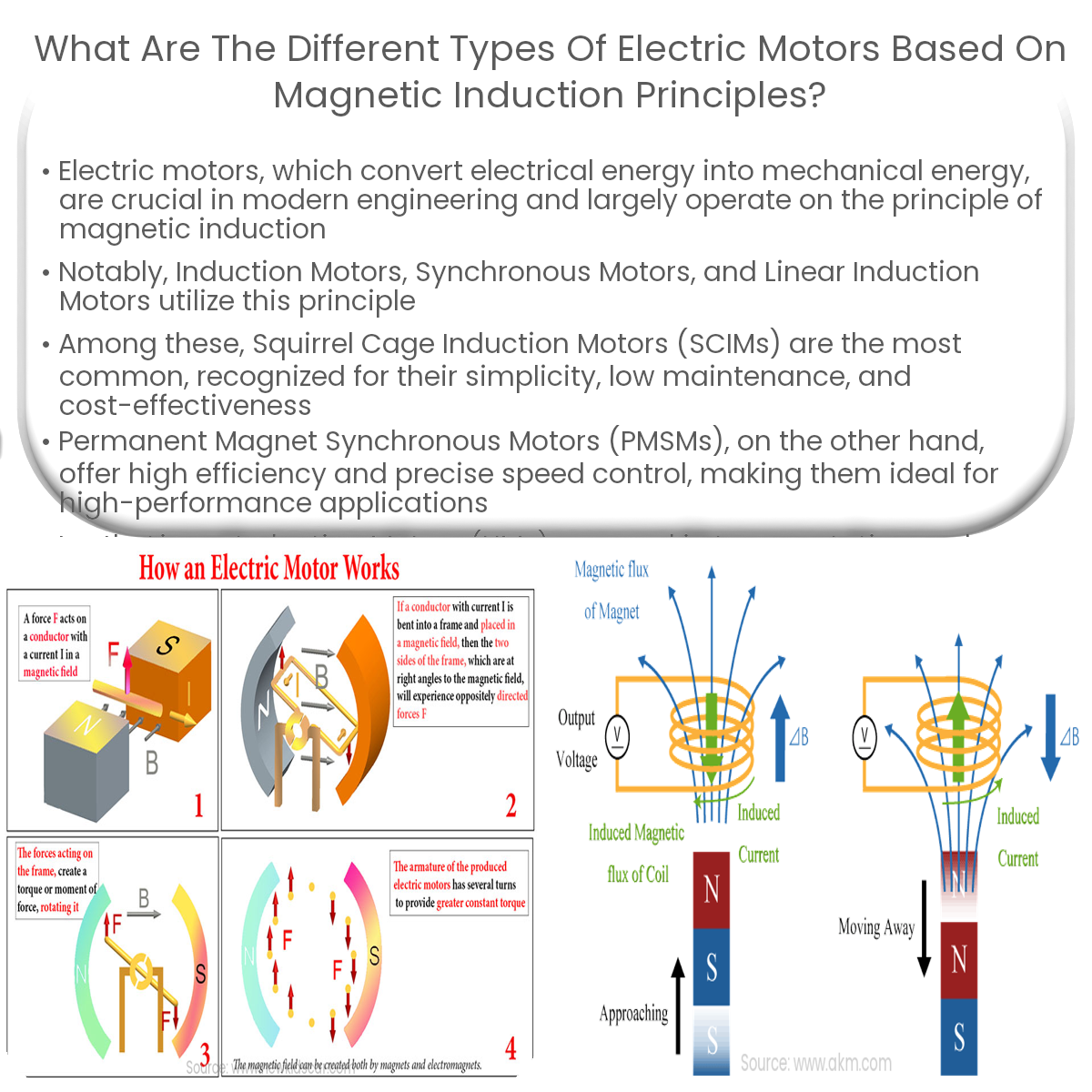
Induction Motors, Synchronous Motors, and Linear Induction Motors are the three types of electric motors based on magnetic induction principles.
Understanding Electric Motors Based on Magnetic Induction Principles
Electric motors have evolved into a cornerstone of modern engineering, transforming electrical energy into mechanical energy. One of the key principles behind electric motors is magnetic induction. In this article, we will explore the various types of electric motors that utilize magnetic induction principles, namely: Induction Motors, Synchronous Motors, and Linear Induction Motors.
1. Induction Motors
- Squirrel Cage Induction Motor (SCIM)
SCIMs are the most commonly used induction motors. They are known for their simple and robust design, low maintenance, and cost-effectiveness. The rotor in these motors consists of short-circuited laminated bars resembling a squirrel cage, hence the name. These motors are self-starting and rely on the slip between the rotor and stator magnetic fields to generate torque.
- Wound Rotor Induction Motor (WRIM)
WRIMs, also known as slip-ring motors, have a wound rotor with external connections through slip rings and brushes. These motors allow for better control of torque and speed, making them suitable for applications that require high starting torque and smooth acceleration. However, they are more complex and require higher maintenance compared to SCIMs.
2. Synchronous Motors
- Permanent Magnet Synchronous Motor (PMSM)
PMSMs utilize permanent magnets on the rotor, resulting in a constant magnetic field. These motors offer high efficiency, precise speed control, and high torque density. PMSMs are widely used in applications that demand high-performance and energy efficiency, such as electric vehicles and robotics.
- Wound Field Synchronous Motor (WFSM)
WFSMs have a wound rotor with field windings connected to a DC source through slip rings. These motors offer excellent speed control, high efficiency, and large power output. They are typically used in high-power applications like power generation and heavy industries.
3. Linear Induction Motors
Linear Induction Motors (LIMs) are a variation of induction motors where the stator and rotor are “unrolled” to create a linear motion instead of rotational motion. LIMs are utilized in transportation systems, material handling, and industrial automation due to their direct linear motion, reduced mechanical complexity, and low maintenance requirements.
In conclusion, the magnetic induction principle has paved the way for various types of electric motors. Each type has its unique characteristics, advantages, and applications, making them indispensable in today’s technology-driven world.