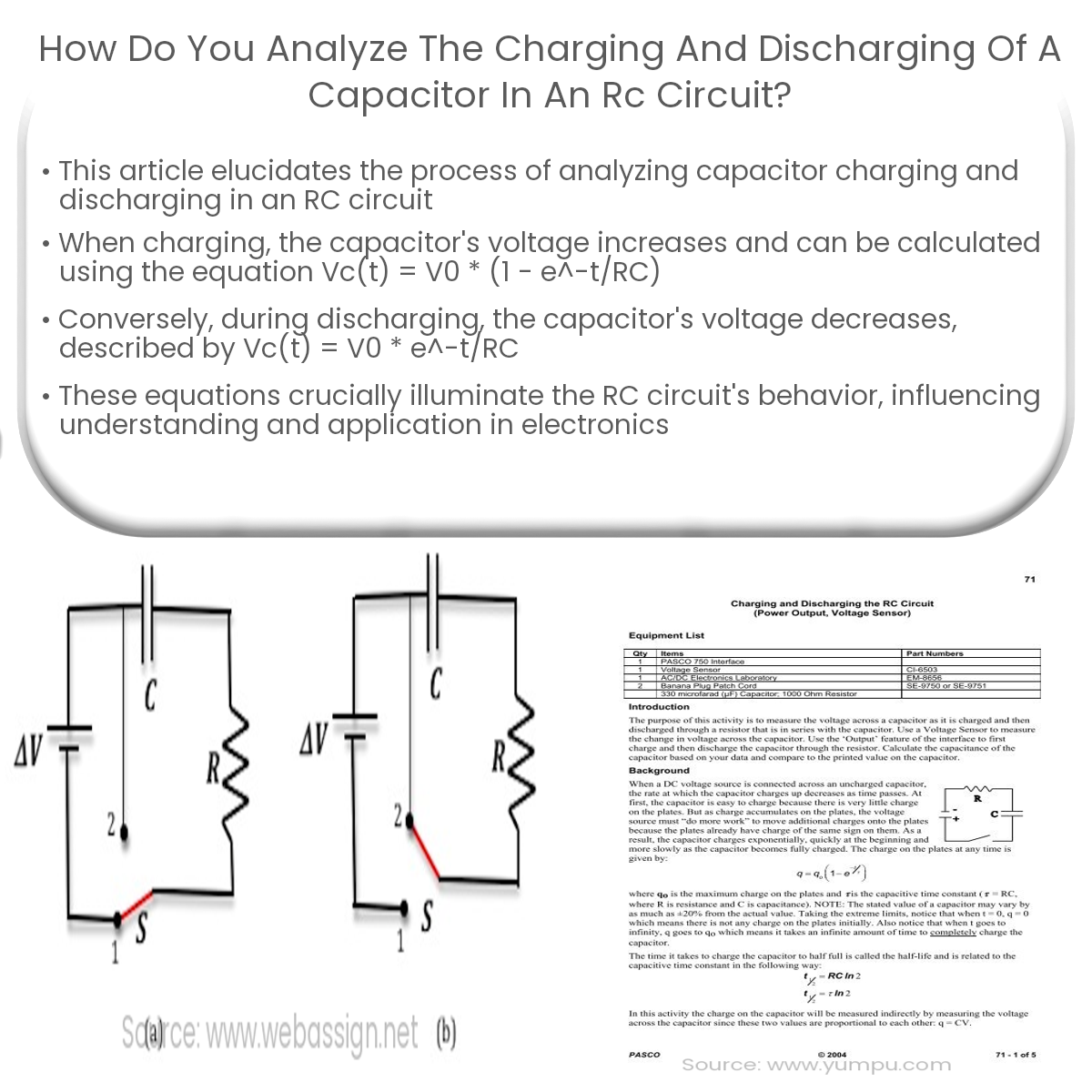
To analyze capacitor charging and discharging in an RC circuit, use exponential equations for voltage as a function of time, considering resistance and capacitance values.
Introduction
Analyzing the charging and discharging of a capacitor in an RC circuit is essential for understanding the circuit’s behavior and applications. This article will guide you through the process of analyzing capacitor charging and discharging in an RC circuit.
Charging a Capacitor in an RC Circuit
When a voltage source is connected to an RC circuit, the capacitor begins to charge. During the charging process, the voltage across the capacitor (VC) increases, while the voltage across the resistor (VR) decreases. The charging process can be analyzed using the following equation:
VC(t) = V0 * (1 – e-t/RC)
Where:
- VC(t) is the voltage across the capacitor at time t
- V0 is the initial voltage across the capacitor
- t is the time elapsed since the circuit was connected to the voltage source
- R and C are the resistance and capacitance values, respectively
This equation shows that the voltage across the capacitor increases exponentially with time, approaching the voltage source value asymptotically.
Discharging a Capacitor in an RC Circuit
When the voltage source is disconnected from the RC circuit, the capacitor begins to discharge through the resistor. The voltage across the capacitor (VC) decreases, while the voltage across the resistor (VR) decreases as well. The discharging process can be analyzed using the following equation:
VC(t) = V0 * e-t/RC
Where:
- VC(t) is the voltage across the capacitor at time t
- V0 is the initial voltage across the capacitor
- t is the time elapsed since the circuit was disconnected from the voltage source
- R and C are the resistance and capacitance values, respectively
This equation shows that the voltage across the capacitor decreases exponentially with time, approaching zero asymptotically.
Conclusion
To analyze the charging and discharging of a capacitor in an RC circuit, use the exponential equations for capacitor voltage as a function of time. These equations describe how the voltage across the capacitor changes as the capacitor charges or discharges, providing insight into the circuit’s behavior and performance in various electronic applications.