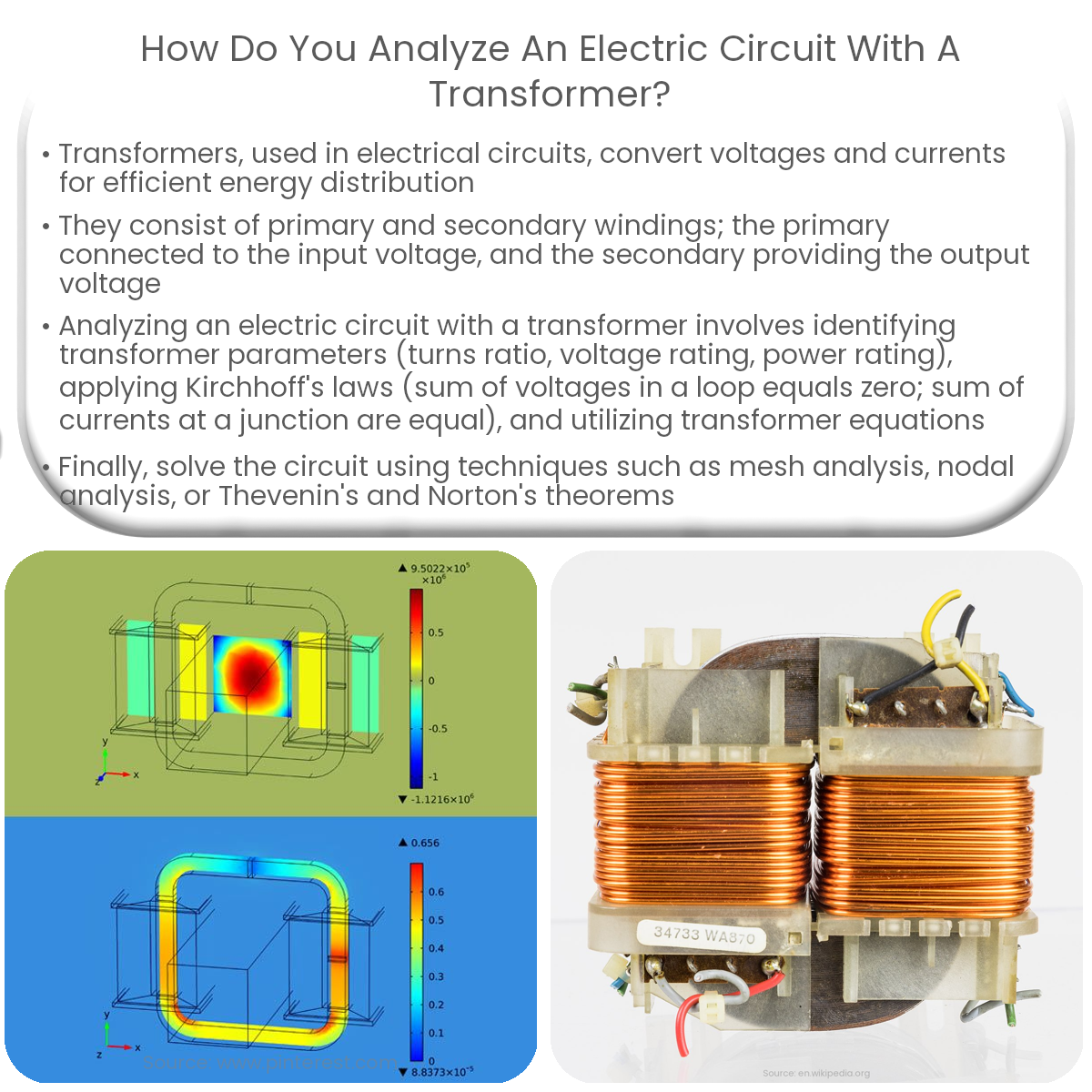
To analyze a circuit with a transformer, identify its parameters, apply Kirchhoff’s laws, use transformer equations, and solve the circuit.
Analyzing an Electric Circuit with a Transformer
Transformers are widely used in electrical circuits for their ability to convert voltages and currents, facilitating the efficient transmission and distribution of electrical energy. In this article, we will discuss the process of analyzing an electric circuit that includes a transformer.
Understanding Transformers
Before diving into circuit analysis, it’s essential to understand the basic principles of a transformer. A transformer consists of two or more coils of wire, known as the primary and secondary windings, wound around a common core. The primary winding is connected to the input voltage, while the secondary winding provides the output voltage. Transformers operate on the principle of electromagnetic induction, where a varying magnetic field in the primary coil induces a voltage in the secondary coil.
Step 1: Identify the Transformer Parameters
- Turns ratio (N1:N2): This is the ratio of the number of turns in the primary winding to the number of turns in the secondary winding. It determines the voltage transformation ratio.
- Voltage rating: The input and output voltage ratings of the transformer provide information about the primary and secondary voltages.
- Power rating: The transformer’s power rating indicates its maximum capacity to transfer power from the primary to the secondary winding.
Step 2: Apply Kirchhoff’s Laws
Kirchhoff’s Voltage Law (KVL) and Kirchhoff’s Current Law (KCL) are essential tools in circuit analysis. KVL states that the sum of voltages around any closed loop in a circuit must equal zero, while KCL states that the sum of currents entering a junction must equal the sum of currents leaving the junction. Apply these laws to the circuit, keeping in mind the transformer’s effect on voltages and currents.
Step 3: Use Transformer Equations
For an ideal transformer, the voltage and current ratios are related by the turns ratio:
- V1/V2 = N1/N2
- I1/I2 = N2/N1
Additionally, the power input to the primary winding should equal the power output of the secondary winding:
- P1 = P2 or V1I1 = V2I2
Step 4: Solve the Circuit
With the transformer parameters, Kirchhoff’s laws, and transformer equations, solve for the unknown voltages, currents, and power values in the circuit. Use techniques such as mesh analysis, nodal analysis, or Thevenin’s and Norton’s theorems, depending on the complexity of the circuit.
In conclusion, analyzing an electric circuit with a transformer involves understanding the transformer’s principles, applying Kirchhoff’s laws, using transformer equations, and employing appropriate circuit analysis techniques. By following these steps, you can effectively analyze and solve circuits that include transformers.