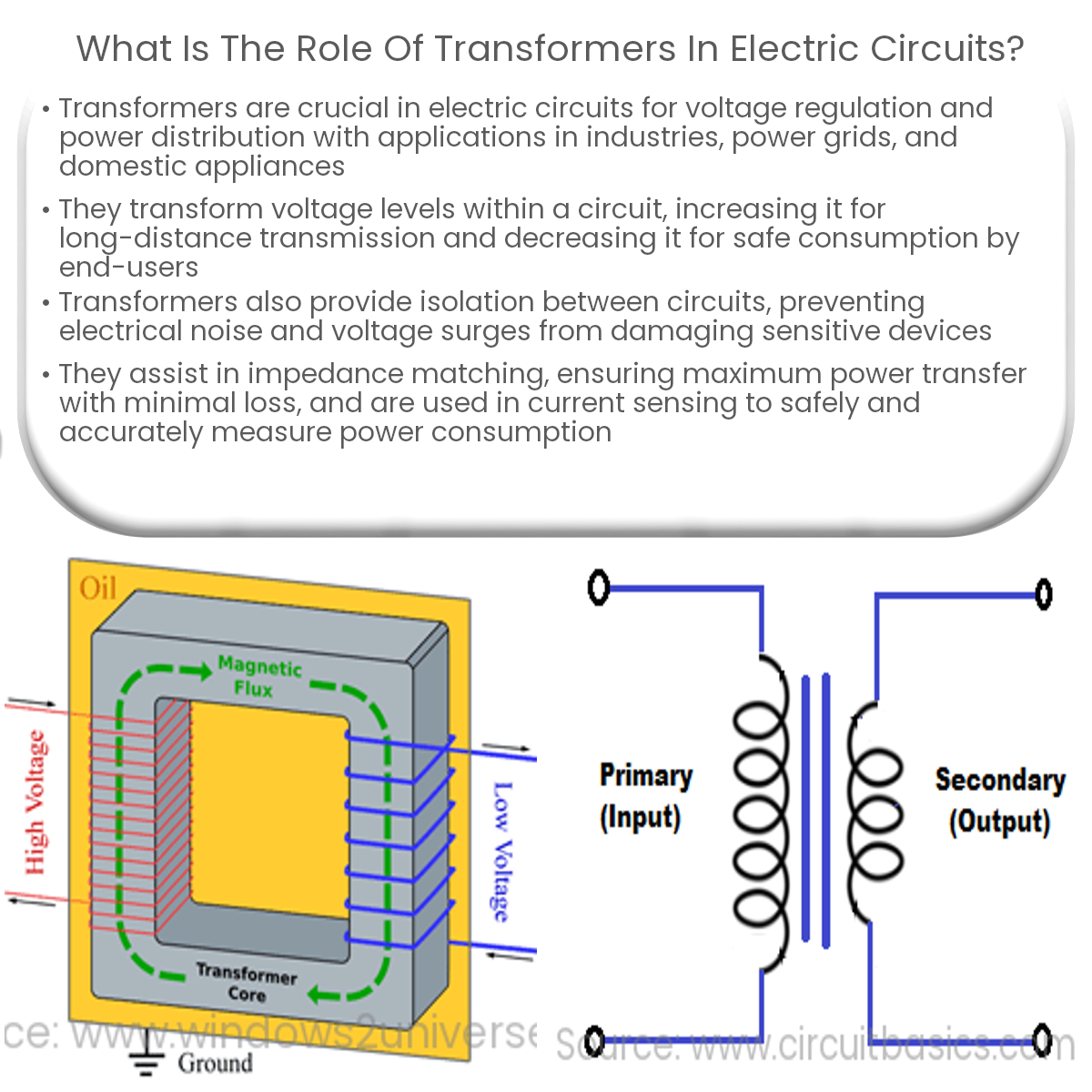
Transformers are essential components in electric circuits, serving as vital devices for voltage regulation and power distribution. They have a wide range of applications in industries, power grids, and domestic appliances. In this article, we will explore the key roles transformers play in electric circuits.
The Role of Transformers in Electric Circuits
Transformers are essential components in electric circuits, serving as vital devices for voltage regulation and power distribution. They have a wide range of applications in industries, power grids, and domestic appliances. In this article, we will explore the key roles transformers play in electric circuits.
1. Voltage Transformation
One of the primary functions of transformers is to step up or step down voltage levels within an electric circuit. This is achieved by adjusting the ratio between the primary and secondary windings, which are coils of wire wrapped around the transformer’s core. When the voltage is increased (stepped up), the current is reduced, and vice versa. This process is crucial for efficient power transmission and distribution.
- Step-up Transformers: These transformers increase the voltage level, making it suitable for long-distance transmission. They are typically found at power plants, where generated electricity must be sent to remote locations.
- Step-down Transformers: These transformers decrease the voltage level, making it safe for end-users, such as homes and businesses. They are commonly found near the end of transmission lines and at local substations.
2. Isolation
Transformers can also provide isolation between two circuits, meaning they are electrically separated while still allowing for power transfer. This is achieved by using two separate sets of windings on the transformer’s core, which are not directly connected. Isolation transformers help to prevent electrical noise and voltage surges from propagating through the circuit, protecting sensitive devices from potential damage.
3. Impedance Matching
Another crucial role of transformers in electric circuits is impedance matching. Impedance is a measure of the opposition a circuit offers to an alternating current (AC). Transformers help to adjust the impedance between two circuits, ensuring that maximum power is transferred with minimal loss. This function is particularly important in audio and radio-frequency applications.
4. Current Sensing
Current transformers are used to measure the current in a circuit without directly connecting a metering device to it. They produce a reduced current proportional to the actual current in the circuit, which can then be measured safely and accurately. This is useful for monitoring power consumption and detecting potential issues in electrical systems.
Conclusion
In summary, transformers play a critical role in electric circuits, facilitating voltage transformation, isolation, impedance matching, and current sensing. Their versatile nature makes them indispensable in modern electrical systems, ensuring efficient and reliable power transmission and distribution.