
Explore the world of high-temperature supercapacitors, their operating principles, components, applications, and future prospects.
Understanding High-Temperature Supercapacitors
Supercapacitors, also known as ultracapacitors or electrochemical capacitors, have been recognized for their remarkable characteristics such as high power density, long cycle life, and rapid charge and discharge capabilities. Yet, the role of high-temperature supercapacitors is especially crucial in sectors where regular supercapacitors fail to deliver the required performance.
Operating Principle of Supercapacitors
To understand high-temperature supercapacitors, it’s essential to first comprehend the basic functioning of a standard supercapacitor. Unlike batteries, supercapacitors store energy through the physical separation of electrical charges, which enables rapid energy storage and release. The energy storage capability of a supercapacitor is primarily determined by two factors:
- Electrode Surface Area: The larger the surface area, the more charge a supercapacitor can store.
- Separation Distance of Charges: The closer the charges, the higher the energy storage.
High-Temperature Supercapacitors: What Makes Them Different?
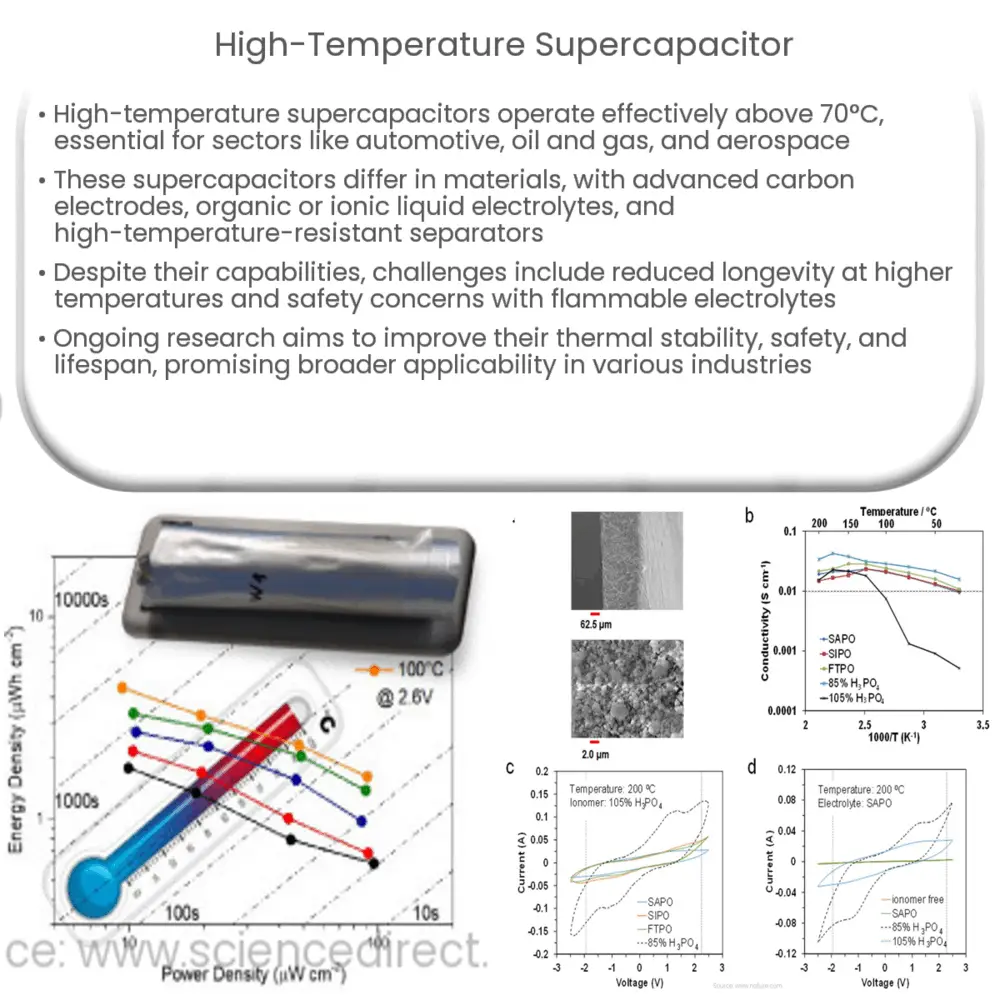
The term “high-temperature” relates to supercapacitors that can operate effectively at elevated temperatures, often exceeding 70°C. This ability is crucial for applications in harsh or extreme temperature environments. The main difference between standard and high-temperature supercapacitors lies in the materials used for their construction, including the electrode, electrolyte, and separator materials.
Key Components of High-Temperature Supercapacitors
While the basic structure of a supercapacitor remains the same, certain components need to be adapted for high-temperature conditions.
- Electrode Material: The electrodes in high-temperature supercapacitors are typically made from advanced carbon materials, such as activated carbon, carbon nanotubes, or graphene, which exhibit high thermal stability and electrical conductivity.
- Electrolyte: High-temperature supercapacitors often employ organic or ionic liquid electrolytes, which have higher boiling points and thermal stability compared to aqueous electrolytes used in standard supercapacitors.
- Separator: The separators in high-temperature supercapacitors must be able to withstand elevated temperatures while maintaining their insulating properties. Materials such as ceramic or certain types of high-temperature resistant polymers are used for this purpose.
Applications of High-Temperature Supercapacitors
High-temperature supercapacitors are increasingly being employed in a variety of applications due to their exceptional operational characteristics under elevated temperature conditions. Some of these applications include:
- Automotive: High-temperature supercapacitors play a vital role in electric vehicles and hybrid electric vehicles, which often operate under high-temperature conditions. They provide instant power for acceleration and store energy from regenerative braking.
- Oil and Gas Industry: These industries often involve operations in extreme temperature conditions where high-temperature supercapacitors can effectively function, enabling energy storage and power delivery.
- Aerospace: The aerospace industry requires reliable energy storage devices capable of withstanding harsh conditions, such as high temperatures and radiation, where high-temperature supercapacitors can be used.
Challenges and Future Perspectives
Despite the impressive capabilities of high-temperature supercapacitors, there are several challenges that need to be addressed to optimize their performance. A major issue is the longevity of these devices at elevated temperatures, as the lifetime tends to decrease due to accelerated aging processes. Furthermore, the safety of high-temperature supercapacitors is a concern, especially when dealing with organic electrolytes that may be flammable.
However, ongoing research and development promise to overcome these challenges. Scientists are exploring new materials and innovative design strategies to enhance the thermal stability, safety, and life span of high-temperature supercapacitors. With the continuous advancement in technology, it is anticipated that the performance of high-temperature supercapacitors will improve significantly, expanding their applicability in various sectors.
Conclusion
High-temperature supercapacitors are a remarkable piece of technology that offers a solution to energy storage and rapid power delivery under extreme temperature conditions. By understanding the working principle of supercapacitors and the modifications required for high-temperature operations, we can appreciate the potential of these devices. While there are still challenges to overcome, the future of high-temperature supercapacitors appears promising. Their unique characteristics and evolving technology not only make them suitable for current applications in various industries but also open the door to many more potential applications in the future.