
Eddy current gear is an innovative tech utilizing electromagnetism for torque transmission and speed control, benefiting various industries.
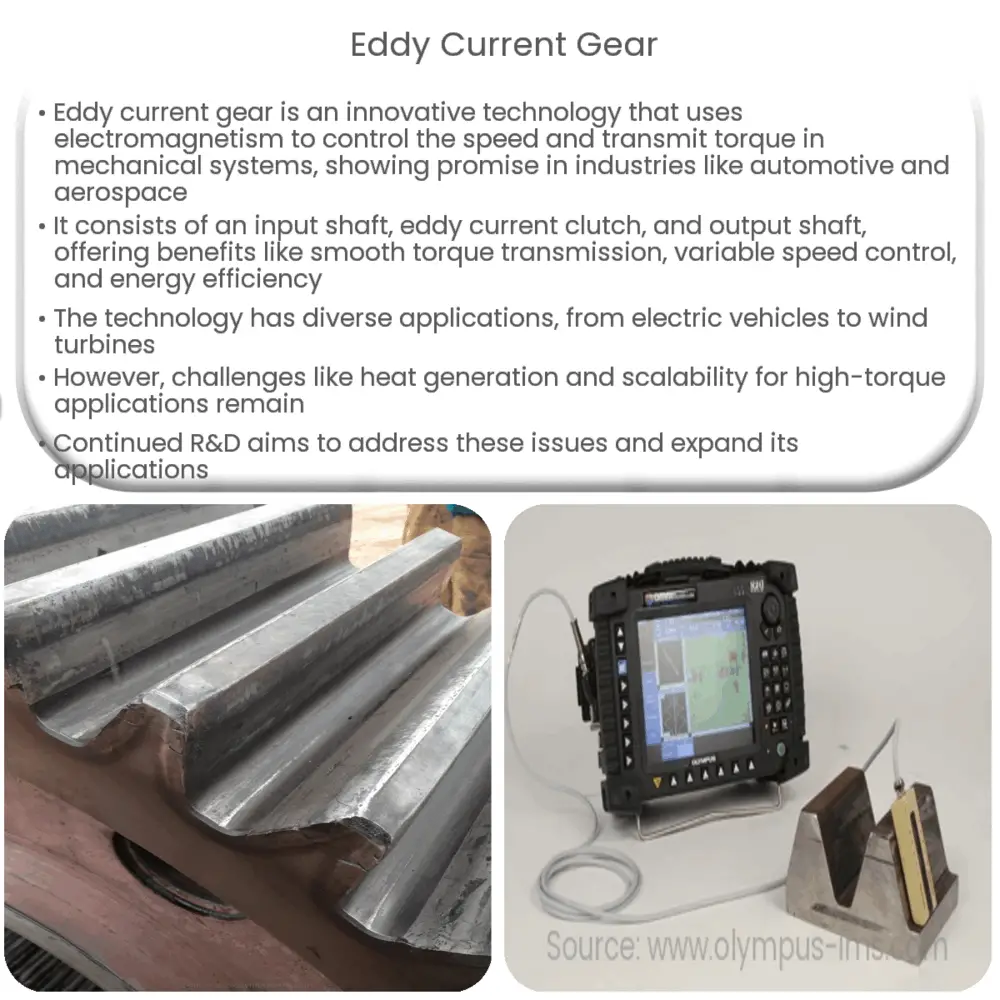
Eddy Current Gear: An Overview
Introduction
Eddy current gear is a highly efficient and innovative technology that has emerged as a game-changer in various industries, including the automotive, aerospace, and manufacturing sectors. This technology utilizes the principles of electromagnetism and eddy currents to transmit torque and control the speed of mechanical systems. In this article, we’ll explore the basics of eddy current gear, its components, and the advantages it offers over conventional gearing systems.
Understanding Eddy Currents
Eddy currents are circular electric currents that are induced within conductive materials when they are exposed to a changing magnetic field. This phenomenon was first discovered by French physicist Jean-Bernard Léon Foucault in 1851 and is sometimes referred to as the “Foucault current. Eddy currents create their magnetic field, which opposes the primary magnetic field that generated them. This interaction results in the generation of resistive losses in the form of heat, which is the primary reason for energy loss in many electromagnetic devices.
Components of Eddy Current Gear
Eddy current gear typically comprises three primary components:
- Input Shaft: The input shaft is connected to the power source, such as an electric motor or an internal combustion engine, and transmits the torque to the eddy current gear.
- Eddy Current Clutch: This component acts as an electromagnetic coupling device between the input shaft and the output shaft. It consists of two primary parts: the rotor, which is connected to the input shaft, and the stator, which is connected to the output shaft. When the input shaft rotates, it creates a magnetic field that induces eddy currents in the stator, resulting in torque transfer to the output shaft.
- Output Shaft: The output shaft is connected to the load, such as the wheels of a vehicle or the gears of a machine. The torque transmitted from the input shaft through the eddy current clutch is used to drive the output shaft and the connected load.
Advantages of Eddy Current Gear
Eddy current gear offers several significant benefits over traditional mechanical gearing systems, including:
- Smooth Torque Transmission: Eddy current gear enables smooth and controlled torque transmission without any physical contact between the input and output shafts. This reduces wear and tear on the components, resulting in longer service life and reduced maintenance costs.
- Variable Speed Control: The eddy current clutch allows for precise control of the output shaft’s speed, which can be adjusted by varying the magnetic field generated by the input shaft. This feature makes eddy current gear highly adaptable to different applications and operating conditions.
- Energy Efficiency: Due to the non-contact nature of the torque transmission, eddy current gear has lower energy losses compared to conventional mechanical systems. This results in improved overall efficiency and reduced energy consumption.
Applications of Eddy Current Gear
Eddy current gear technology has been successfully implemented in a wide range of applications, such as:
- Automotive Industry: Eddy current gear can be used in electric and hybrid vehicles to provide smooth and efficient torque transfer between the electric motor and the drivetrain. This technology offers better performance, higher energy efficiency, and reduced wear and tear compared to traditional transmission systems.
- Aerospace Industry: In aerospace applications, eddy current gear can be employed in actuators and other systems that require precise speed control and smooth torque transmission. The non-contact nature of this technology makes it suitable for high-reliability applications, where minimal maintenance and long service life are critical.
- Industrial Automation: Eddy current gear can be utilized in various manufacturing processes, such as assembly lines and conveyor systems, where variable speed control and smooth torque transmission are essential. The technology’s energy efficiency and low maintenance requirements make it an attractive option for cost-conscious industrial applications.
- Renewable Energy: In wind turbines and other renewable energy systems, eddy current gear can be employed to manage variable loads and optimize power generation efficiently. The technology’s adaptability to changing operating conditions makes it well-suited for these applications.
Challenges and Future Developments
While eddy current gear offers numerous advantages, there are certain challenges and limitations that need to be addressed. One of the primary concerns is the heat generated due to eddy currents, which can cause temperature-related issues in the components and reduce overall efficiency. Developing advanced cooling systems and materials with better thermal properties can help mitigate these challenges.
Another area of improvement is the scalability of eddy current gear technology for high-torque applications. Current designs may not be suitable for extremely high-torque loads, limiting their applicability in specific industries. Continued research and development in this area can potentially lead to more robust and efficient designs for high-torque applications.
Conclusion
Eddy current gear is an innovative and promising technology that has the potential to revolutionize various industries by offering a more efficient, adaptable, and low-maintenance alternative to conventional gearing systems. While there are certain challenges to overcome, ongoing research and development efforts are expected to pave the way for more advanced and versatile eddy current gear systems in the future. As the technology matures, it is likely to find its way into an even broader range of applications, providing significant benefits in terms of energy efficiency, performance, and sustainability.



