
What is Kirchhoff’s Voltage Law (KVL)?
Kirchhoff’s Voltage Law (KVL) states that the sum of voltages around any closed loop in a circuit is always equal to zero.
Kirchhoff’s Voltage Law (KVL) states that the sum of voltages around any closed loop in a circuit is always equal to zero.
The relationship between voltage, current, and power is given by P = V × I, where P is power, V is voltage, and I is current in the circuit.

To use an LDR in a circuit, create a voltage divider with a fixed resistor, measure output voltage, and process the signal to determine light intensity.
A Light Dependent Resistor (LDR) is a resistor that changes its resistance with light intensity, commonly used in ambient light sensing and control.

To use a thermistor in a circuit, create a voltage divider or constant current source, measure output voltage, and process the signal for temperature.

A thermistor is a temperature-sensitive resistor whose resistance changes with temperature, used for sensing, control, and over-temperature protection.

Fixed resistors have a constant resistance value, while variable resistors allow for adjustable resistance, suiting different applications.

Calculate power dissipation in a resistor using P=IV, P=V²/R, or P=I²R, depending on available information, and choose a resistor with a suitable power rating.
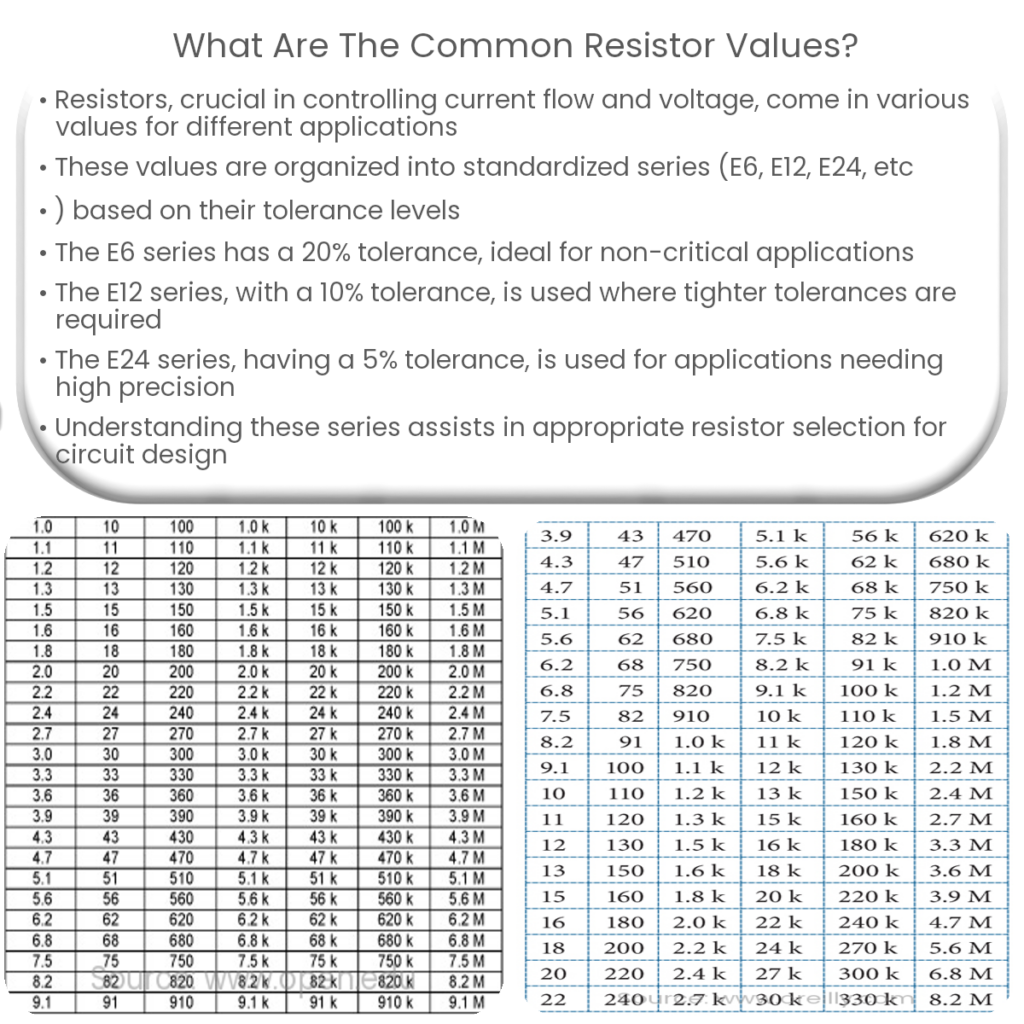
Common resistor values are organized into series (E6, E12, E24) based on tolerance. They provide a balance between value selection and cost.

To use pull-up and pull-down resistors, connect input pins to voltage source or ground through resistors, ensuring stable voltage levels in circuits.

The primary purpose of this project is to help the public to learn some exciting and important information about electricity and magnetism.
Our Website follows all legal requirements to protect your privacy. Visit our Privacy Policy page.
The Cookies Statement is part of our Privacy Policy.
The information contained on this website is for general information purposes only. This website does not use any proprietary data. Visit our Editorial note.
It’s simple:
1) You may use almost everything for non-commercial and educational use.
2) You may not distribute or commercially exploit the content, especially on another website.


