
What are the factors affecting conductivity?
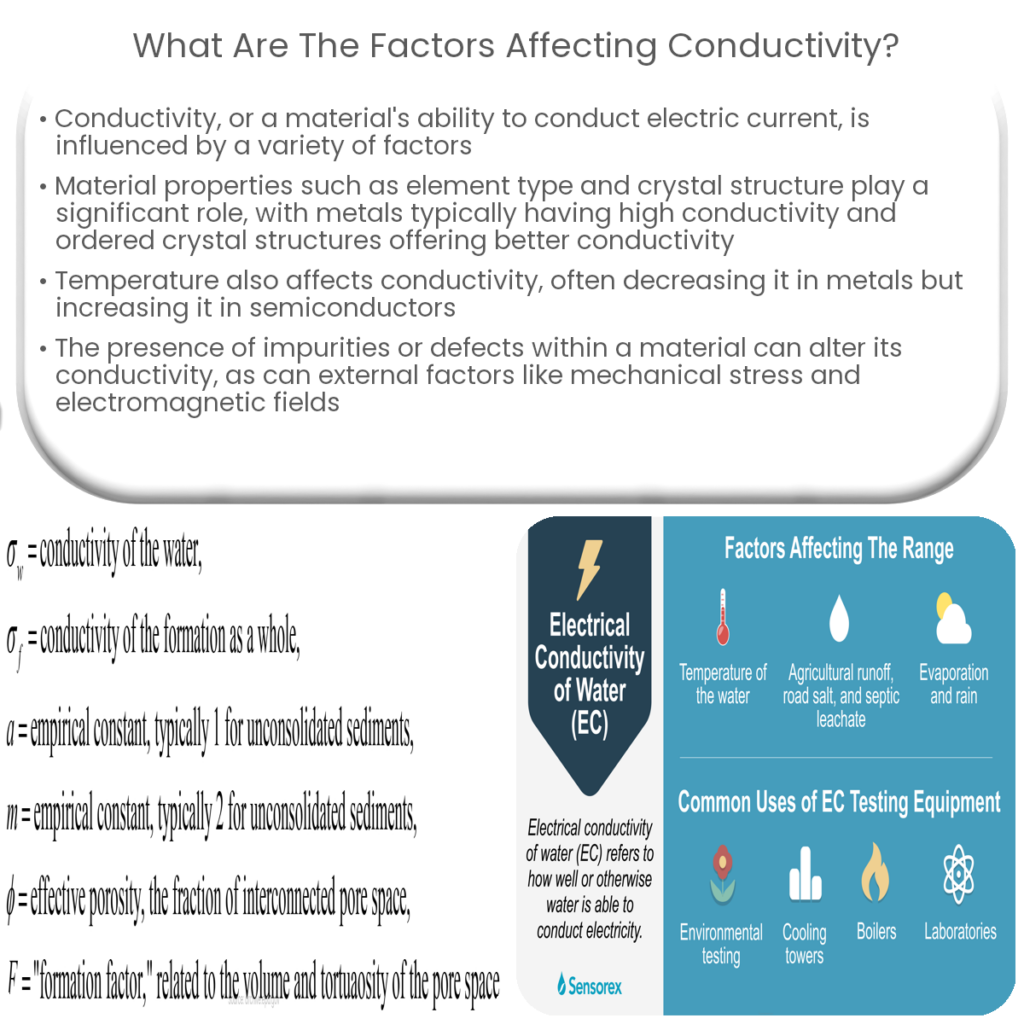
Factors affecting conductivity include material properties, temperature, impurities, defects, mechanical stress, and external electromagnetic fields.
Factors affecting conductivity include material properties, temperature, impurities, defects, mechanical stress, and external electromagnetic fields.

The cross-sectional area of a conductor affects its resistance inversely; as the area increases, resistance decreases, leading to efficient current flow.

The resistance of a conductor is directly proportional to its length; as the length increases, so does the resistance, leading to higher energy losses.

The resistivity equation is ρ = R * (A / L), where ρ is resistivity, R is resistance, A is cross-sectional area, and L is the sample’s length.

Resistivity and conductivity are inversely related; as resistivity increases, conductivity decreases, influencing material performance in electrical applications.

Resistivity is an intrinsic property of a material, quantifying its ability to resist electric current flow, and is affected by factors like temperature and impurities.

Temperature affects resistance differently in conductors, semiconductors, and insulators, with resistance typically increasing in conductors and decreasing in semiconductors and insulators as temperature rises.

A superconductor is a material with zero electrical resistance at a critical temperature, allowing current to flow without energy loss.

DC flows in one direction with constant voltage, while AC periodically changes direction with varying voltage, and they have distinct applications.
Alternating current (AC) is an electrical current that periodically changes direction, used in power transmission and various appliances.

The primary purpose of this project is to help the public to learn some exciting and important information about electricity and magnetism.
Our Website follows all legal requirements to protect your privacy. Visit our Privacy Policy page.
The Cookies Statement is part of our Privacy Policy.
The information contained on this website is for general information purposes only. This website does not use any proprietary data. Visit our Editorial note.
It’s simple:
1) You may use almost everything for non-commercial and educational use.
2) You may not distribute or commercially exploit the content, especially on another website.


