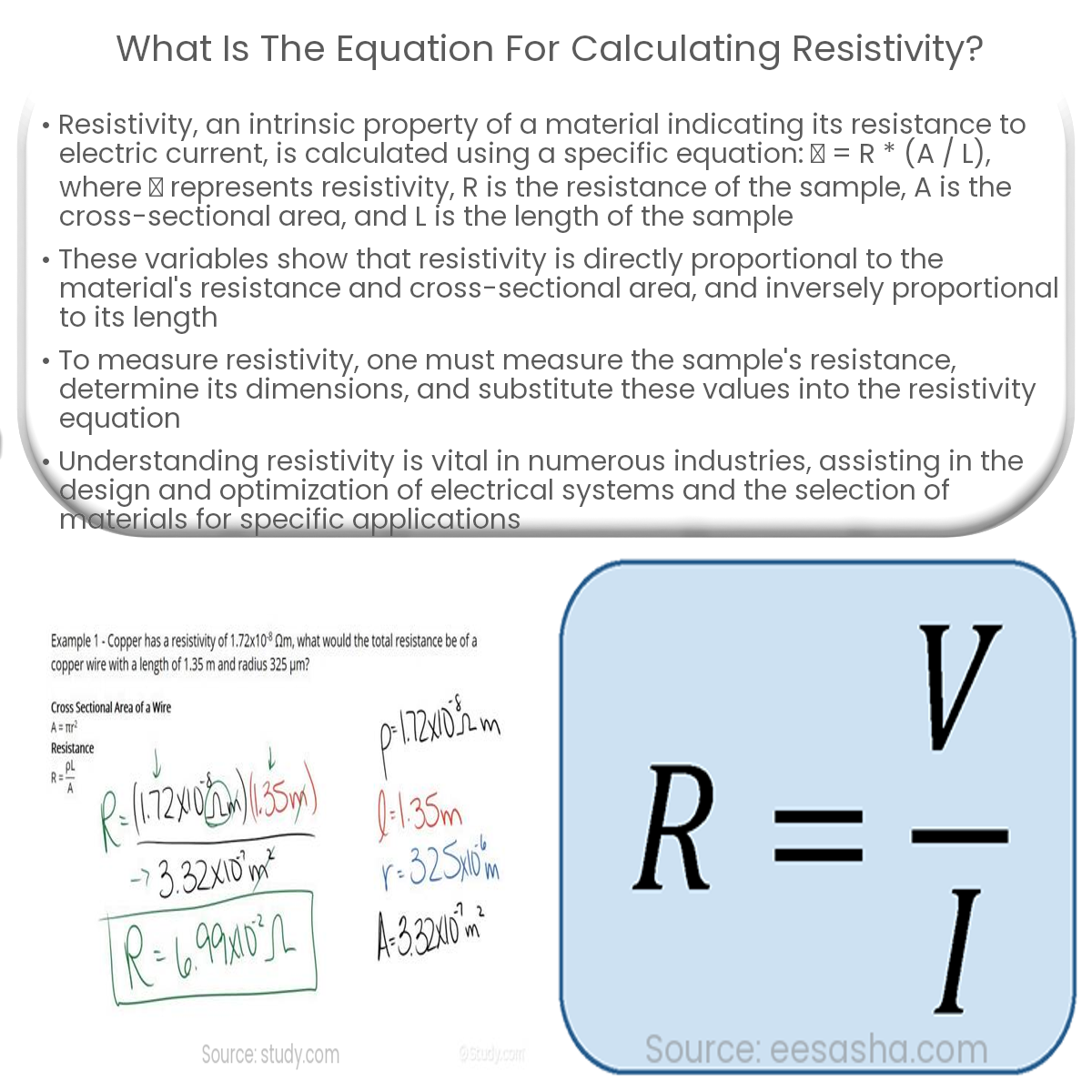
The resistivity equation is ρ = R * (A / L), where ρ is resistivity, R is resistance, A is cross-sectional area, and L is the sample’s length.
What is the Equation for Calculating Resistivity?
Resistivity is an intrinsic property of a material that measures its ability to resist the flow of electric current. It is a fundamental concept in the field of electrical engineering and material science. To calculate resistivity, a specific equation is used, which takes into account the resistance of a sample and its dimensions.
Resistivity Equation
The equation for calculating resistivity (ρ) involves the resistance (R) of a sample, its length (L), and its cross-sectional area (A). The resistivity equation is as follows:
ρ = R * (A / L)
Understanding the Equation
Each component of the resistivity equation has a specific meaning:
- Resistivity (ρ): The resistivity of the material, typically measured in ohm-meters (Ω·m).
- Resistance (R): The resistance of the sample, measured in ohms (Ω).
- Length (L): The length of the sample along which the current flows, measured in meters (m).
- Cross-sectional Area (A): The cross-sectional area of the sample perpendicular to the direction of current flow, measured in square meters (m²).
This equation demonstrates that resistivity is directly proportional to the resistance of the material and the cross-sectional area and inversely proportional to its length. Consequently, if two samples of the same material with different dimensions have the same resistivity, their resistances will vary according to their length and cross-sectional area.
Measuring Resistivity
To measure the resistivity of a material, the following steps are typically followed:
- Measure the resistance of a sample using an ohmmeter or another suitable instrument.
- Determine the dimensions of the sample, including its length and cross-sectional area.
- Substitute the measured resistance and dimensions into the resistivity equation to calculate the resistivity of the material.
Significance and Applications
Understanding the resistivity of materials is crucial for numerous applications and industries. It plays a vital role in the design and optimization of electrical systems, devices, and components. Knowledge of resistivity enables engineers and researchers to select materials with appropriate electrical properties for specific applications, such as power transmission lines, electronic circuits, and insulation materials.
In summary, the equation for calculating resistivity takes into account the resistance, length, and cross-sectional area of a sample. This relationship is fundamental for understanding the electrical properties of materials and their applications in various fields.