
Explore the fundamentals, applications, benefits, and limitations of Venturi flow meters, a critical tool in fluid dynamics across various industries.
Venturi Flow Meters: An Introduction
The Venturi flow meter, named after its inventor Giovanni Battista Venturi, is a highly utilized instrument in a range of industries. This piece of equipment is renowned for its accuracy in measuring the flow rate of fluids, including gases and liquids.
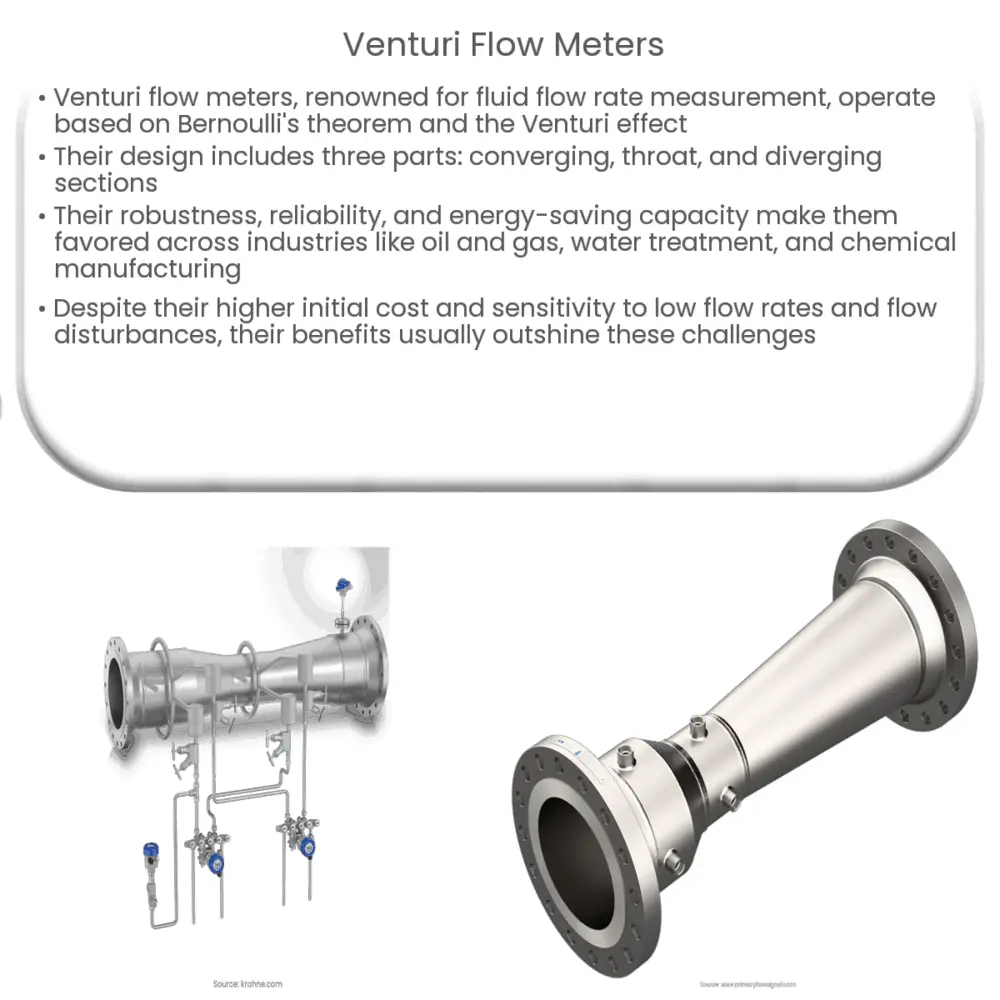
Employing the principle of Bernoulli’s theorem, a Venturi flow meter calculates the flow rate of a fluid by assessing its pressure change when flowing through a pipe. The operation of this device can be divided into three main components: an entrance or converging section, a throat, and a diverging or recovery section.
Operating Principle of Venturi Flow Meters
The functionality of a Venturi flow meter is based on the principles of fluid dynamics. When a fluid flows through a constricted section of a pipe, it experiences an increase in velocity, resulting in a decrease in pressure. This pressure differential, created by the constriction in the pipe (Venturi effect), is what the flow meter measures to determine the fluid’s velocity and consequently its flow rate.
- Converging Section: This section is where the fluid initially enters. It’s designed with a gradual reduction in cross-sectional area which causes the fluid’s velocity to increase and the pressure to decrease.
- Throat: The throat is the narrowest part of the Venturi flow meter where the velocity of the fluid is at its highest and the pressure at its lowest.
- Diverging Section: After the throat, the pipe gradually widens again, slowing down the fluid and allowing the pressure to increase. This is known as the recovery phase.
Advantages of Venturi Flow Meters
Venturi flow meters offer several distinct advantages that make them a popular choice in many industries. Firstly, their simple design and lack of moving parts make them incredibly robust and reliable. They’re able to withstand high pressures and temperatures, making them suitable for a wide range of applications. Secondly, Venturi flow meters have a low-pressure drop, which can result in significant energy savings. Lastly, they are not prone to wear and tear, which results in minimal maintenance requirements.
However, despite their numerous advantages, Venturi flow meters are not without their limitations. These include a lack of accuracy with low flow rates, sensitivity to upstream and downstream flow disturbances, and a higher initial cost compared to other flow meters.
Applications of Venturi Flow Meters
Venturi flow meters find their application across a broad array of industries due to their versatile nature. In the petroleum and gas industries, for instance, they are extensively used for well testing, allocation metering, and custody transfer. Meanwhile, in the water treatment industry, these flow meters are employed in distribution systems and wastewater treatment plants. Other industries such as power generation, chemical manufacturing, and HVAC also heavily utilize Venturi flow meters for their respective applications.
- Petroleum and Gas Industries: The robust design of Venturi flow meters, capable of withstanding high pressures and temperatures, is particularly suitable for the harsh environments in the oil and gas industry.
- Water Treatment: Venturi flow meters’ high accuracy makes them ideal for water distribution and wastewater treatment applications, where precise flow measurement is critical.
- Chemical Manufacturing: The ability of Venturi flow meters to handle corrosive substances efficiently makes them a popular choice in chemical manufacturing processes.
Limitations of Venturi Flow Meters
Despite the numerous advantages, Venturi flow meters are not without their limitations. Their efficiency and accuracy tend to decrease with low flow rates, making them less suitable for applications requiring precision at such rates. Moreover, they are sensitive to changes in the flow profile caused by disturbances in the flow upstream or downstream of the meter. Furthermore, Venturi flow meters are more expensive initially compared to other types of flow meters, which may make them less affordable for some applications.
Conclusion
To sum up, Venturi flow meters are a vital instrument in the field of fluid dynamics. Their robustness, reliability, and accuracy make them a preferred choice across various industries, from oil and gas to water treatment and chemical manufacturing. While they have some limitations, especially in handling low flow rates and being sensitive to flow disturbances, their benefits often outweigh these challenges. With proper selection and installation, a Venturi flow meter can provide a long service life with consistent and reliable measurements, making them a valuable tool in many industrial applications.