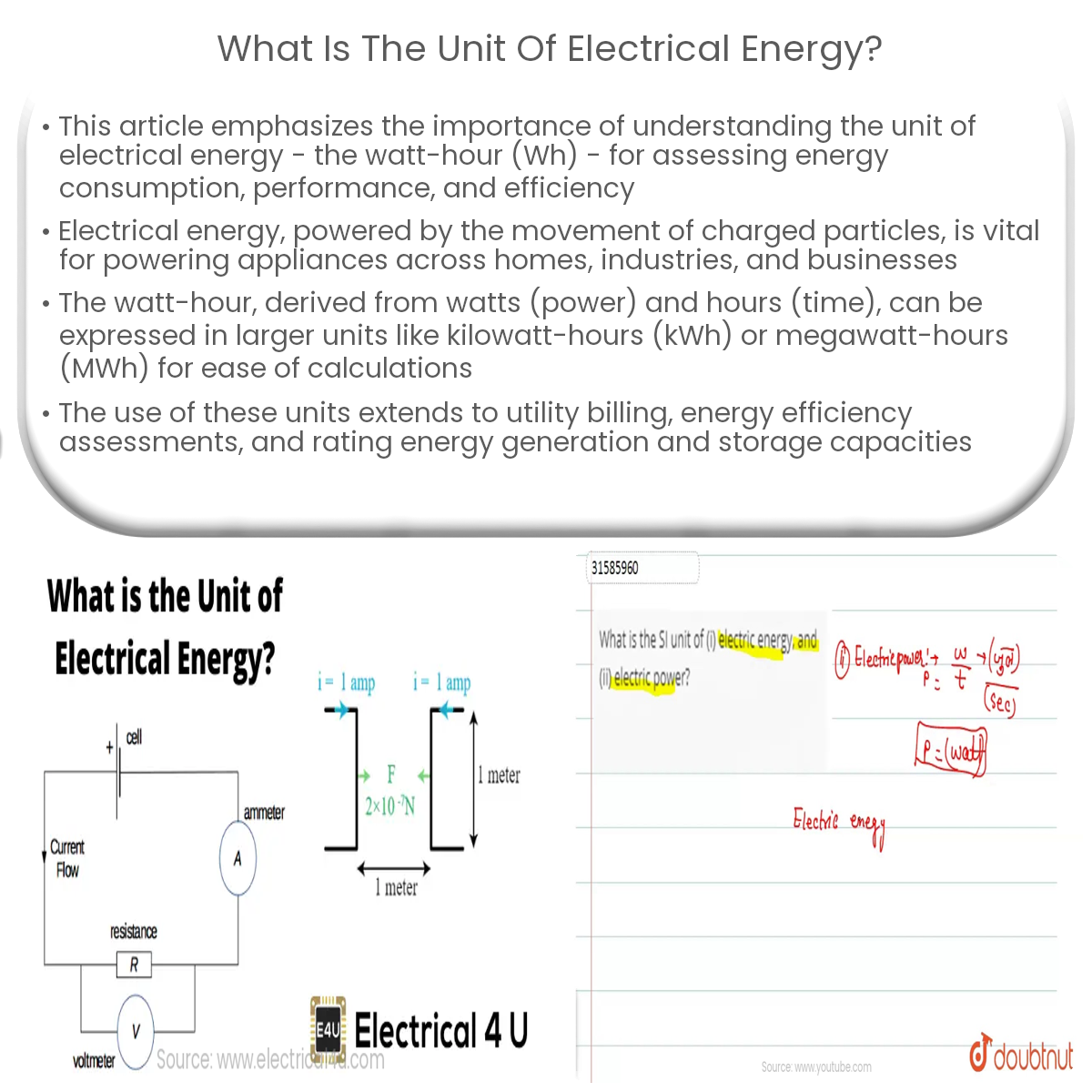
The unit of electrical energy is the joule (J), but for practical purposes, kilowatt-hour (kWh) is more commonly used to measure electricity consumption.
Introduction to the Unit of Electrical Energy
Electrical energy is a crucial aspect of our daily lives, powering homes, offices, and industries. It is essential to understand the unit of electrical energy, which helps us measure and quantify the consumption, generation, and distribution of this vital resource.
Electrical Energy Unit: The Joule
The basic unit of electrical energy is the joule (J), named after the English physicist James Prescott Joule. One joule is defined as the amount of energy transferred when a force of one newton moves an object one meter in the direction of the force. This unit is used to express energy in various forms, including mechanical, electrical, and thermal energy.
Kilowatt-Hours: A More Practical Unit
While the joule is the fundamental unit of energy, it is not the most convenient unit for expressing electrical energy consumption in daily life. A more practical unit is the kilowatt-hour (kWh), which is widely used for billing electricity consumption and tracking energy usage.
One kilowatt-hour is equivalent to 1,000 watts of power being used continuously for one hour. It is equal to 3.6 million joules (3.6 x 10⁶ J). The kilowatt-hour is a more suitable unit for expressing electrical energy consumption because it represents a larger quantity of energy, making it easier to manage and understand.
Other Units of Electrical Energy
Other units of electrical energy are also used in specific contexts. Some examples include:
- Watt-hour (Wh): This is a smaller unit than the kilowatt-hour, representing one watt of power used for one hour. One watt-hour is equivalent to 3,600 joules.
- Megawatt-hour (MWh): This unit is used to express large amounts of electrical energy, often in the context of power plants or large-scale energy consumption. One megawatt-hour is equal to 1,000 kilowatt-hours or 3.6 x 10⁹ joules.
- Gigawatt-hour (GWh): This unit is even larger than the megawatt-hour and is typically used to represent the energy production or consumption of countries or regions. One gigawatt-hour is equivalent to 1,000 megawatt-hours or 3.6 x 10¹² joules.
Conclusion
The unit of electrical energy is the joule, which is a measure of energy in various forms, including electrical energy. However, for practical purposes, electrical energy consumption is often expressed in kilowatt-hours, as it represents a more manageable and easily understood unit. Other units, such as watt-hours, megawatt-hours, and gigawatt-hours, are used depending on the scale and context of the energy being measured.