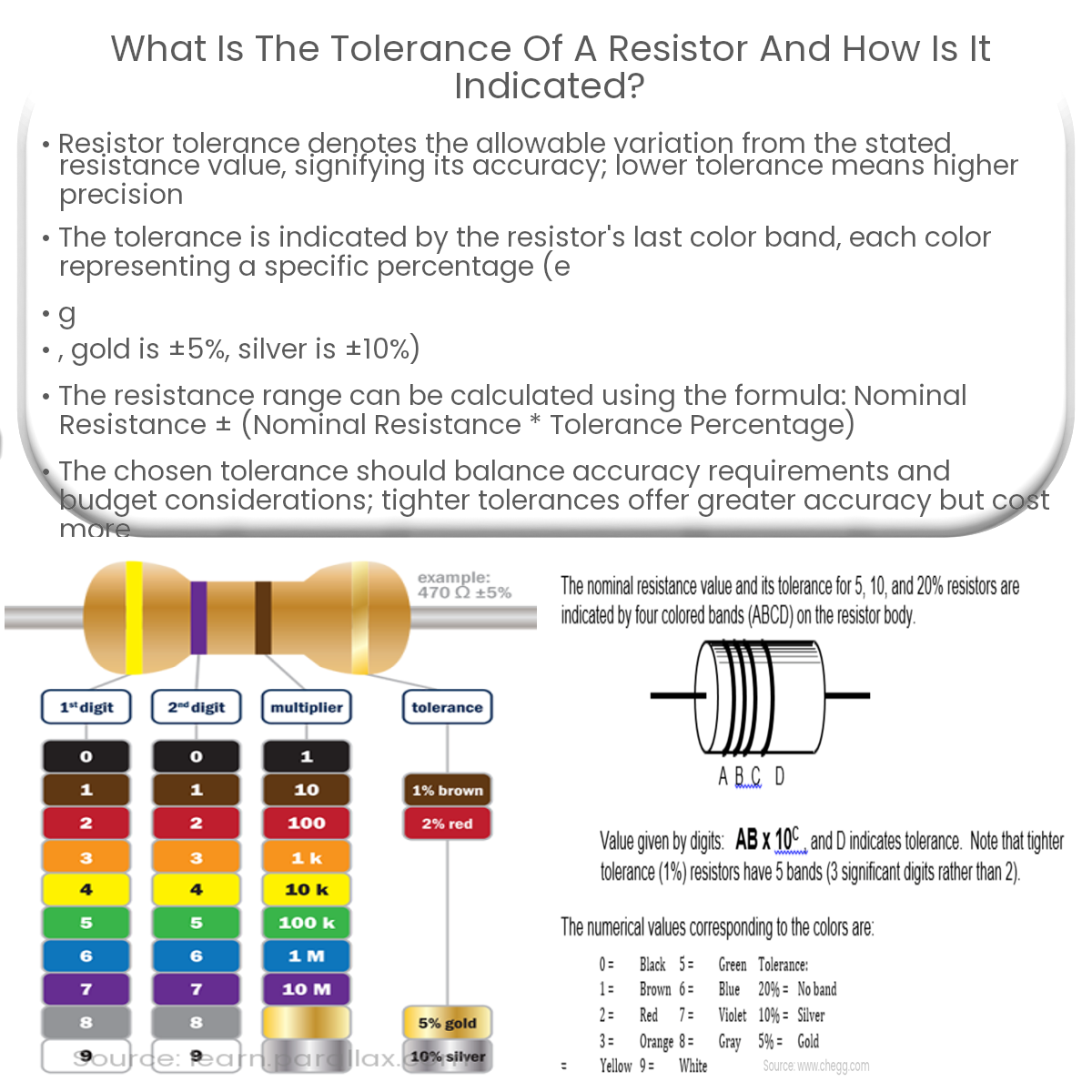
Resistor tolerance is the allowed deviation from the specified resistance value, indicated by the last color band on the resistor.
Understanding Resistor Tolerance
The tolerance of a resistor refers to the allowable range of deviation from its nominal or specified resistance value. It represents the accuracy of the resistor and is expressed as a percentage. A lower tolerance percentage signifies higher precision, while a higher percentage denotes lower precision.
How is Tolerance Indicated?
The tolerance is typically indicated by the last color band on a resistor. For a four-band resistor, it is the fourth band; for a five-band resistor, it is the fifth band. Each color corresponds to a specific tolerance percentage, as shown below:
If the last band is not colored, the tolerance is assumed to be ±20%.
Calculating the Resistance Range
To determine the resistance range based on the tolerance value, you can use the following formula:
Resistance Range = (Nominal Resistance ± (Nominal Resistance * Tolerance Percentage))
For example, if you have a 1kΩ resistor with a gold tolerance band (±5%), the resistance range would be 1kΩ ± 50Ω, or between 950Ω and 1050Ω.
Choosing the Right Tolerance
The choice of tolerance depends on the specific application and the level of accuracy required. For general-purpose electronics, a tolerance of ±5% (gold) or ±10% (silver) is often adequate. However, for precision circuits, such as those found in measurement and control systems, a tighter tolerance (e.g., ±1%, ±0.5%, or lower) may be necessary to ensure accurate and reliable performance.
Cost Considerations
Keep in mind that resistors with tighter tolerances typically cost more than those with looser tolerances. Therefore, when selecting resistors for a project, it is essential to balance the need for accuracy with the overall project budget.