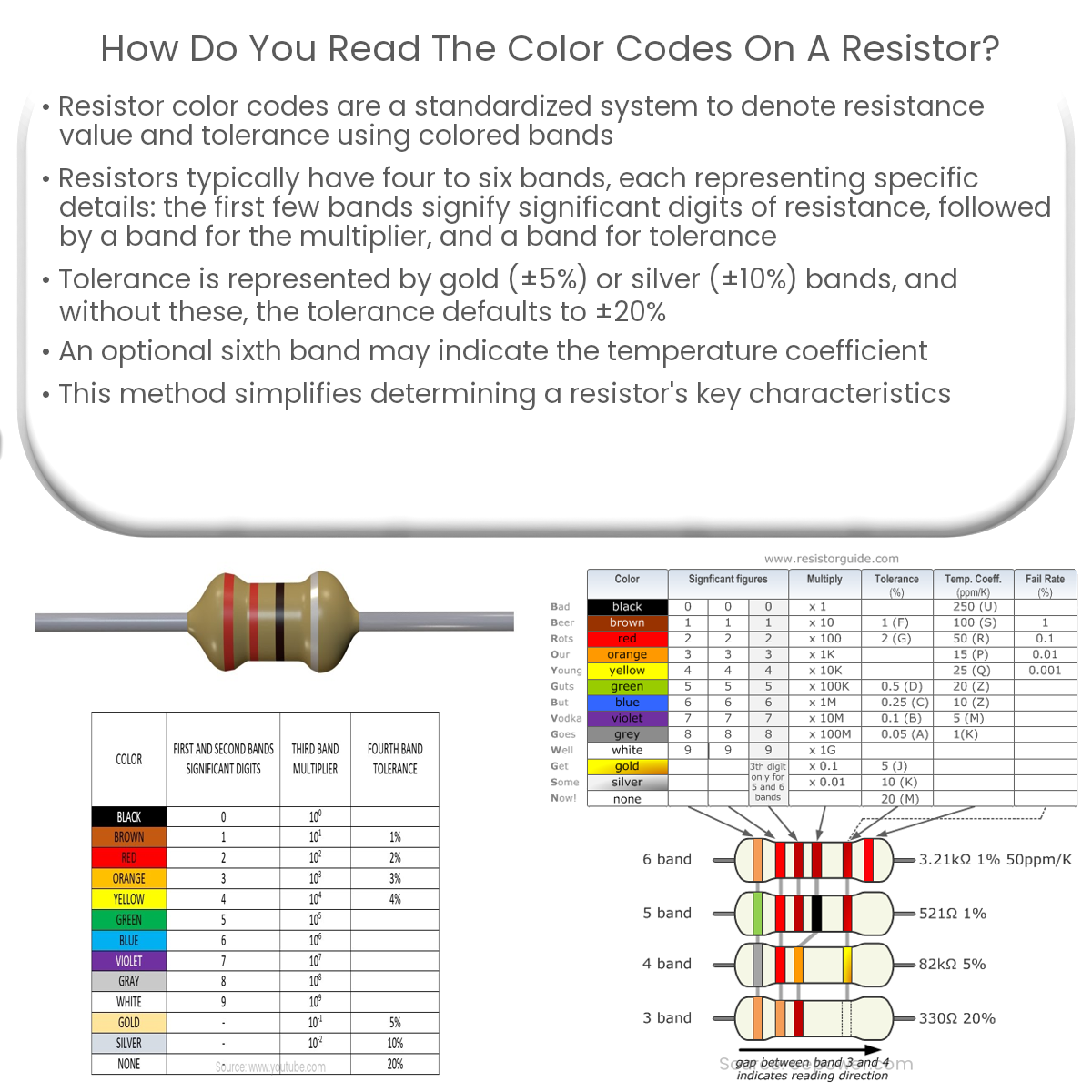
To read resistor color codes, identify color bands, decode colors to numbers, combine significant digits, apply the multiplier, and assess tolerance.
Reading Resistor Color Codes
Resistor color codes are a simple and standardized way to indicate the value of a resistor. This system uses colored bands painted on the body of the resistor to represent its resistance value and tolerance. Here’s a step-by-step guide on how to read these color codes:
1. Identify the Color Bands
Most resistors have either four, five, or six color bands. Locate these bands on the resistor body. Typically, there is a small gap between the last band and the others, which helps identify the correct orientation.
2. Decode the Color Bands
Each color corresponds to a specific number. Use the following list to identify the numerical value of each color:
3. Determine the Resistance Value
The first two or three bands (depending on the total number of bands) represent the significant digits of the resistor value. Combine these digits to form a number.
4. Calculate the Multiplier
The next band represents the multiplier. The numerical value of this color indicates the power of ten by which the significant digits should be multiplied.
5. Assess the Tolerance
The last band indicates the tolerance, or the possible variation in resistance value. Gold and silver bands are used for tolerance:
If there is no tolerance band, the tolerance is assumed to be ±20%.
6. Determine Temperature Coefficient (Optional)
If there is a sixth band, it represents the temperature coefficient in ppm/°C (parts per million per degree Celsius). This information is not always necessary but can be useful in specific applications.
By following these steps, you can easily decode the color bands on a resistor and determine its resistance value, tolerance, and, if applicable, temperature coefficient.