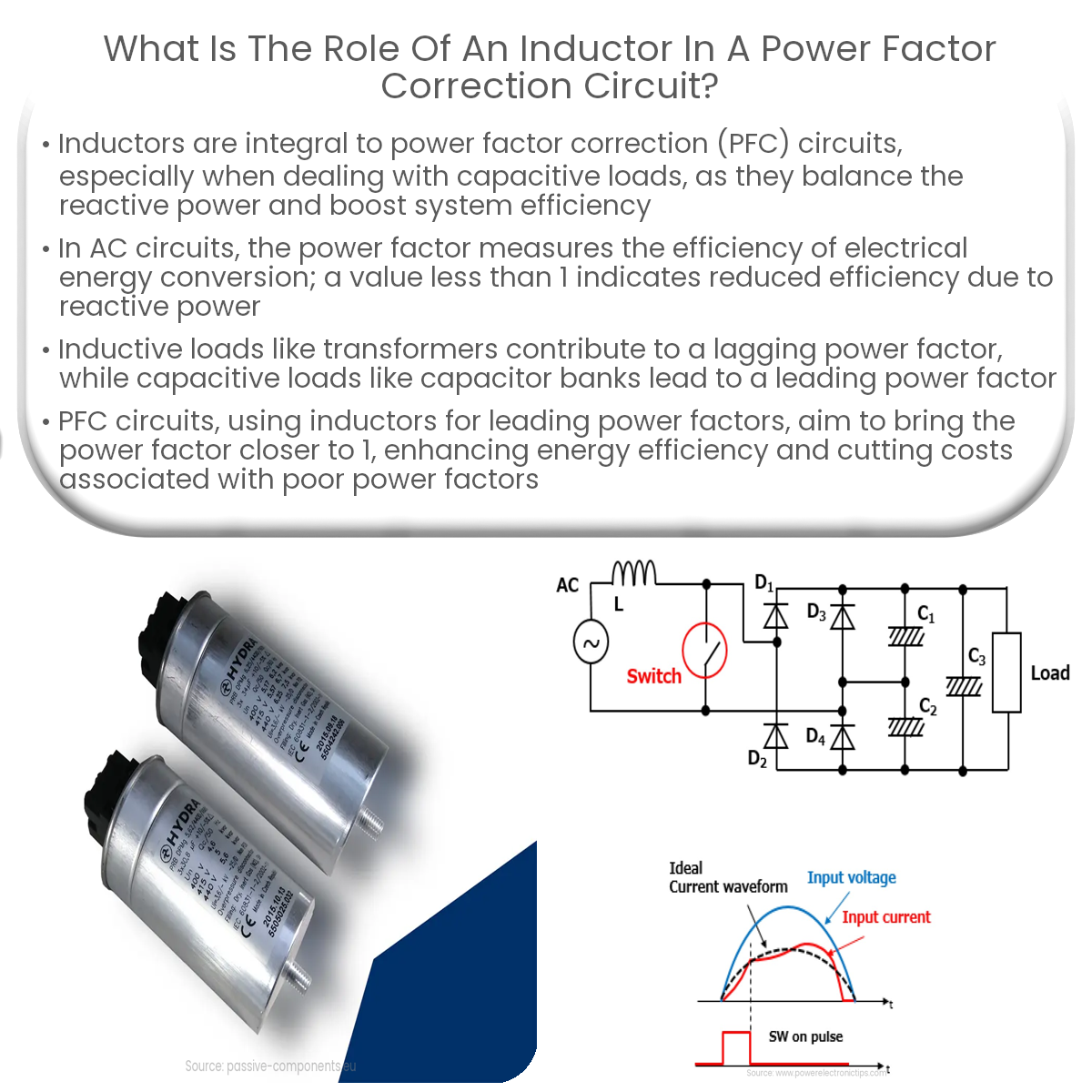
Inductors in power factor correction circuits balance reactive power in capacitive loads, improving efficiency and reducing costs associated with poor power factors.
Role of an Inductor in a Power Factor Correction Circuit
Inductors play a crucial role in power factor correction (PFC) circuits, particularly in cases where the load has a capacitive nature. In such scenarios, inductors help balance the reactive power, ensuring the overall system operates efficiently.
Understanding Reactive Power and Power Factor
In AC circuits, the power factor (PF) is a measure of the efficiency with which electrical energy is converted into useful work. A power factor of 1 indicates maximum efficiency, while a value less than 1 signifies the presence of reactive power, leading to reduced efficiency. Reactive power arises from the presence of inductive or capacitive loads, causing a phase shift between the voltage and current waveforms.
Inductive Loads and Power Factor Correction
Inductive loads, such as transformers, motors, and solenoids, typically contribute to a lagging power factor, meaning the current lags the voltage. In contrast, capacitive loads, such as capacitor banks and long transmission lines, can lead to a leading power factor, where the current leads the voltage.
Power factor correction circuits are employed to bring the power factor closer to 1, maximizing energy efficiency and reducing the costs associated with poor power factors. While capacitors are often used to correct lagging power factors, inductors are vital in addressing leading power factors.
Role of Inductors in PFC Circuits
When dealing with capacitive loads, inductors serve as a reactive power source that provides a lagging reactive power component, counteracting the effects of the capacitive load. This balancing of reactive power reduces the phase angle between the voltage and current, thereby improving the overall power factor.
- Series Configuration: Inductors can be connected in series with the capacitive load to adjust the overall impedance of the circuit, thereby correcting the power factor.
- Automatic Tuning: In more complex systems, automatic tuning circuits can be used to dynamically adjust the inductive reactance, providing optimal power factor correction under varying load conditions.
In summary, inductors play a significant role in power factor correction circuits when capacitive loads are present. By providing a lagging reactive power component, they help balance the reactive power, increase energy efficiency, and reduce the costs associated with poor power factors.