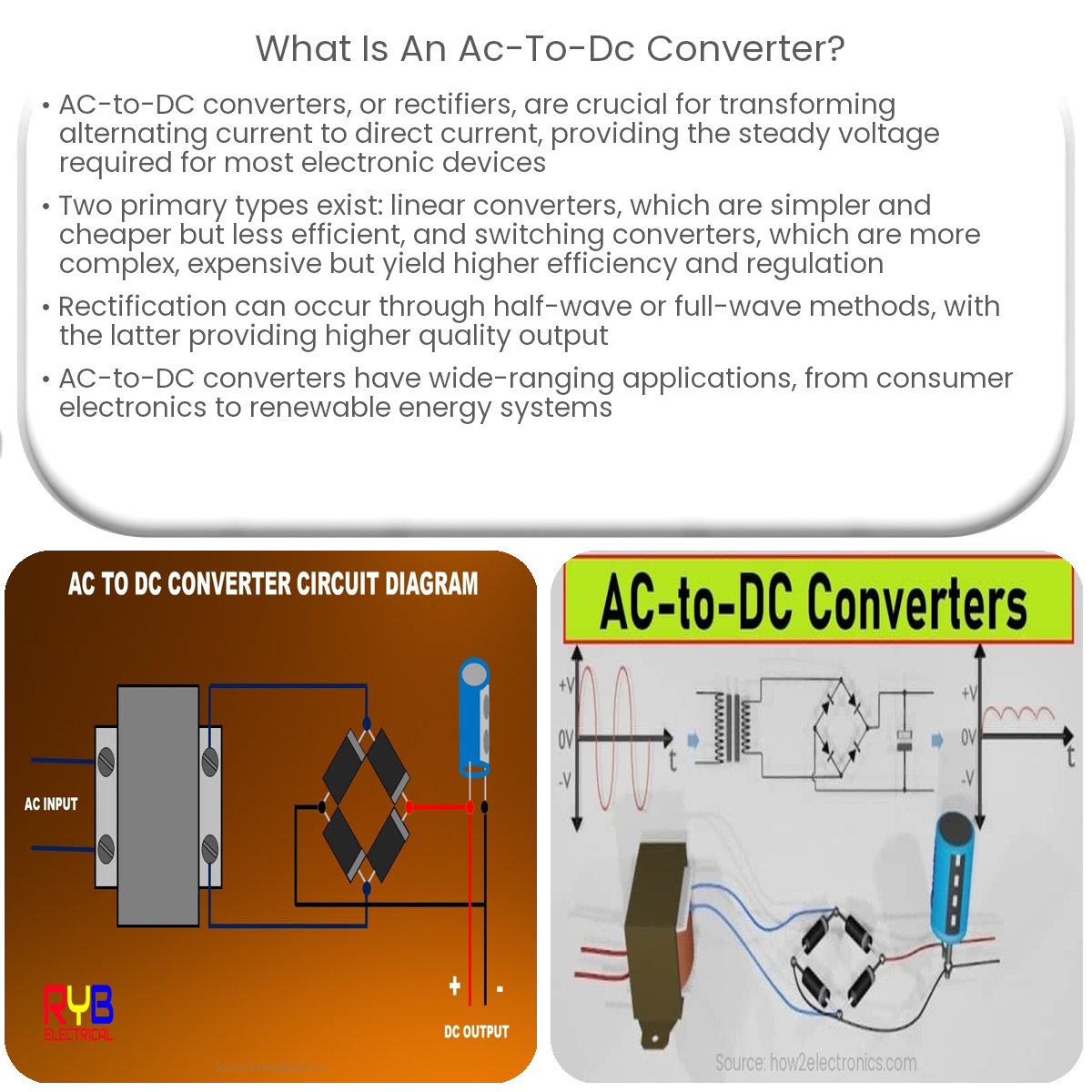
An AC-to-DC converter, or rectifier, is an electronic device that converts alternating current (AC) input to direct current (DC) output for device operation.
Introduction to AC-to-DC Converters
An AC-to-DC converter, also known as a rectifier, is an electronic device that converts alternating current (AC) input to direct current (DC) output. This conversion is essential because most electronic devices and circuits require a steady DC voltage for proper operation.
Types of AC-to-DC Converters
There are two primary types of AC-to-DC converters: linear and switching. Both types serve the same purpose but have different characteristics and applications.
1. Linear Converters
Linear converters are simple and cost-effective, typically consisting of a transformer, diode rectifier, and filter capacitor. The transformer reduces the input voltage, while the diode rectifier converts the AC waveform into a pulsating DC signal. Finally, the filter capacitor smooths the output, providing a stable DC voltage. Linear converters are suitable for low-power applications but suffer from low efficiency due to power dissipation in the transformer and diodes.
2. Switching Converters
Switching converters, also known as switched-mode power supplies (SMPS), use high-frequency switching devices like transistors to convert the AC input into DC. These converters are more complex and expensive than linear converters but offer higher efficiency and better regulation. SMPS are commonly used in high-power applications such as computers, industrial equipment, and telecommunication systems.
Rectification Methods
There are two primary methods of rectification in AC-to-DC converters: half-wave and full-wave rectification.
1. Half-wave Rectification
Half-wave rectifiers utilize a single diode to convert the AC input into DC. This type of rectification only uses one half of the AC waveform, discarding the other half. Although half-wave rectifiers are simple and inexpensive, they produce a low-quality DC output with high ripple content, making them unsuitable for most applications.
2. Full-wave Rectification
Full-wave rectifiers use multiple diodes or diode bridges to convert both halves of the AC waveform into DC. This approach results in a higher-quality DC output with less ripple content, making it more suitable for sensitive electronic devices. Full-wave rectifiers can be further classified into single-phase and three-phase configurations, depending on the AC input voltage.
Applications of AC-to-DC Converters
AC-to-DC converters are widely used in various applications, including:
- Consumer electronics, such as smartphones, laptops, and televisions
- Industrial equipment and machinery
- Power supplies for electronic devices and circuits
- Electric vehicle chargers
- Renewable energy systems, like solar panels and wind turbines