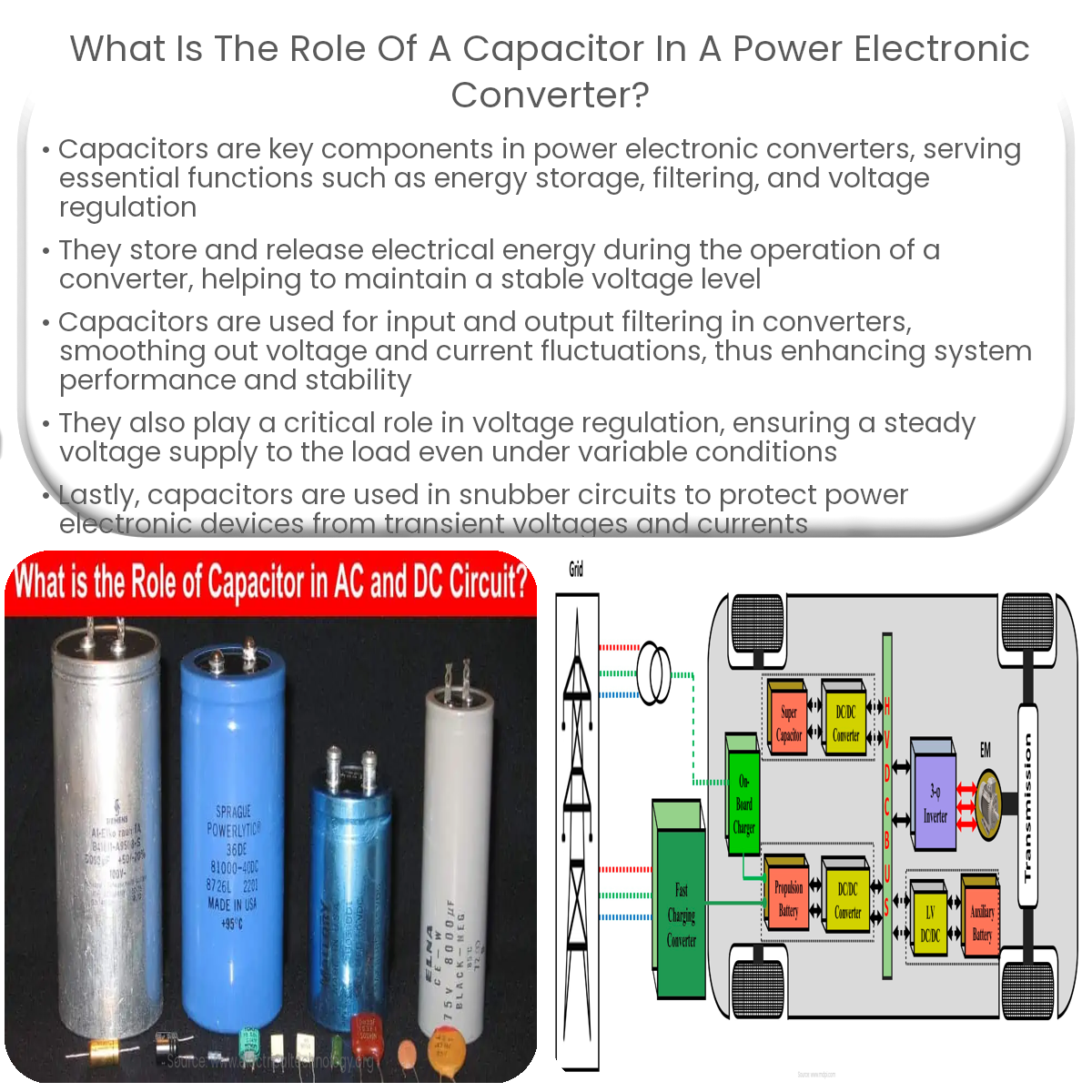
In power electronic converters, capacitors store energy, filter voltage and current ripples, regulate voltage, and protect devices in snubber circuits.
Capacitors in Power Electronic Converters
A capacitor is an essential component in power electronic converters, playing a crucial role in various functions such as energy storage, filtering, and voltage regulation. This article will explore the roles capacitors play in these systems.
Energy Storage
One primary role of capacitors in power electronic converters is energy storage. During the operation of a converter, the capacitor stores electrical energy when the voltage across it increases and releases energy when the voltage decreases. This ability to store and release energy helps maintain a stable voltage level in the converter circuit.
Filtering
Another significant role capacitors play in power electronic converters is filtering. In both DC-DC and AC-DC converters, capacitors help eliminate voltage and current ripples generated during the conversion process. By placing capacitors at the input and output of the converter, they can smooth out fluctuations and reduce the ripple effect, improving the overall performance and stability of the system.
- Input filtering: Capacitors placed at the input stage of a converter help reduce voltage fluctuations from the source, providing a smoother input voltage to the converter.
- Output filtering: Capacitors placed at the output stage of a converter minimize the output voltage ripple, ensuring a more stable and continuous voltage to the load.
Voltage Regulation
Capacitors are also crucial in voltage regulation within power electronic converters. They help maintain a constant voltage level across the load, even under varying input voltage or load conditions. Capacitors connected in parallel with the load can compensate for voltage drops and transient voltage changes, ensuring that the load receives a stable voltage supply.
Snubber Circuits
Capacitors are also used in snubber circuits, which protect power electronic devices such as transistors, diodes, and thyristors from voltage and current transients. By combining a capacitor with a resistor or inductor, snubber circuits can absorb and dissipate the transient energy, preventing damage to the power devices.
Conclusion
In summary, capacitors play several vital roles in power electronic converters, including energy storage, filtering, voltage regulation, and protection. By fulfilling these functions, capacitors contribute significantly to the efficiency, reliability, and overall performance of power electronic systems.