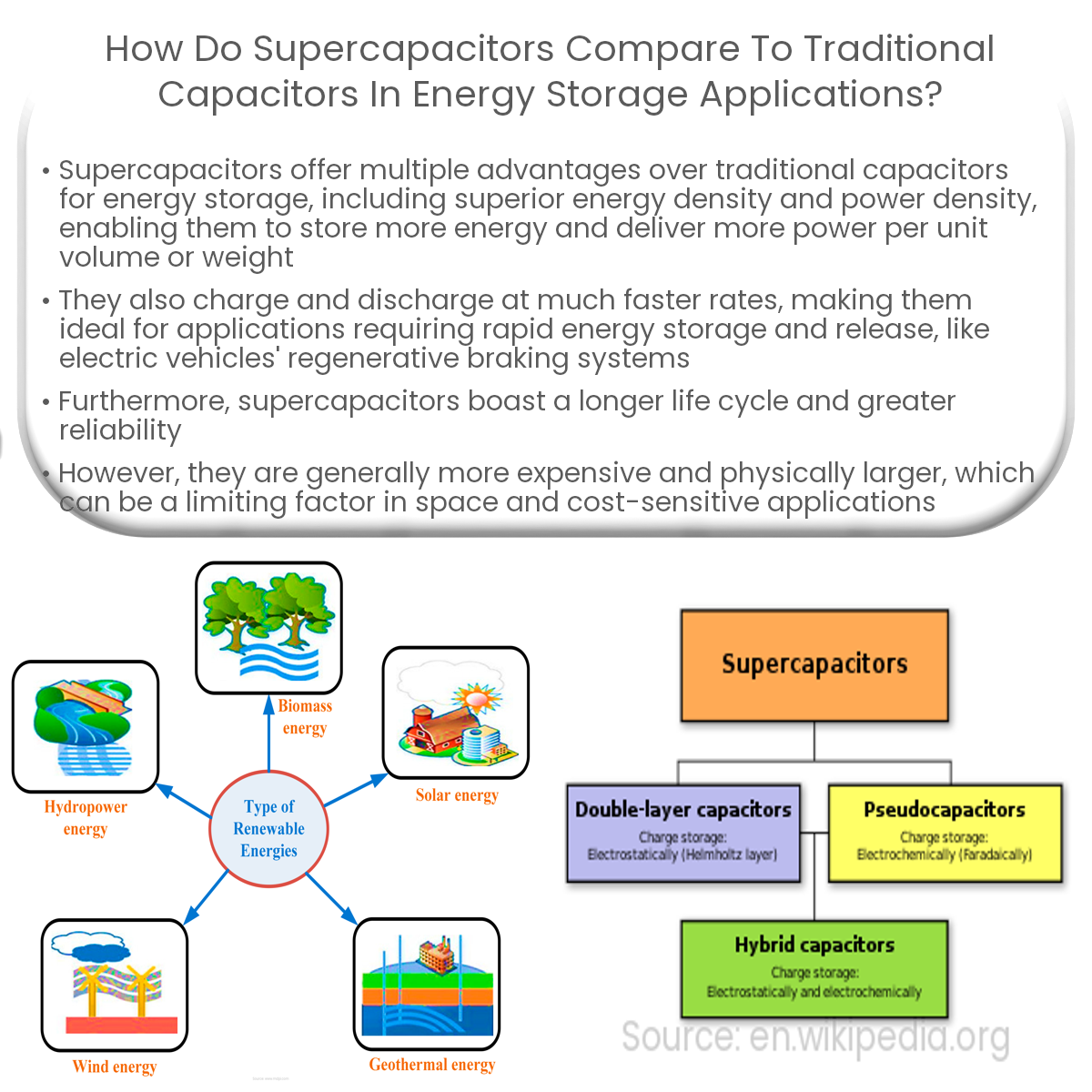
Supercapacitors offer higher energy density, power density, faster charge/discharge rates, and longer life cycles but are costlier and larger.
Supercapacitors vs Traditional Capacitors in Energy Storage
Supercapacitors, also known as ultracapacitors or electrochemical double-layer capacitors (EDLCs), are advanced energy storage devices that have gained popularity in recent years. They offer several advantages over traditional capacitors in energy storage applications. This article will discuss the key differences between supercapacitors and traditional capacitors.
Energy Density
One of the most significant differences between supercapacitors and traditional capacitors is their energy density. Supercapacitors have a higher energy density than traditional capacitors, which means they can store more energy per unit volume or weight. This makes them suitable for applications where a larger amount of energy storage is required.
Power Density
Supercapacitors also have a higher power density compared to traditional capacitors. They can deliver more power per unit volume or weight, making them an ideal choice for applications that require rapid energy discharge or high peak power demands. This high power density allows supercapacitors to bridge the gap between traditional capacitors and batteries in many applications.
Charge and Discharge Rates
Another advantage of supercapacitors is their ability to charge and discharge at much faster rates than traditional capacitors. This characteristic makes them suitable for use in applications where rapid energy storage and release are essential, such as regenerative braking systems in electric vehicles.
Life Cycle and Reliability
Supercapacitors generally have a longer life cycle and better reliability compared to traditional capacitors. They can withstand a higher number of charge-discharge cycles without significant degradation in performance. This makes them an attractive option for applications where long-term stability and reliability are critical.
Cost and Size
Despite their advantages, supercapacitors have some drawbacks. They are generally more expensive than traditional capacitors, and their physical size is larger for an equivalent capacitance value. This can be a limiting factor in applications where space and cost constraints are significant.
Conclusion
Supercapacitors offer several benefits over traditional capacitors in energy storage applications, including higher energy density, power density, rapid charge and discharge rates, and longer life cycle. However, they also come with drawbacks such as higher cost and larger size. As technology continues to advance, it is expected that supercapacitors will find more widespread use in various energy storage applications, complementing or even replacing traditional capacitors and batteries in some cases.