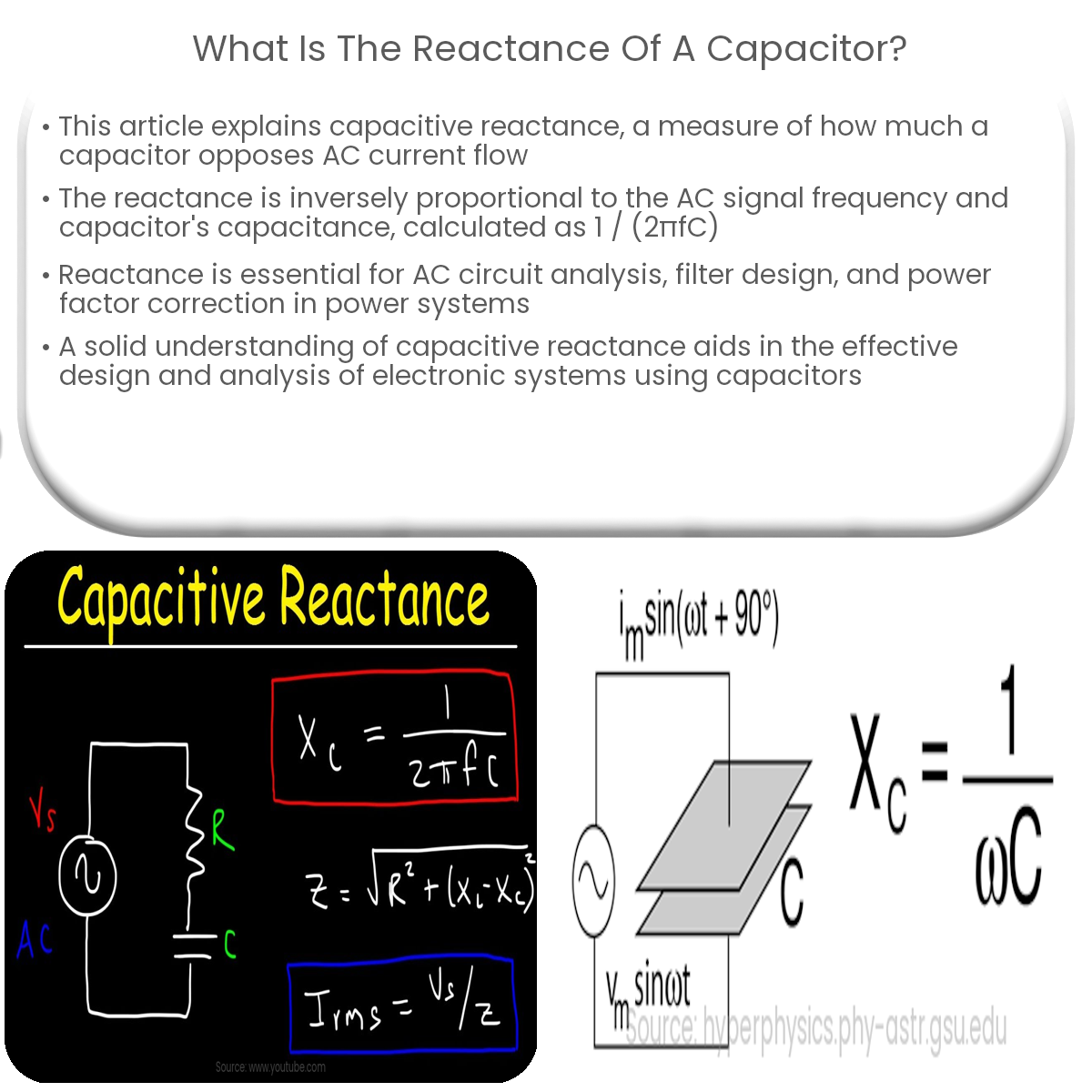
Capacitive reactance is a measure of how a capacitor opposes AC current flow, calculated as Xc = 1 / (2πfC), where f is frequency and C is capacitance.
Understanding the Reactance of a Capacitor
Capacitors are passive electrical components widely used in electronic circuits for energy storage, filtering, and signal processing. A key parameter to understand when working with capacitors is their reactance, which dictates how they behave in AC circuits. This article will explain the concept of capacitor reactance and its significance in electronic applications.
Capacitor Basics
A capacitor consists of two conductive plates separated by an insulating material known as the dielectric. When a voltage is applied across the capacitor, an electric field forms, and electric charge accumulates on the plates. The ability of a capacitor to store this charge is defined by its capacitance, measured in farads (F).
Capacitive Reactance
Reactance is a measure of how much a capacitor (or any other reactive component, such as an inductor) opposes the flow of alternating current (AC) in an electrical circuit. Capacitive reactance, denoted as XC, is inversely proportional to the frequency of the AC signal (f) and the capacitance of the capacitor (C). It is calculated using the following formula:
XC = 1 / (2πfC)
As the frequency increases, the capacitive reactance decreases, meaning the capacitor becomes less resistive to the AC signal’s flow. Conversely, a decrease in frequency or capacitance increases the reactance.
Significance of Capacitive Reactance
Understanding capacitive reactance is essential for various electronic applications, including:
- AC Circuit Analysis: Reactance is a key parameter when analyzing AC circuits with capacitors, as it helps determine the impedance, phase shift, and other critical performance characteristics of the circuit.
- Filter Design: Capacitive reactance plays a crucial role in designing filters, which are used to eliminate or attenuate specific frequency ranges in electronic signals. By manipulating the reactance, filters can be tailored to target frequencies.
- Power Factor Correction: In AC power systems, capacitors are used to correct the power factor, which is the ratio of real power to apparent power. Reactance helps determine the appropriate capacitance value to achieve the desired power factor.
In conclusion, capacitive reactance is a fundamental concept for understanding capacitor behavior in AC circuits. It quantifies the opposition a capacitor presents to the flow of alternating current and plays a vital role in various electronic applications, such as AC circuit analysis, filter design, and power factor correction. A solid grasp of capacitive reactance enables better design and analysis of electronic systems that incorporate capacitors.