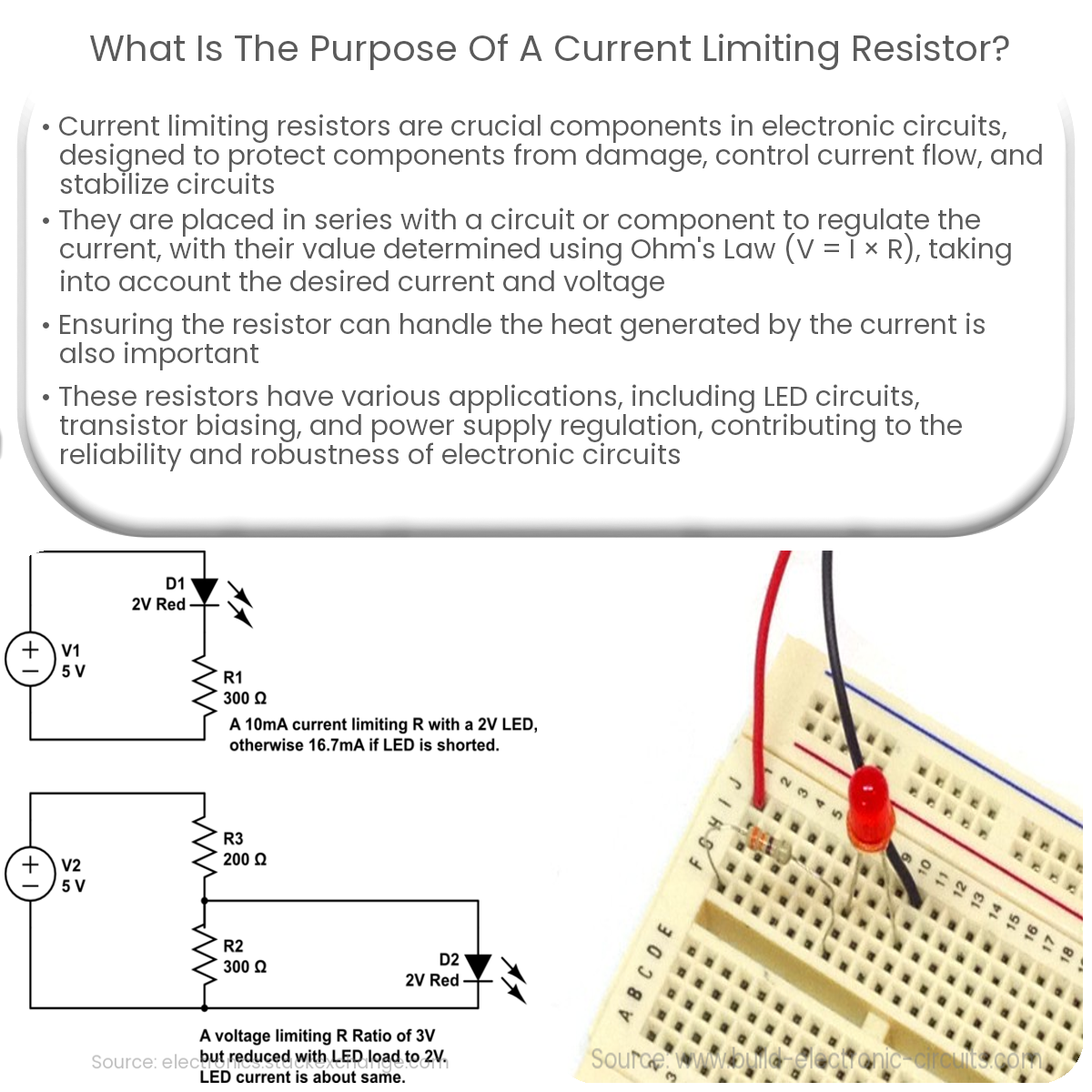
A current limiting resistor protects components, controls current flow, and stabilizes circuits by ensuring current stays within safe limits.
Current Limiting Resistors: Purpose and Applications
Electronic circuits often require precise control of current to ensure proper operation and prevent damage to components. One way to achieve this control is by using a current limiting resistor. In this article, we will discuss the purpose of a current limiting resistor and its applications in electronic circuits.
Purpose of a Current Limiting Resistor
A current limiting resistor is a fixed-value resistor placed in series with a circuit or component to limit the current flowing through it. The main purposes of a current limiting resistor are:
- Protecting components: Many electronic components, such as LEDs and transistors, can be damaged by excessive current. A current limiting resistor helps prevent damage by ensuring the current stays within safe limits.
- Controlling current flow: In some circuits, the desired current flow may be lower than the maximum current a component can handle. A current limiting resistor can be used to adjust the current to the desired level.
- Stabilizing circuits: Current limiting resistors can help stabilize circuits by reducing the effects of variations in power supply voltage or component tolerances.
Calculating the Required Current Limiting Resistor
To determine the appropriate value for a current limiting resistor, you can use Ohm’s Law, which states that the voltage (V) across a resistor is equal to the current (I) flowing through it multiplied by the resistance (R):
V = I × R
Given the desired current (I) and the voltage across the resistor (V), you can calculate the required resistance (R) using the following formula:
R = V / I
It’s essential to consider the power rating of the resistor, ensuring it can dissipate the heat generated by the current flowing through it without damage.
Applications of Current Limiting Resistors
Current limiting resistors are commonly used in various electronic circuits, including:
- LED circuits: LEDs require a specific current to operate correctly and can be damaged by excessive current. A current limiting resistor is used to protect the LED and maintain the desired brightness.
- Transistor biasing: In transistor circuits, a current limiting resistor can be used to set the base current, controlling the transistor’s operating point and preventing damage from excessive current.
- Power supply regulation: In linear voltage regulators, a current limiting resistor can help protect the regulator and the load from overcurrent conditions.
In conclusion, a current limiting resistor serves an essential purpose in electronic circuits, protecting components, controlling current flow, and stabilizing circuit operation. Understanding the role of current limiting resistors and how to calculate their values is crucial for designing and building reliable and robust electronic circuits.