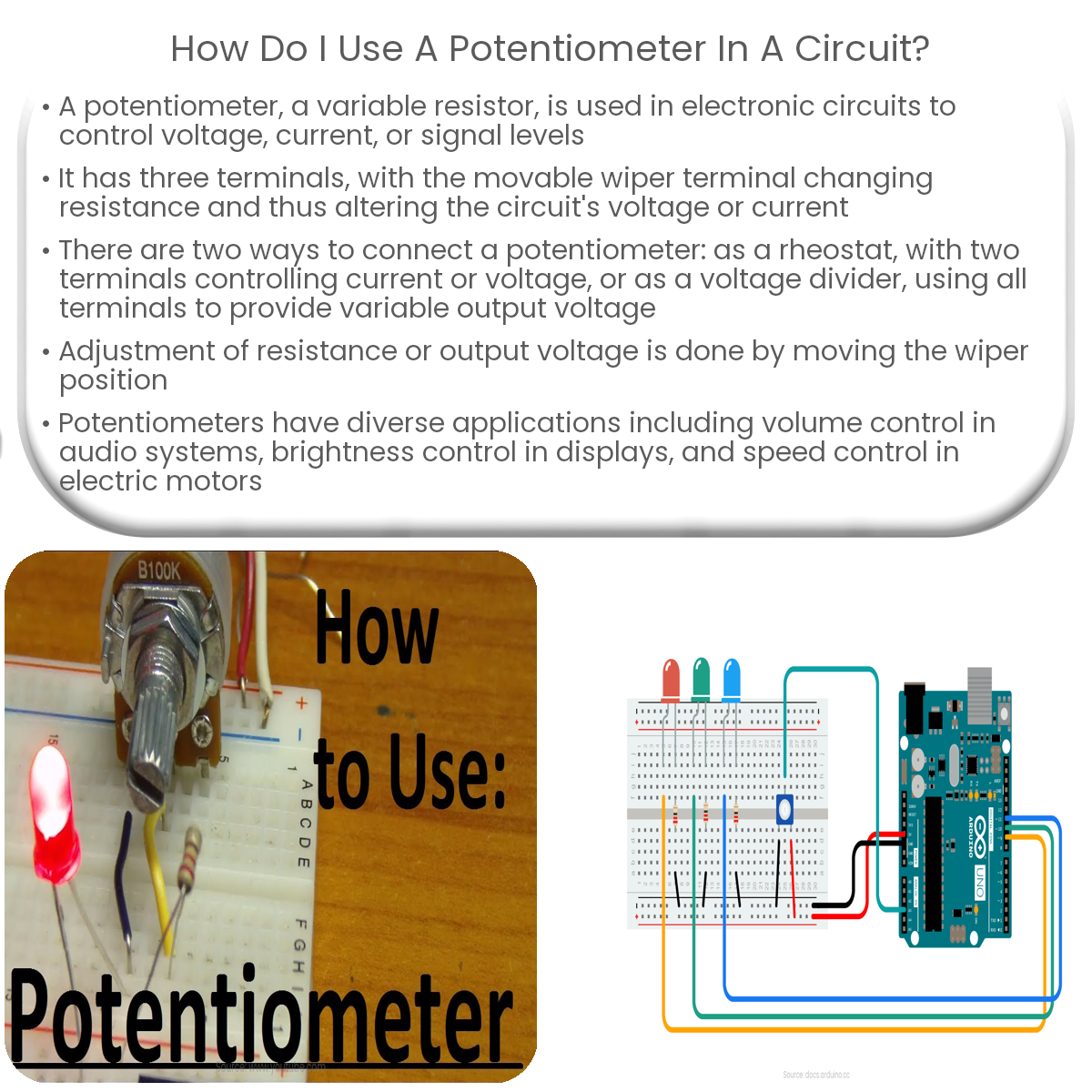
To use a potentiometer in a circuit, connect it as a rheostat or voltage divider, then adjust the wiper to control voltage, current, or signal levels.
Using a Potentiometer in a Circuit
A potentiometer is a variable resistor commonly used in electronic circuits to control voltage, current, or signal levels. In this article, we’ll discuss how to use a potentiometer in a circuit for various applications.
Understanding Potentiometer Basics
A potentiometer typically has three terminals:
- Terminal 1: Connected to one end of the resistive element
- Terminal 2: Connected to a movable wiper that slides along the resistive element
- Terminal 3: Connected to the other end of the resistive element
As the wiper moves along the resistive element, the resistance between terminals 1 and 2 or terminals 2 and 3 changes, which in turn alters the voltage or current in the circuit.
Connecting a Potentiometer to a Circuit
There are two common ways to connect a potentiometer in a circuit: as a rheostat or as a voltage divider.
Rheostat Connection
In a rheostat configuration, only two terminals of the potentiometer are used, one end terminal and the wiper terminal. The potentiometer acts as a variable resistor in series with a load to control the current or voltage through the load. To create a rheostat connection:
- Connect Terminal 1 to the positive side of the load
- Connect Terminal 2 (wiper) to the negative side of the load
- Leave Terminal 3 unconnected or connect it to Terminal 2 (wiper) to improve reliability
Voltage Divider Connection
In a voltage divider configuration, all three terminals of the potentiometer are used. The potentiometer divides the input voltage and provides a variable output voltage. To create a voltage divider connection:
- Connect Terminal 1 to the input voltage source (Vin)
- Connect Terminal 2 (wiper) to the output voltage source (Vout)
- Connect Terminal 3 to the ground or reference voltage
Adjusting the Potentiometer
To adjust the resistance or output voltage, turn the potentiometer’s knob or use a screwdriver to adjust the wiper position along the resistive element. This changes the resistance between terminals and subsequently alters the current or voltage in the circuit.
Applications of Potentiometers
Potentiometers are widely used in various applications, such as:
- Volume control in audio systems
- Brightness control in display devices
- Speed control in electric motors
- Position sensing and feedback in robotics
In summary, a potentiometer is a versatile electronic component used to control voltage, current, or signal levels in a circuit. By understanding its operation and how to connect it in various configurations, you can effectively utilize potentiometers in your electronic projects.