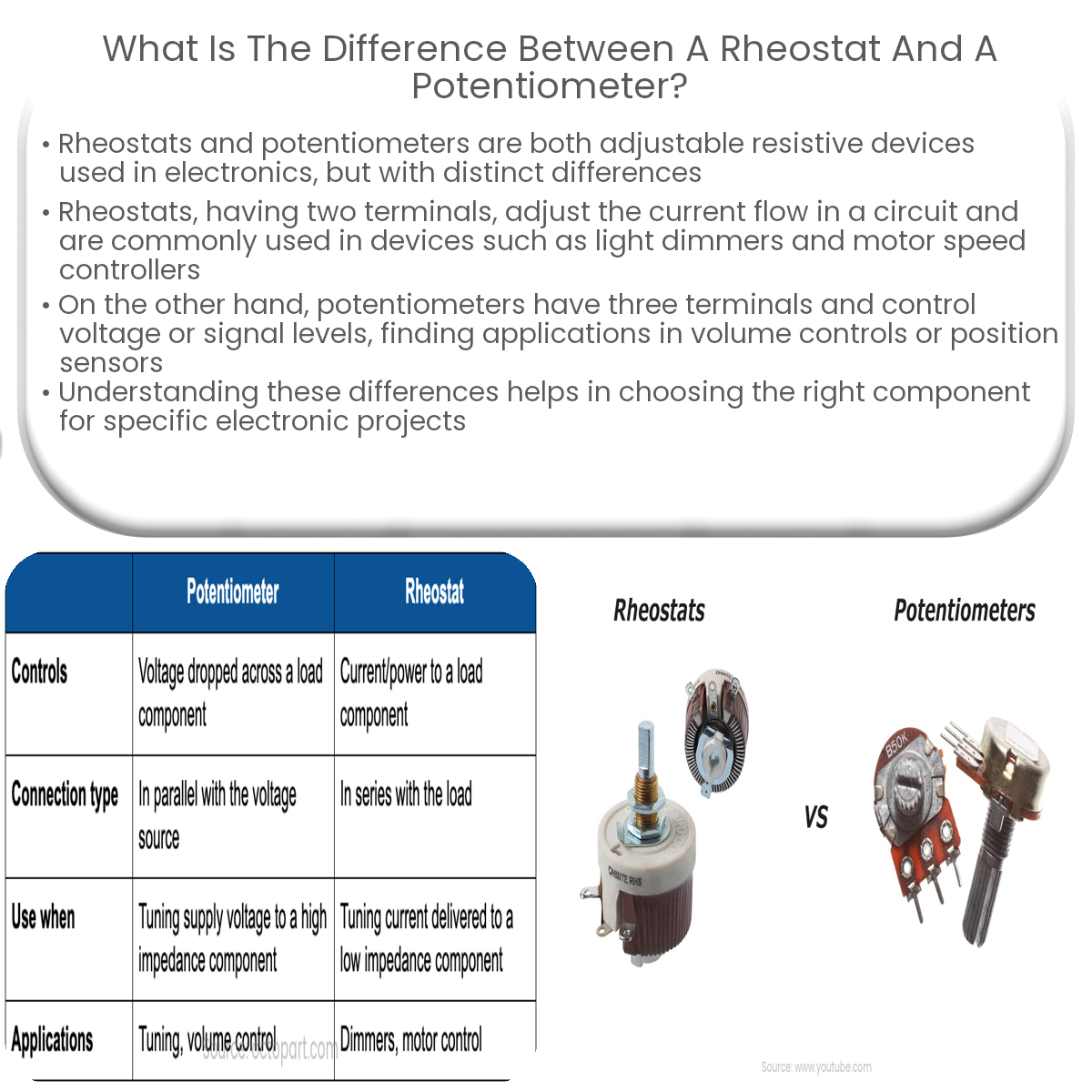
Rheostats control current with two terminals, while potentiometers control voltage or signal levels with three terminals, serving different purposes.
Difference Between a Rheostat and a Potentiometer
Rheostats and potentiometers are both adjustable resistive devices used in electronic circuits. However, they serve different purposes and have unique characteristics. In this article, we will explore the differences between rheostats and potentiometers, their applications, and how they are used in circuits.
Rheostat: Overview and Applications
A rheostat is a variable resistor that can be adjusted to control the current flowing through a circuit. It typically has two terminals: one connected to the resistive element and the other connected to a movable wiper that slides along the resistive element. As the wiper moves, the resistance between the two terminals changes, allowing for precise control of current in the circuit.
Rheostats are commonly used in applications that require adjusting the current flow, such as:
- Light dimmers
- Electric motor speed controllers
- Heater temperature controllers
Potentiometer: Overview and Applications
A potentiometer is a three-terminal adjustable resistor that can be used as a variable voltage divider. Like a rheostat, it has a resistive element and a movable wiper. However, the potentiometer has an additional terminal connected to the other end of the resistive element. By connecting the input voltage across the entire resistive element and taking the output voltage from the wiper, the potentiometer can provide a variable output voltage proportional to the input voltage.
Potentiometers are widely used in applications that require precise control of voltage or signal levels, such as:
- Volume controls in audio systems
- Position sensors in robotics
- Adjustable gain controls in amplifiers
Main Differences Between Rheostats and Potentiometers
While both rheostats and potentiometers are adjustable resistors, their main differences lie in their construction, operation, and applications:
- Terminals: Rheostats have two terminals, while potentiometers have three terminals.
- Function: Rheostats control current flow in a circuit, while potentiometers control voltage or signal levels by acting as voltage dividers.
- Applications: Rheostats are used for current control applications, such as motor speed or light dimming, while potentiometers are used for voltage or signal control applications, like volume or gain adjustments.
In conclusion, rheostats and potentiometers are both adjustable resistive devices with distinct characteristics and uses. Understanding their differences and applications can help you choose the right component for your electronic projects.