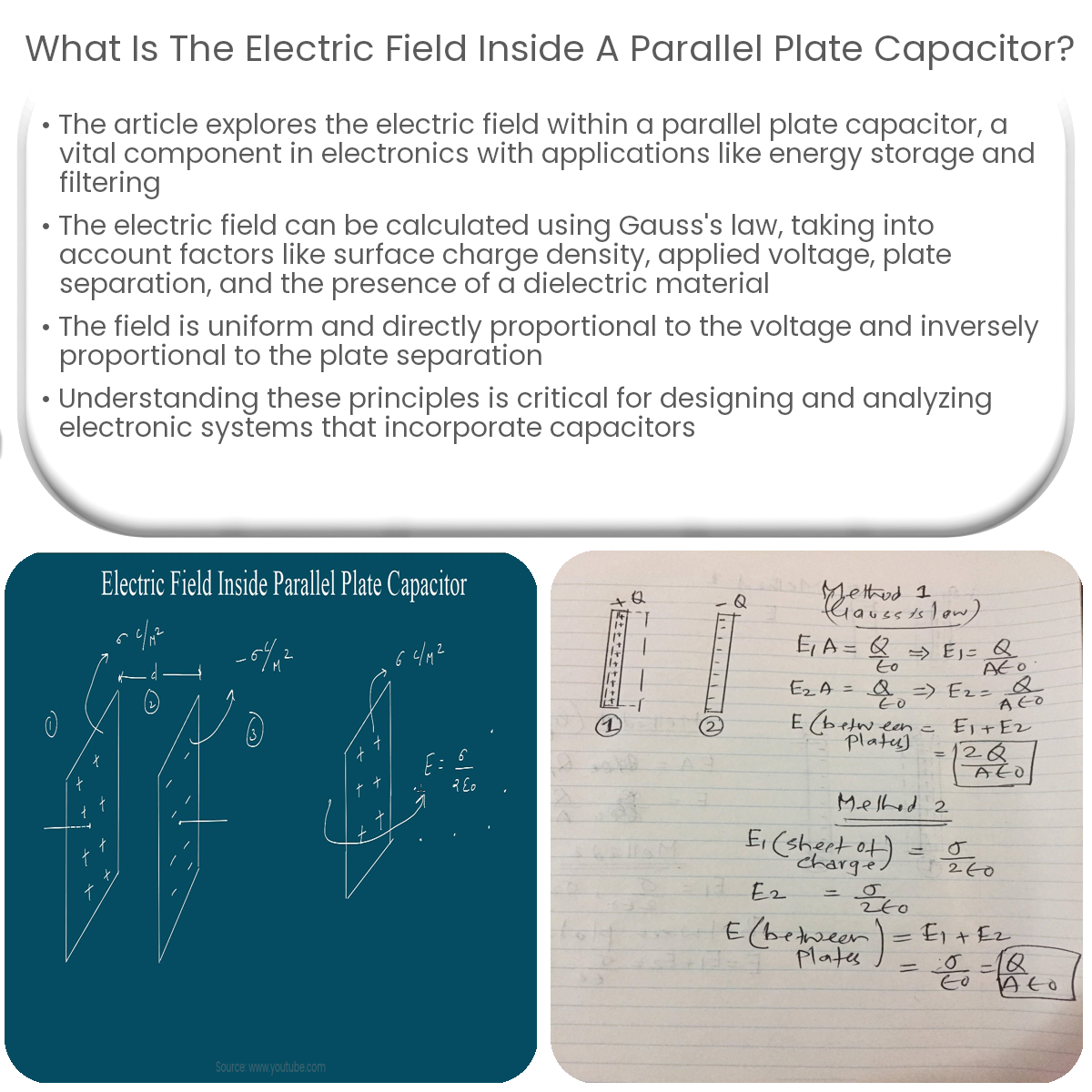
The electric field inside a parallel plate capacitor is uniform and depends on surface charge density, voltage, plate separation, and dielectric material.
Introduction to the Electric Field Inside a Parallel Plate Capacitor
Parallel plate capacitors are fundamental components in electronics and have numerous applications, such as energy storage and filtering. In this article, we will discuss the electric field inside a parallel plate capacitor and the factors affecting it.
Structure of a Parallel Plate Capacitor
A parallel plate capacitor consists of two conducting plates separated by a small distance d, often filled with a dielectric material. When a voltage V is applied across the plates, a uniform charge distribution with equal magnitude and opposite sign forms on the plate surfaces, leading to an electric field inside the capacitor.
Electric Field Inside a Parallel Plate Capacitor
According to Gauss’s law, the electric field inside a parallel plate capacitor can be calculated using the following equation:
E = σ / ε0
where E is the electric field, σ is the surface charge density, and ε0 is the vacuum permittivity. The surface charge density is the charge per unit area on the capacitor plates, which is related to the total charge Q stored in the capacitor by σ = Q / A, where A is the plate area.
Since the electric field inside a parallel plate capacitor is uniform, its magnitude can also be expressed as the voltage across the plates divided by the distance between them:
E = V / d
These two expressions can be combined to find the relationship between the charge, voltage, and geometry of a parallel plate capacitor:
Q = ε0AV / d
Factors Affecting the Electric Field Inside a Parallel Plate Capacitor
The electric field inside a parallel plate capacitor depends on the following factors:
- Surface charge density: The greater the surface charge density, the stronger the electric field inside the capacitor.
- Voltage: The electric field inside the capacitor is directly proportional to the applied voltage. A higher voltage will result in a stronger electric field.
- Plate separation: The electric field is inversely proportional to the distance between the plates. A smaller separation will produce a stronger electric field.
- Dielectric material: The presence of a dielectric material between the plates can alter the electric field by a factor of the dielectric constant.
Conclusion
In summary, the electric field inside a parallel plate capacitor is uniform and depends on the surface charge density, applied voltage, plate separation, and the dielectric material between the plates. Understanding the electric field inside a parallel plate capacitor is essential for designing and analyzing electronic circuits and systems that utilize capacitors.