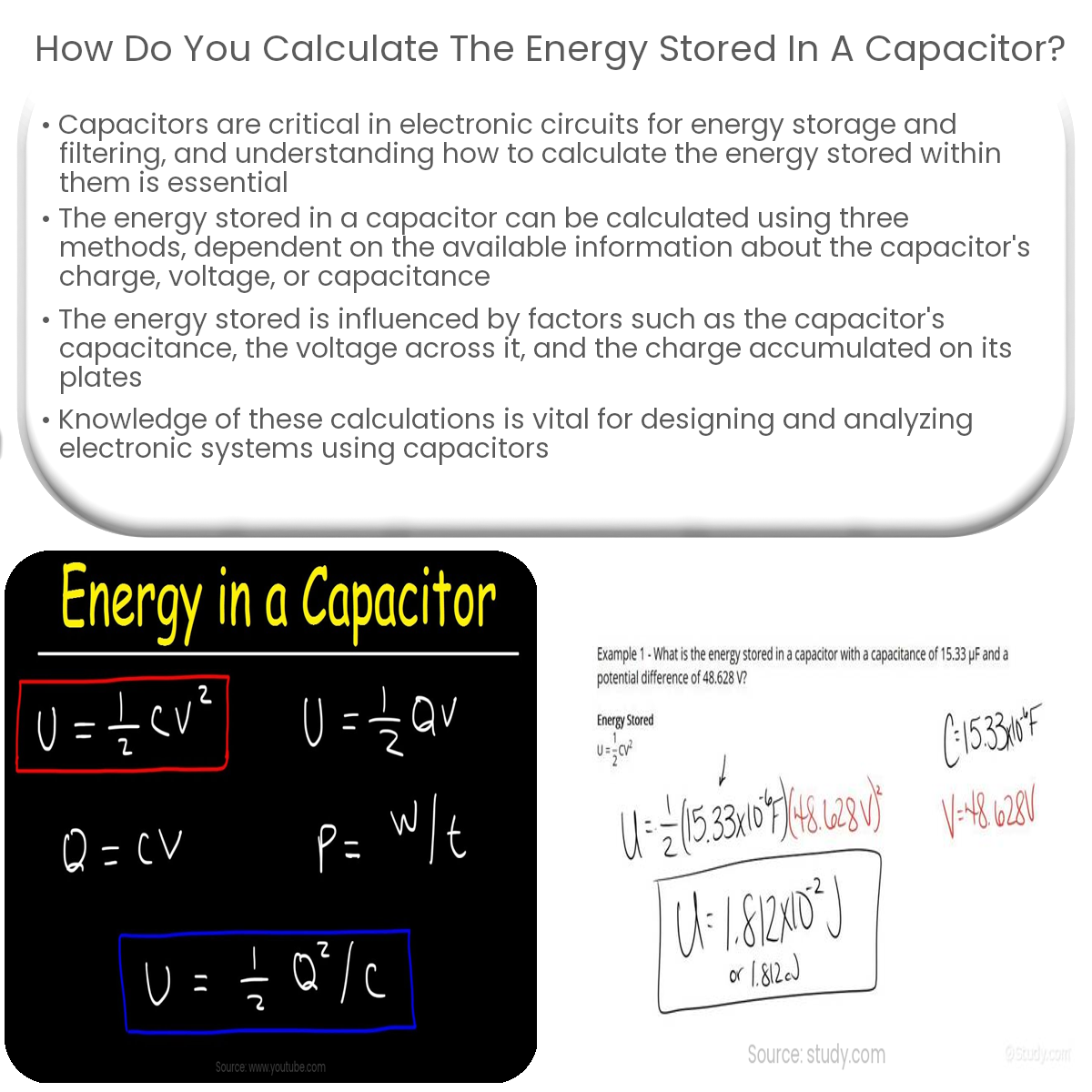
The energy stored in a capacitor can be calculated using W = 1/2 * Q * V, W = 1/2 * C * V², or W = Q² / (2 * C), depending on the available information.
Introduction to Energy Stored in a Capacitor
Capacitors are essential components in electronic circuits, playing a vital role in energy storage and filtering. Understanding how to calculate the energy stored in a capacitor is crucial for designing and analyzing electronic systems. In this article, we will discuss the methods to calculate the energy stored in a capacitor.
Energy Storage in Capacitors
When a voltage is applied across a capacitor, charges accumulate on its plates, creating an electric field. This process stores energy in the electric field, which can be released when needed. The energy stored in a capacitor can be calculated using three different methods, based on the capacitor’s charge, voltage, or capacitance.
Calculating Energy Stored in a Capacitor
Here are the three methods for calculating the energy stored in a capacitor:
- Based on charge: If the charge Q stored in a capacitor and the voltage V across it are known, the energy (W) can be calculated using the following equation: W = 1/2 * Q * V.
- Based on voltage: If the capacitance C of the capacitor and the voltage V across it are known, the energy (W) can be calculated using the following equation: W = 1/2 * C * V2.
- Based on capacitance: If the capacitance C of the capacitor and the charge Q stored in it are known, the energy (W) can be calculated using the following equation: W = Q2 / (2 * C).
Each of these methods is applicable under different circumstances and depends on the available information about the capacitor.
Factors Affecting Energy Stored in a Capacitor
The energy stored in a capacitor depends on the following factors:
- Capacitance: A higher capacitance value allows a capacitor to store more energy for a given voltage.
- Voltage: The energy stored in a capacitor is directly proportional to the square of the voltage across it. A higher voltage leads to a higher stored energy.
- Charge: The energy stored in a capacitor is directly proportional to the square of the charge accumulated on its plates.
Conclusion
In summary, the energy stored in a capacitor can be calculated using three different methods, based on the capacitor’s charge, voltage, or capacitance. Understanding these calculations is essential for the design and analysis of electronic circuits and systems that rely on capacitors for energy storage and filtering.