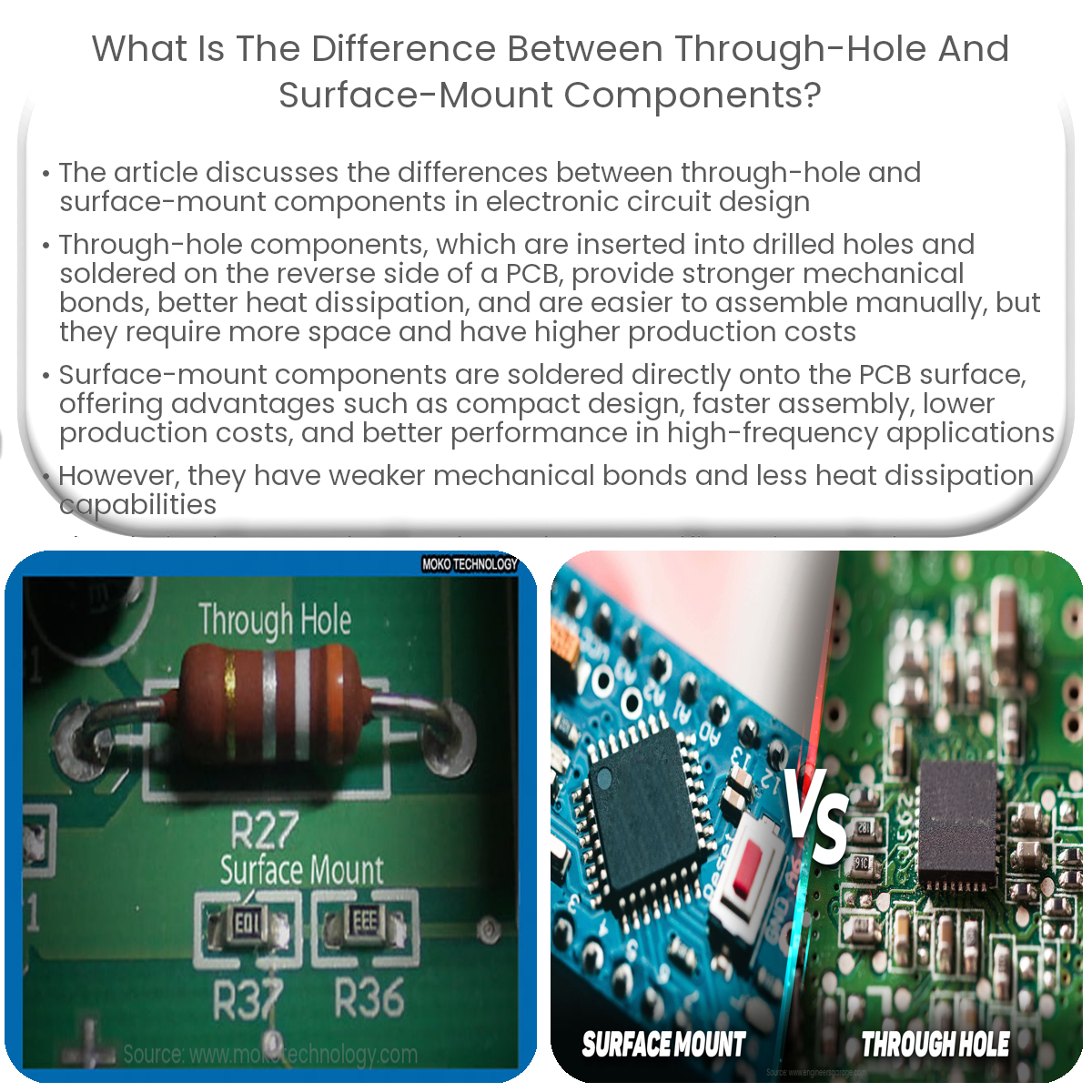
Through-hole components have leads that pass through holes in a PCB, while surface-mount components are soldered directly onto the PCB surface.
Through-hole vs. Surface-mount Components
When designing and assembling electronic circuits, there are two main types of components to choose from: through-hole and surface-mount. Both have distinct differences and applications, so understanding their unique characteristics is essential for selecting the most suitable option for your project.
Through-hole Components
Through-hole components have long leads that pass through holes drilled into a printed circuit board (PCB) and are soldered on the opposite side. This technology has been in use for many years and is still popular for its ease of assembly, especially for beginners or hobbyists. Some advantages of through-hole components include:
- Stronger mechanical bonds due to the leads being soldered through the PCB
- Easier manual assembly and prototyping
- Better heat dissipation and power handling capabilities
However, through-hole components also have some disadvantages:
- Larger size, occupying more PCB space
- Slower assembly and higher production costs
- Less suitable for high-frequency applications due to longer leads and larger parasitic effects
Surface-mount Components
Surface-mount components, on the other hand, are smaller and have shorter leads or terminals that are soldered directly onto the surface of the PCB. Surface-mount technology (SMT) has become increasingly popular due to its various advantages:
- Smaller size, enabling high-density and compact circuit designs
- Faster assembly and lower production costs
- Improved performance in high-frequency applications
- Simultaneous soldering of all components using reflow soldering techniques
However, surface-mount components also come with some drawbacks:
- More challenging manual assembly and soldering
- Weaker mechanical bonds compared to through-hole components
- Less heat dissipation and power handling capabilities
Conclusion
Choosing between through-hole and surface-mount components depends on the specific requirements and constraints of your project. Through-hole components are generally better for prototyping, hobbyist projects, and situations where strong mechanical bonds are necessary. Surface-mount components are more suited for high-density, compact designs, and high-frequency applications. Understanding the differences between these two types of components will help you make the right choice for your electronic project.