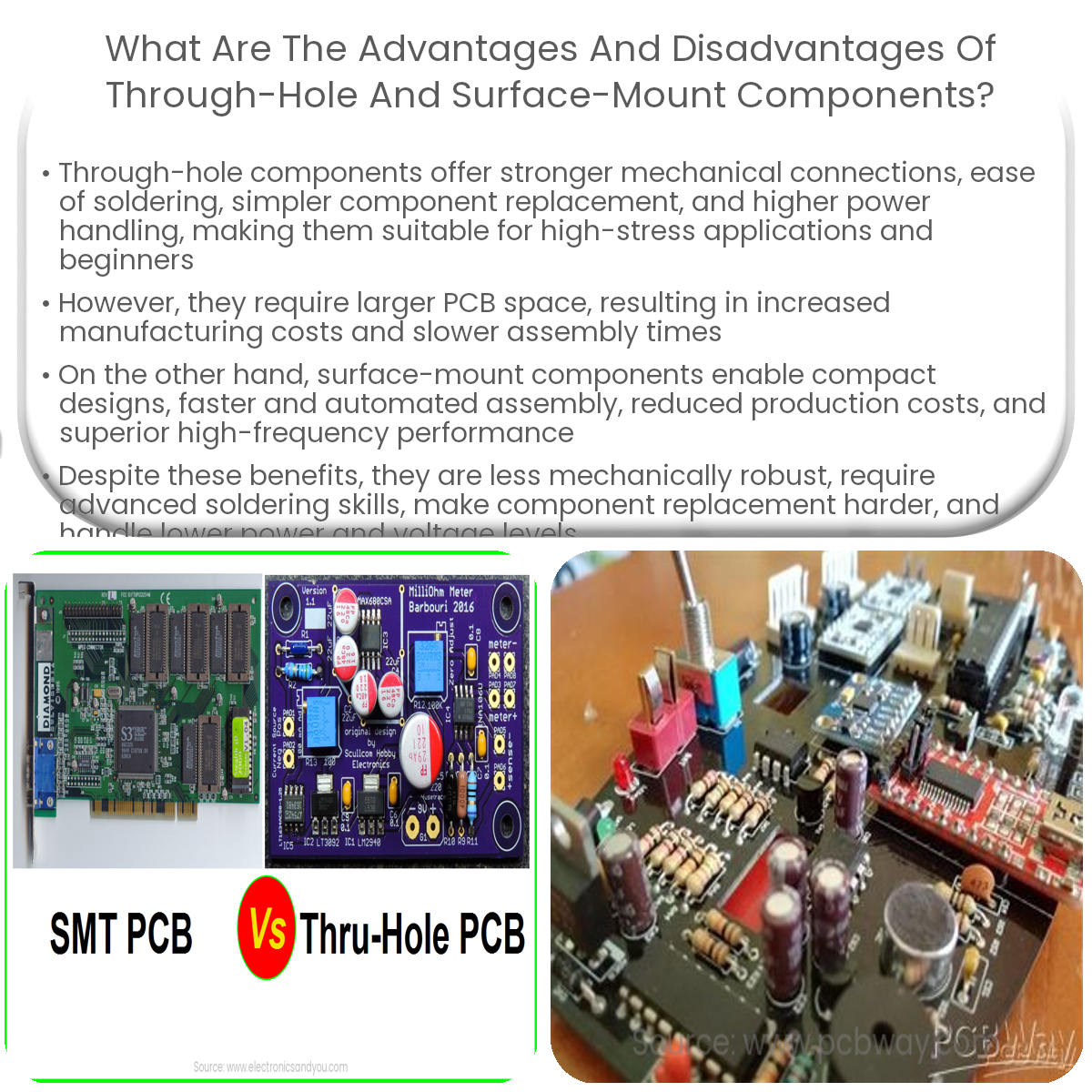
Through-hole components offer stronger connections and easier soldering, while surface-mount components enable compact designs and faster assembly.
Through-hole Components
Advantages:
- Stronger mechanical connections: The leads of through-hole components pass through the holes in the PCB, creating stronger bonds, making them ideal for applications with mechanical stress.
- Ease of soldering: Through-hole soldering is more straightforward, making it suitable for beginners and DIY enthusiasts.
- Component replacement: Through-hole components are easier to replace, as their larger size and soldering method make them more accessible.
- Higher power handling: Through-hole components can handle higher power and voltage levels compared to surface-mount components.
Disadvantages:
- Increased PCB size: Through-hole components require more space on the PCB, making it difficult to achieve compact designs.
- Slower assembly: The manual assembly of through-hole components is slower compared to the automated assembly process of surface-mount components.
- Higher cost: The larger PCB size and slower assembly time can lead to higher manufacturing costs.
Surface-mount Components
Advantages:
- Smaller size: Surface-mount components are smaller, allowing for more compact and densely populated PCB designs.
- Faster assembly: Surface-mount technology enables automated assembly, leading to faster production times and reduced labor costs.
- Lower cost: The smaller size and faster assembly process result in lower overall production costs.
- Improved performance: Surface-mount components have a lower parasitic effect, leading to better high-frequency performance.
- Double-sided assembly: Surface-mount components can be placed on both sides of a PCB, further reducing board size and increasing component density.
Disadvantages:
- Less mechanically robust: Surface-mount components have weaker mechanical connections compared to through-hole components, making them less suitable for high-stress applications.
- Difficult soldering: Soldering surface-mount components requires more skill, precision, and specialized equipment, making it challenging for beginners and DIY enthusiasts.
- Component replacement: Surface-mount components can be harder to replace due to their smaller size and soldering method.
- Lower power handling: Surface-mount components have lower power and voltage handling capabilities compared to through-hole components.