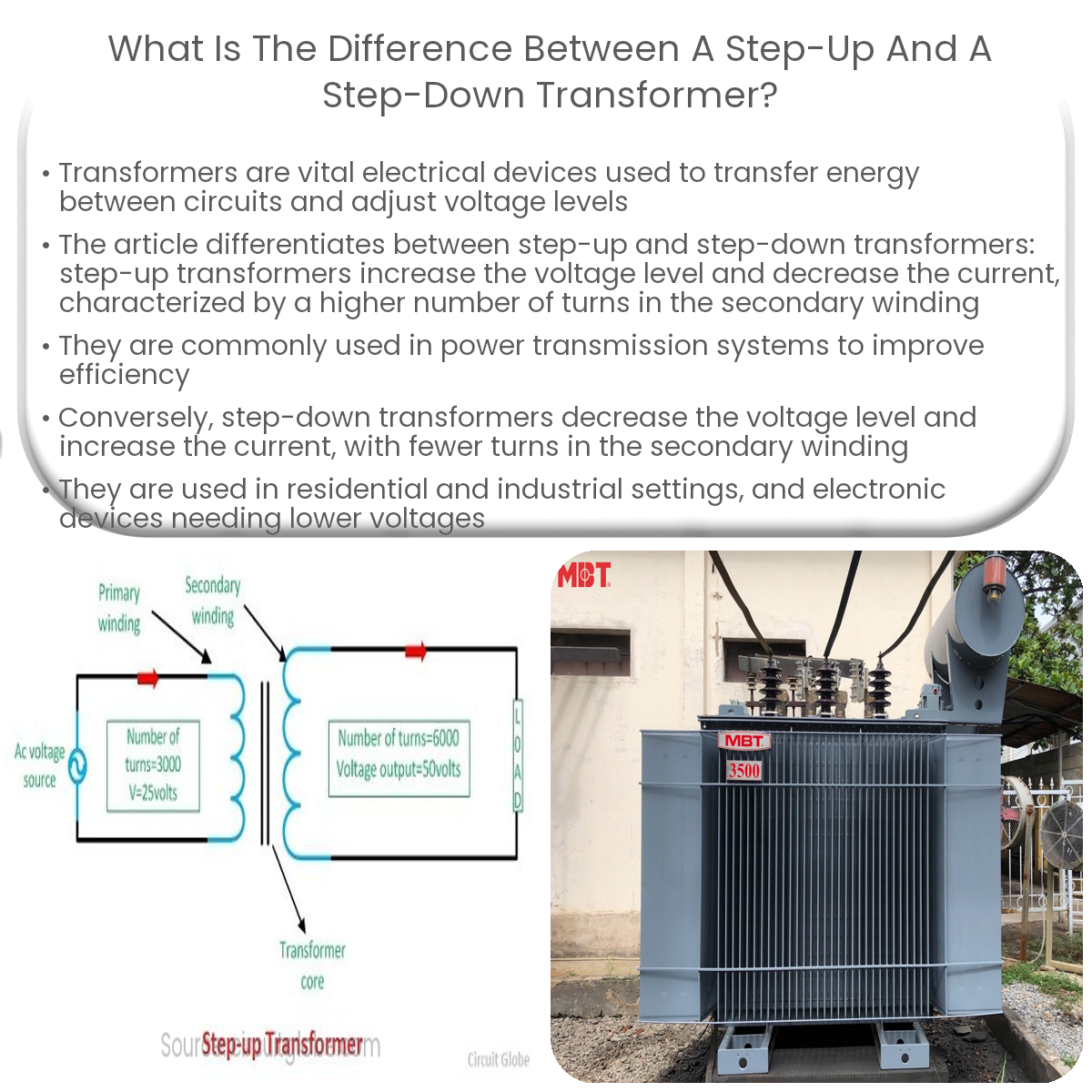
The main difference is that a step-up transformer increases voltage and decreases current, while a step-down transformer decreases voltage and increases current.
Introduction to Transformers
Transformers are essential electrical devices used to transfer electrical energy between circuits and alter voltage levels in alternating current (AC) systems. They operate based on the principles of electromagnetic induction. In this article, we will explore the differences between step-up and step-down transformers.
Step-up Transformer
A step-up transformer is designed to increase the voltage level from the primary winding to the secondary winding. The key characteristics of a step-up transformer are:
- The number of turns in the secondary winding (N2) is greater than the number of turns in the primary winding (N1).
- The output voltage (V2) is higher than the input voltage (V1).
- As a result, the output current (I2) is lower than the input current (I1) due to the conservation of energy.
Step-up transformers are commonly used in power transmission and distribution systems to increase the voltage level, which reduces power losses and improves efficiency during long-distance transmission.
Step-down Transformer
A step-down transformer is designed to decrease the voltage level from the primary winding to the secondary winding. The key characteristics of a step-down transformer are:
- The number of turns in the secondary winding (N2) is less than the number of turns in the primary winding (N1).
- The output voltage (V2) is lower than the input voltage (V1).
- As a result, the output current (I2) is higher than the input current (I1) due to the conservation of energy.
Step-down transformers are widely used in various applications, such as lowering voltage levels for residential and industrial usage, and in electronic devices that require lower voltages.
Conclusion
The primary difference between a step-up and a step-down transformer lies in their purpose and the ratio of turns in the primary and secondary windings. A step-up transformer increases the voltage level and decreases the current, while a step-down transformer decreases the voltage level and increases the current. Both types of transformers play crucial roles in power transmission, distribution, and electronic devices, ensuring efficient and safe operation of electrical systems.