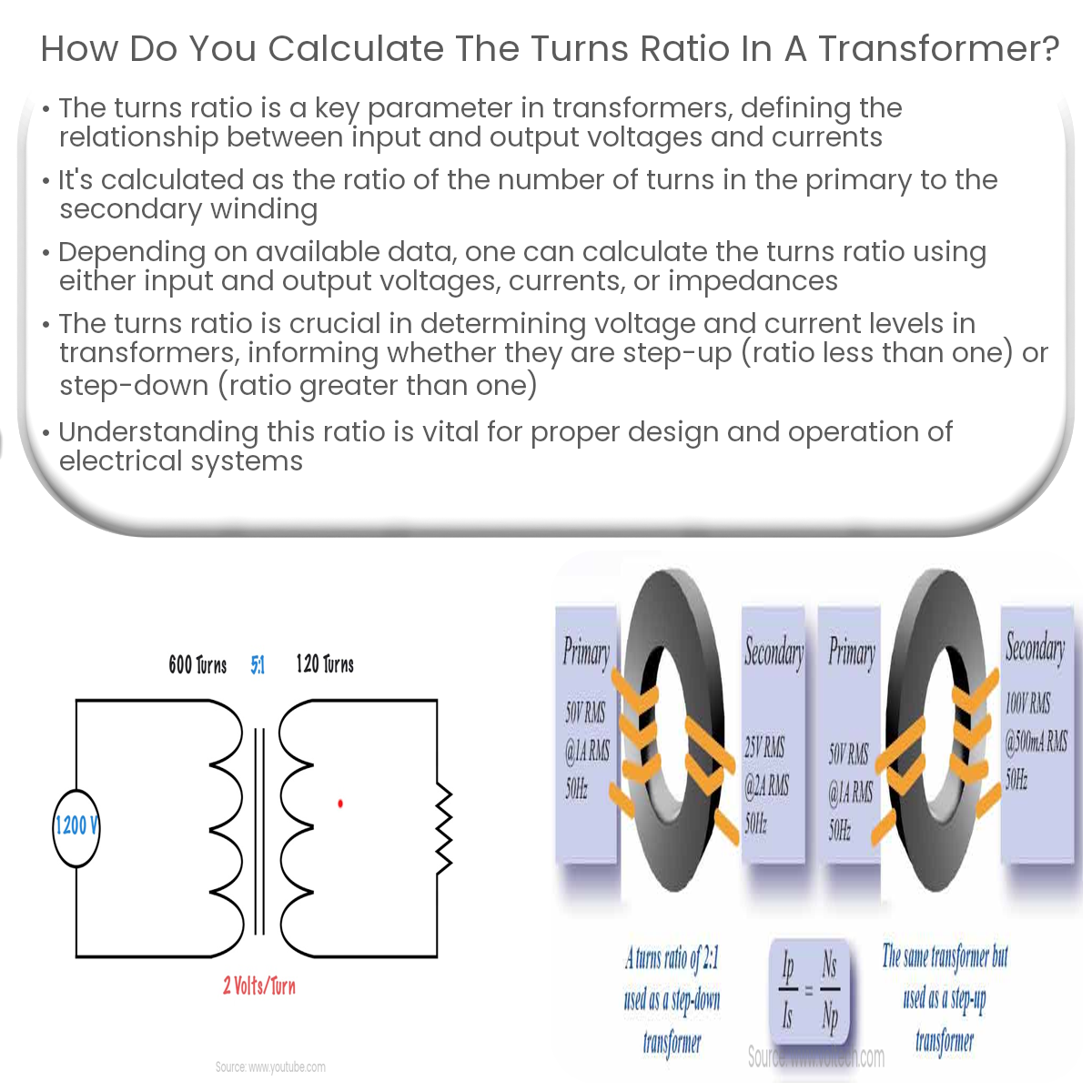
To calculate the turns ratio in a transformer, divide the number of turns in the primary winding by the number of turns in the secondary winding.
Introduction to Turns Ratio
The turns ratio is a crucial parameter in a transformer, as it helps determine the relationship between the input and output voltages, and the input and output currents. This article will discuss how to calculate the turns ratio in a transformer.
Turns Ratio Definition
The turns ratio (TR) is the ratio of the number of turns in the primary winding (N1) to the number of turns in the secondary winding (N2). It can be expressed mathematically as:
TR = N1 / N2
Calculating the Turns Ratio
There are several methods to determine the turns ratio of a transformer, depending on the available information:
- Using input and output voltages: If the input voltage (V1) and output voltage (V2) are known, the turns ratio can be calculated using the voltage transformation equation:
TR = V1 / V2
- Using input and output currents: If the input current (I1) and output current (I2) are known, the turns ratio can be calculated using the current transformation equation:
TR = I2 / I1
Note that the above equation is based on the assumption of an ideal transformer with no power losses.
- Using impedance: If the primary impedance (Z1) and secondary impedance (Z2) are known, the turns ratio can be calculated using the impedance transformation equation:
TR = sqrt(Z1 / Z2)
Application of Turns Ratio
The turns ratio is essential in determining the voltage and current levels in a transformer. For step-up transformers, the turns ratio is less than one, meaning that the secondary voltage is higher than the primary voltage. Conversely, for step-down transformers, the turns ratio is greater than one, resulting in a lower secondary voltage compared to the primary voltage.
Conclusion
Calculating the turns ratio in a transformer is crucial in understanding the relationship between input and output voltages and currents. Various methods can be used to determine the turns ratio, including using input and output voltages, currents, or impedances. Knowing the turns ratio is essential for the proper design, analysis, and operation of transformers in electrical systems.